
Prospective. Category:Transhumanists. Extropianism. Humans will be extinct in 100 years says eminent scientist. (PhysOrg.com) -- Eminent Australian scientist Professor Frank Fenner, who helped to wipe out smallpox, predicts humans will probably be extinct within 100 years, because of overpopulation, environmental destruction and climate change.
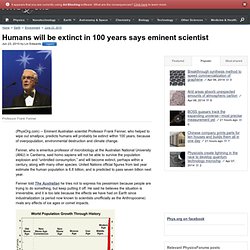
Fenner, who is emeritus professor of microbiology at the Australian National University (ANU) in Canberra, said homo sapiens will not be able to survive the population explosion and “unbridled consumption,” and will become extinct, perhaps within a century, along with many other species. United Nations official figures from last year estimate the human population is 6.8 billion, and is predicted to pass seven billion next year. Fenner told The Australian he tries not to express his pessimism because people are trying to do something, but keep putting it off. Prophétie autoréalisatrice.
Un article de Wikipédia, l'encyclopédie libre.

Une prophétie autoréalisatrice est une prophétie qui modifie des comportements de telle sorte qu'ils font advenir ce que la prophétie annonce. Ce qui n'était qu'une possibilité parmi d'autres devient réalité, par l'autorité de l'oracle qui énonce la prophétie ou par la focalisation des esprits sur cette possibilité. L'inverse, la prophétie autodestructrice ou paradoxe du prophète ou encore paradoxe du prévisionniste, est une prédiction qui, au contraire, détruit les possibilités de réalisation de la prédiction. Dans les deux cas, le fait d'énoncer la prédiction et de trouver des gens pour y croire modifie les anticipations et donc les comportements. Innovation. Diamond « Dr Popper's Foresight & Horizon Scanning Blog. For example, Delphi surveys are probably becoming less of an exclusively expert-oriented activity, and being used more as part of consultation processes for gathering views from wider pools of knowledge and practice; similarly, they are used to explore normative possibilities as well as to forecast “when” particular things might happen.

With regards to the type of knowledge source (based on creativity, expertise, interaction or evidence) it is important to emphasise that these domains are not fully independent from one another. However, it is helpful to consider characteristics that can be assigned to each of them, as indicated below: Creativity-based methods normally require a mixture of original and imaginative thinking, often provided by technology “gurus”, via genius forecasting, backcasting or essays. Expertise-based methods rely on the skill and knowledge of individuals in a particular area or subject. Tracking the Future.
Future Possibilities. [MAPPING FORESIGHT] : EFP. The Futurist Party. Future. Futurable Planet: Answers from a Shifted Paradigm. Futures « Dr Popper's Foresight & Horizon Scanning Blog. Futures Diamond Futures research (including Foresight and Horizon Scanning) has emerged as a key instrument for the development and implementation of research and innovation policy.

The main focus of activity has been at the national level. Governments have sought to set priorities, to build networks between science and industry and, in some cases, to change their research system and administrative culture. Futur. Society: Future. Future. The Strange Neuroscience of Immortality - The Chronicle Review. By Evan R. Goldstein Cambridge, Mass. Illustrations by Harry Campbell for The Chronicle Review In the basement of the Northwest Science Building here at Harvard University, a locked door is marked with a pink and yellow sign: "Caution: Radioactive Material. " Inside researchers buzz around wearing dour expressions and plastic gloves. Anticipating Tomorrow's Crimes Today. Why you shouldn’t bet on digital immortality. Kenneth Hayworth has a vision.

One day, right before his body gives out, he will be injected with a highly toxic soup of chemicals that will preserve him down to the cell. Russian Mogul Plans to Plant Our Brains in Robots and Keep Them Alive Forever. Outline of futurology. The following outline is presented as an overview of and topical guide to futures studies – study of postulating possible, probable, and preferable futures, and the worldviews and myths that underlie them. It seeks to understand what is likely to continue, what is likely to change, and what is novel. Le monde d'après. Post Scarcity Utopia - HOPE FOR DESPAIRING PEOPLE. Despair has many causes.

Stupid people cause despair. Mind Uploading = Brain Emulation = Reverse Engineering the Brain. In an interesting article from January 2011 this year, Carl Zimmer, writes about mind uploading and the future of neurotechnology.

The article was published in Scientific American. 23 incredible new technologies you’ll see by 2021. Future Non Stop. The 21st Century. The Uncertain Future. Radical Futurism for Newbies » goertzel.org. Global Catastrophic Risks. Bernard Werber, site officiel. FUTURES DIAMOND - The Diamond. The Futures Diamond is a practical framework including 44 methods commonly used in strategic foresight and decision-making.

It updates the Foresight Diamond developed by Popper in The Handbook of Technology Foresight (Georghiou et al., 2008). The spatial location in the "Diamond" is done in terms of the core type of knowledge source each method is mainly based upon (see figure below). There are three font styles in the Diamond which indicate the type of technique: qualitative (using normal style), semi-quantitative (using strong style), and quantitative (using italic style). Arguably, a forward-looking research and innovation process should try to use at least one method from each pole.