Get flash to fully experience Pearltrees
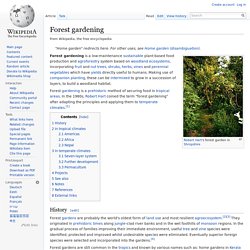
Forest gardening is a low-maintenance organic plant-based food production and agroforestry system based on woodland ecosystems , incorporating fruit and nut trees , shrubs , herbs , vines and perennial vegetables which have yields directly useful to humans. Making use of companion planting , these can be intermixed to grow in a succession of layers, to replicate a woodland habitat. [ edit ] Origins and history
Edible Forest Gardens.com is dedicated to offering inspiring and practical information on the vision, ecology, design, and stewardship of perennial polycultures of multipurpose plants in small-scale settings. We intend this website to grow into an information and networking resource for newcomers, amateurs, students, and serious practitioners and researchers alike. Forest gardening is an idea whose time has come.
In the first stage of the milpa, a piece of forest is cleared of trees, and then burned to prepare for planting. For the first two to three years the Mesoamerican trilogy of maize, beans, and squash are cultivated in the full sun . Amidst this low canopy of maize is a dynamic ecology of herbs, tubers, and other plants that we might consider weeds, but are actually cultivated by the forest gardener to detract pests from the main crops, enhance the soil with nutrients, and help maintain moisture in the ground. This system provides for many household needs including: In the second stage , the milpa evolves into the for est garden. Quick-yielding fruit trees, like plantain, banana, and papaya , are planted and begin to produce within a year.