
Virtual exchange and Internationalisation at Home: navigating the terminology - Blog. #Take5 #50 The best way to bring the human into virtual space? This #Take5 post is brought to you from Sandra Abegglen (University of Calgary), Emma Gillaspy (University of Central Lancashire), and Tom Burns and Sandra Sinfield (London Metropolitan University) – all are members of ALDinHE and are involved in the #creativeHE community.
There will be a follow up to this blog in November, where we will run the first #creativeHE event of this academic year: Game on: playful practice for online environments – 18th November 14.00-16.00 – and where we will also call for the community to say what sort of creative activities they want support with across this challenging year. Information and Registration: Photo: Making a fortune teller with Emma Gillaspy at last year’s #creativeHE Jam: Virtually Impossible: Embodiment and ‘Being There’ in online space For most of us the majority of our teaching, if not all, has shifted online for the foreseeable future.
A Teenager Didn’t Do Her Online Schoolwork. So a Judge Sent Her to Juvenile Detention. ProPublica is a nonprofit newsroom that investigates abuses of power.
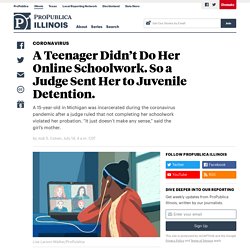
Sign up to receive our biggest stories as soon as they’re published. This story was co-published with the Detroit Free Press and Bridge Magazine. PONTIAC, Mich. — One afternoon in mid-June, Charisse* drove up to the checkpoint at the Children’s Village juvenile detention center in suburban Detroit, desperate to be near her daughter. @Mactoot sketchnote of keynote by @courosa on Reimagining Education in the Digital Age #cltauc @CLTAUC… Digital Literacy Can Be a Bad Present: Why We Must Align Our Expectations of What “Digital Learning” is With Our Students – Jenae Cohn.
Survey results benchmark students’ attitude to technology in teaching and learning. Digital Learning Theories and Models That All Educators Should Know. You’ve probably heard about the benefits of digital learning: It’s engaging, student-centered, often collaborative, and can increase student achievement. d3edd2 8b825d24c3fa4a79b5fceed5226aaa28.
Logic and rhetoric: the problem with digital literacy – Critical Theory of Technology. The computer is a rhetorical device, not just a logical one – Richard Lanham.
Taylor & Francis Group. Is there a right way to teach? Making sense of the trad-prog debate. (I wrote this in February for Guardian Teacher Network but since they didn’t ever get back to me I’m posting it here instead….)
Proposal for a Council Recommendation on improving the teaching and learning of languages. Language competences are at the heart of the ambitious vision to create a European Education Area.
Being able to speak foreign languages is not only a competence needed for studying abroad and on increasingly international job markets. It also opens new perspectives and enables people to discover other cultures. Studies show that across the board, EU Member States are not making progress fast enough towards the EU-wide agreed goal that every European should be able to learn two foreign languages from an early age. Myth busting – Leading Platform for Cognitive Assessment. The danger of Pseudo-Traditionalist Teachers. Copyright and Education in Europe: 15 everyday cases in 15 countries - International Communia Association. Today we publish the findings of a new study carried out by Teresa Nobre that intends to demonstrate the impact exerted by narrow educational exceptions in everyday practices.
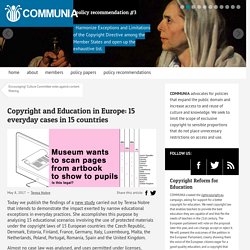
She accomplishes this purpose by analysing 15 educational scenarios involving the use of protected materials under the copyright laws of 15 European countries: the Czech Republic, Denmark, Estonia, Finland, France, Germany, Italy, Luxembourg, Malta, the Netherlands, Poland, Portugal, Romania, Spain and the United Kingdom. Almost no case law was analysed, and uses permitted under licenses, namely extended collective licenses, are not indicated here. Thus, the study does not give a detailed picture of all the countries under analysis. Materials available for educational uses. SO, What’s THE CHANGE For Teachers In 21st Century Education!? – EDU: Digital CitiZENship, CyberSecurity, eSkills, Modern EDU by Gust MEES. This is a general overview only to explain in simple words: I get asked very often and get also a lot of discussions with people and also teachers about what’s THE real CHANGE in 21st Century Education and especially for teachers, even that MOST people tell me that “THE CHANGE” is very difficult to understand!
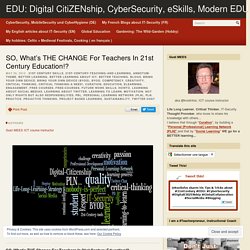
BUT it’s actually very easy to understand, BUT it needs to get accepted from the teachers! This is my point of view, let me explain, please:. The Keystone Species of Digital Learning Environments. The keystone About Keystone-ness Learning Management Systems (LMS) and Virtual Learning Environment (VLE) are used to mean more or less the same thing.
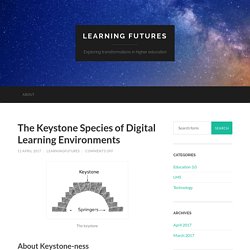
For example, the term LMS is used for Blackboard Learn in Australia and VLE for the same system in the UK. 21st Century Skills Have Always Been "Needed" Skills, But Now We Need Them More Than Ever - A.J. JULIANI. It’s 2017.
Communication is changing fast (my 7-yr old daughter and I just exchanged Snaps while I am in Chicago and she is outside of Philadelphia in different time zones, with real-time interaction). Collaboration has evolved to a point of instantaneous feedback loops (my colleague and I are on a shared Google Slide presentation changing and adding to slides for this week’s presentation in real-time, able to modify and go back to old versions if need be.
We also shared this with someone who is going to be in the presentation to get their feedback on a teacher perspective.) Critical Thinking has become a necessity in order to not only solve big problems, but every day issues (we know teachers learn best from other teachers, but it is increasingly harder to get teachers into each other’s room due to sub shortages and other factors. The Future of Free Speech, Trolls, Anonymity and Fake News Online. Many experts fear uncivil and manipulative behaviors on the internet will persist – and may get worse.
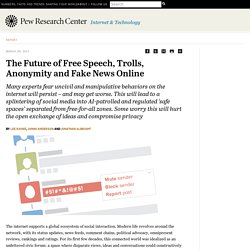
This will lead to a splintering of social media into AI-patrolled and regulated ‘safe spaces’ separated from free-for-all zones. Some worry this will hurt the open exchange of ideas and compromise privacy The internet supports a global ecosystem of social interaction. Modern life revolves around the network, with its status updates, news feeds, comment chains, political advocacy, omnipresent reviews, rankings and ratings. Log In. 5 innovations that transformed education (and one that hasn’t happened yet) Teachers and learners are finding new ways to use modern technology in the field of education. What are some of the innovations that changed the way we learn? What's the next big innovation? 1. In an era of knowledge abundance – Part 2 – Small Blog On Networked Learning. Turning the tables – how do copyright laws measure up for libraries? Every April, the Office of the US Trade Representative (USTR) issues the "Special 301 Report", an annual review of the state of intellectual property (IP) rights with US trading partners around the world.
Strategic Planning in e-Learning. As spring descends upon us, thoughts of innovation and new ideas start to burst forth. How to help autistic students succeed at university. About one in 100 people are on the autism spectrum, so the chances are that some of your students have been, or will be, diagnosed as autistic. The condition can have a considerable effect on how well a student is able to cope at university, which involves decisions about what to study and whether to leave the familiarity of home; navigating a new campus; and relating to teaching staff and fellow students. The 8 Skills Students Must Have For The Future. Editor’s note: This is a revised version of an article written by Katie Lepi that originally appeared on June 7th, 2014.
Online learning is here to stay.
A digital ‘Arab Spring’ for higher education? The phrase “Digital Life and Mobile Learning” is intended to summarise the tensions and paradox between two powerful and significant ideas. These ideas are, on the one hand, the attempts in schools, colleges and universities around the world to use personal mobile devices to finally deliver learning ‘anywhere, anytime’, as promised 20 years ago by the e-learning missionaries and visionaries, and, on the other hand, the reality of people outside these institutions, using the same mobile technologies to create, transform, discuss, discard, share, store and transmit ideas, opinions, images and information. These attempts at exploiting mobile devices within schools, colleges and universities have succeeded in demonstrating:
A digital Arab Spring for higher education? The Global Network for Open Education. Joanna m-My ELT rambles. What makes a good teacher? JLF0002_digitalstudent_POSTERS_ALL.pdf. The History of the Future of Education. Why disruptive innovation matters to education. Visitors and Residents: What Motivates Engagement with the Digital Information Environment? @Ignatia Webs: Free report on #innovative #pedagogy, practices and use. Report highlights 10 trends set to shake up education. American Schools Are Training Kids for a World That Doesn't Exist.
Background to the 4E's — Digisim - A Flipped Academic. A veteran teacher turned coach shadows 2 students for 2 days – a sobering lesson learned. “18th-c studies” meets “digital humanities” Ol Tools for 21st Century Learners: Connected Educators: Power Up Your Pedagogy with ThingLink. What is a Relevant Educator? - Corwin Connect. OU Digital Tools: Connected Learning Infographic. What do students entering HE expect from digital technologies? 7 Pillars Of Digital Leadership In Education. Pins from. Students' experiences and expectations of the digital environment. Raising Modern Learners — Learning in the 21st Century. Learners’ needs, diversity, and pedagogy. Watch 21st Century Literacies. Transversal Skills Definition.
Jisc Digital Student. Jisc Digital Student. Effective use of virtual learning environments (VLEs) Sra. Spanglish Rides Again: 21st Century WL Teacher. A Guidebook for Social Media in the Classroom. Keynote speakers. The future of online learning: challenges, opportunities and creativity. Search - #etwion.
Game Play Has No Negative Impact on Kids, UK Study Finds. From the Individual Laptop to the Integrated Learner – Sarah Pasfield-Neofitou. 27 Habits That Produce 21st Century Teachers. The Future Is Now: 15 Innovations to Watch For - Commentary. Network Era Fluency. Moodle-backed Online Training Portal. Social Collaboration… The 12 Must-Have Skills Of Modern Learners. Écoutez Bien – A Listening Journey. Just in Time Teaching (JiTT)
Stop Talking about Education; Start Doing Something. What Teens Get About the Internet That Parents Don't - Mimi Ito. A&H: Technology Enhanced Learning. Droits et obligations pour l'utilisation des TICE dans l'Education. Digital literacies: What are they and why should we care? What will the new Google search mean for teachers? The (Coming) Social Media Revolution in the Academy - Daniels and Feagin - Fast Capitalism 8.2. A New Pedagogy is Emerging...And Online Learning is a Key Contributing Factor. Welcome to the Frontpage. 48_3_4_reinders.pdf. Tech Comfy NOT Tech Savvy! Story of an Idea. The 33 Digital Skills Every 21st Century Teacher should Have.
Et si on enseignait vraiment le numérique ? Et si on enseignait vraiment le numérique ? Developing independent learning skills. Flipped Learning: my efforts so far - TeachMeet Brighton 2012. 7 Must-Read Books on the Future of Information and the Internet.
HE Policy blog: The five big trends shaping higher education. The Flipped Classroom: Turning the Traditional Classroom on its Head. The 21st Century Teaching and Learning Skills for Teachers and Students. Turning Students into Good Digital Citizens. Mooc.wikispaces. Teaching technology: we need a digital revolution in the classroom. What does it mean to be literate in 2012? Digital classrooms for a digital age.
5 Areas of Consideration for Developing a BYOD Policy for Your School or District.