
Analyst Firm Predicts Rapid Growth In BPM Software Market > & Revenues from business process management suites are expected to soar to $5.5 billion in 2011 from $890 million last year, according to IDC.
The market for business process management suites is growing rapidly, and the software is expected to become the front end to next-generation deployment platforms used in building custom applications, an analyst firm says. The BPMS market grew by nearly 80% last year to $890 million, according to IDC. By 2011, the market was expected to reach $5.5 billion, reflecting a five-year compound annual growth rate of 44%.
"This year and next are critical years for BPMS vendors," IDC analyst Maureen Fleming said in a recent report. Network Blogs. Hi,Implementing user centric business processes with SAP NetWeaver MDM and Guided Procedures was and is still very popular since it has many advantages in comparison to the standard MDM Workflow tool for certain use cases (like integrating additional services, custom UI's, cross system workflows etc).
With the combination SAP NW MDM and SAP BPM/BRM you can do the same but you will add a lot of new features to your solutions as well like: Since some months I already implemented some “Proof of Designs” and demo scenarios to show these advantages. If you are interested you can view this ScreenCam: Expanding the Reach of your MDM Solution with SAP BPM/BRM. Process for the Enterprise » Blog Archive » BPM Experts are n. As a firm that is entirely focused on BPM implementations, we get a lot of queries from staffing firms, and I’m going to take this post to speak out against the practice of using these expensive, non-value-adding, players in the marketplace.
Application Platform Strategies Blog: Six BPMs and the Elephant. Blogger: Richard Watson It was six men of Indostan To learning much inclined, Who went to see the Elephant (Though all of them were blind), That each by observation Might satisfy his mind The First approached the Elephant, And happening to fall Against his broad and sturdy side, At once began to bawl: "God bless me!
But the Elephant Is very like a wall! " The Second, feeling of the tusk, Cried, "Ho! Community Network Blogs. At SAP TechEd 2009 Vienna, I met Chris Horak, with whom I share a passion for good single malt, music (he’s into Metal and Bebop and plays Donna Lee on the e-bass), and the occasional witticism.
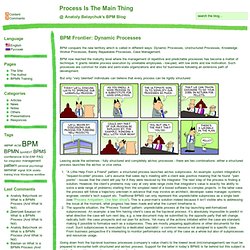
Chris told me that he wondered what the future of Business Process Management might look like: “What will the successors of today’s BPM and ERP software in 10 or 15 years look like?” Chris works at the office of the CTO at SAP and it appears that they try to look very far ahead. I don’t normally try to do that – frankly, I think it’s often difficult enough to see clearly what is happening right now in front of my nose -, but I took Chris’ question as a challenge and tried to come up with a few ideas. BPM Frontier: Dynamic Processes - Process Is The Main Thing. BPM conquers the new territory which is called in different ways: Dynamic Processes, Unstructured Processes, Knowledge Worker Processes, Barely Repeatable Processes, Case Management.
BPM now reached the maturity level where the management of repetitive and predictable processes has become a matter of technique. Process People » Blog Archive » Announcing the October. Reuse-Friendly BPM Capabilities « Art of Software Reuse. I have been stressing the need for integrating various concepts for succeeding with systematic reuse.
BPM is no different. In an earlier post I introduced reusable BPM integration capabilities. In this post I want to list additional capabilities that you can build as part of BPM initiatives: Mature your integration function that helps consumers integrate, use, and discover business process assets. BPM tool selection: Strategies for success. There are many business process management (BPM) tools on the market today for enterprise CIOs to choose from.
The selection process should begin with defining both your business and technical requirements -- reviewing the vendor options should be the last step. In this podcast, Mike Kavis, an independent consultant and chief technology officer at MDot, offers tips for identifying your business and technical requirements and how to get the most out of your vendor research. Kavis has more than 23 years of IT experience, including 12 years in leadership positions. His areas of expertise include IT strategy and planning, organizational change management, BPM, service-oriented architecture, enterprise architecture, Web 2.0, cloud computing, business intelligence, outsourcing and turnarounds. Todd Biske: Outside the Box » Blog Archive » Oracle OpenWorld. Full disclosure: I am attending Oracle OpenWorld courtesy of Oracle.
This was a session focused on BPM 11g. It’s a bit of a whirlwind overview, but so far they have emphasized the use of BPMN 2.0, Business Rules integration, SCA, and the new rich form designer. Next up is the BPA suite based on their OEM relationship with IDS Scheer ARIS. 11g introduces round trip integration with BPM Studio and a unified repository with IDS products, etc. I haven’t heard anything about Oracle ER becoming a centralized metadata repository for all Oracle products, which a find a bit surprising. Process-centric Composite Applications with SAP Netweaver #sapte. Composite applications combine various existing functions into a new application, typically managed using a business process or orchestration as the framework.
SAP talks about core business processes, those built into the enterprise application backbone,and composite business processes that integrate and extend these processes by reusing the services within them. Specifically a composite application contains: Workcenter Where users can initiate processesComposite Process Where the process is definedUser Interfaces For those services that need human interactionBusiness Entities and Services Where new and existing entities and services are exposedESB and underlying Services/Systems Netweaver BPM and Business Rules are used together with the Composite Application Framework, Developer Studio and Visual Development Environment. In addition this session will use the new SAP Discovery Systems (v4). Process for the Enterprise » Blog Archive » Oil and Water(fal. Network Blogs.
The combination of Business Process Management (BPM) tools and enterprise services unleashes the full power of SOA and is an exclusive and unmatched offering from SAP. All SAP Community members now have the opportunity to easily access this powerful technology in a test drive. Effective today, SAP started a beta test for three new pilot Simple Sample Applications using SAP NetWeaver Business Process Management (BPM) technology.
These pilot apps are implementations of small business processes, such as Approve Sales Order Change Request,Approve Purchase Requisition and Create Purchase Order, andManage Leave Request Send us an email to be among the first who get access to these new Simple Sample Applications, and let us know what you think. Process for the Enterprise » Blog Archive » E-commerce News B. In an article titled “Getting Small Firms on Board with BPM“, the author starts with the following assertion: The greatest obstacle small business operators face in adopting business process management (BPM) is themselves. That factor could account for the underutilization of BPM by small businesses[...]
Of course, the abundant offerings of vendors can be confusing, and the trade jargon (SOA, Saas, ROI) can be daunting. Still, the reluctance of small firms to fully utilize BPM often comes down to one thing: attitude. Of course, the first problem is that the author fails to define “small business” for purposes of the discussion, so that we can all operate with the same assumptions in mind. “A consultant is definitely not called for,” added WinterGreen’s Eustis. Does Documentum BPM 6.5 Offer Anything New? « Let’s Talk Documen. We recently created a Healthcare application on Documentum Process Suite 6.5.
We used the latest versions of Taskspace, Process Builder, Process Integrator, Process Engine, Business Activity Monitor, and the new Composer. Here’s my review of Process Suite D6.5… As the former Group Product Manager for the Documentum Process Suite, I was pleased to see the improvements in the product. Of course, I was disappointed with some shortfalls on the quality of the BAM (formerly Proactivity) products, which until now, to my opinion, has not met the quality required by its customers and the industry. My favorite addition to the package was the high-fidelity forms. Large-Scale Federated BPM / Workflow. Process for the Enterprise » Blog Archive » The Case Against. “Window Dressing” can kill your project.
It can even kill your BPM project. Keith Swenson wrote a humorous but educational piece on an in-house BPM project gone awry. Anyone who has deployed an internal application can relate to his story, but if you’ve deployed your own technology (or your own BPM technology) it hits especially close to home! My favorite point made in the post is that flashy or pretty UIs don’t add value in-and-of-themselves. BPM explained in 15 minutes (Lombardi webinar) Workflow Pattern Coverage in SAP NetWeaver BPM 7.11. Enterprise 2.0 Must be Aligned with Business Process. Only hours before the first day of the Enterprise 2.0 event in Boston, two of France’s leading software companies announced today that they would be combining social software with traditional business process to create “social innovation”, and help organizations succeed in Enterprise 2.0. BlueKiwi was created in 2006, and is already the leading European provider of enterprise social software, with an on-demand platform that allows organizations to create secured social networks among employees, partners, and customers, integrating all the standard Web 2.0 services such as wikis, blogs, forums, and tags.
Dassault Systems is one of France’s largest independent software company, and a worldwide leader in product lifecycle management and 3D software (notably CATIA used by Boeing and Airbus to create their airplanes). “Enterprise 2.0 only works if it is part of a business process. It’s great to work in new ways, but it’s not enough. To make it real, it has to be very practical.” Related posts: The Wizardry of Business Process Management – Part 2 » The TEC B. Written By: Predrag Jakovljevic Published On: June 4 2009 (Originally Published On:) ) Four Myths of BPMS: The real truth about BPM and collaboration b. I am very excited to post a replay of an exceptionally well-received webinar we first presented on June 3, 2009. Just 15% of Companies that Implemented a BPM System are Realizin.
The Wizardry of Business Process Management – Part 1 » The TEC B. Written By: Predrag Jakovljevic Published On: May 21 2009 (Originally Published On:) ) The business process management (BPM) market is sizzling hot, with Gartner Dataquest estimating its compound annual growth rate (CAGR) at 13 percent in 2009. TIBCO's Employee On-boarding BPM/SOA Demo Screencast. Oh Process, How Do You Flow? Enterprise 2.0 (finally) moves toward Enterprise. An interesting and salutary move is being iniated in the small world of both web and enterprise 2.0. It’s about what I would call a “de-technologization” of the concept and, according to me, will take back enterprise 2.0 to a ground it should not have left : the enterprise as a productive organization that must deal with internal rules and constraints.
Sneak Preview of jBPM 4 at JAX conference. Lombardi Driven Online - April 20-22, 2009. PROWIT - Prozess-orientierter Web 2.0-basierter integrierter Tel. Says Enterprises Can Experience As Much As a 20 Percent Cost Sav. STAMFORD, Conn., March 16, 2009 View All Press Releases BPM Best Practices and Tactics To Be Discussed at the Gartner BPM Summit, March 23-25 in San Diego As companies try to find cost optimization opportunities during the economic downturn, business process management (BPM) investments can provide a cost savings of as much as 20 percent within the first year of implementation, according to Gartner, Inc.
Michael Hammer Was Right - Process Is The Main Thing. Your criteria for choosing a BPM tool? Image via Wikipedia. Home. How to do a BPM initiative. Network Blogs. “BPM In Practice” in San Diego « Go Flow.