
Tour. Photography of Curiosity Landing Site on Mars First HD Panorama of Gale Crater - photoJPL.com . 10451_earth.jpg (JPEG Image, 2560×1600 pixels) Felix Baumgartner Skydives From The Edge Of Space [11 High Quality Photos] Red Bull is supposed to give you wings bit that would only slow Felix Baumgartner down.
![Felix Baumgartner Skydives From The Edge Of Space [11 High Quality Photos]](http://cdn.pearltrees.com/s/pic/th/baumgartner-roosevelts-36249858)
This week the daredevil made a test skydive from 18 miles up in preparation for his upcoming jump from 120,000 feet (22 miles) in which he hopes to reach speeds of 690 MPH and be the first person the break the sound barrier. In the latest test jump Felix went 0 to 509 MPH in just 30 seconds and all that is without the aid of a plane fo rocket, just pure gravity baby! Here are photos from his latest jump… Felix Baumgartner hugs Capcom 1 USAF Col (ret) Joe Kittinger after his 96,640 ft free fall from the stratosphere making them the only two people to freefall from that high an altitude. Felix Baumgartner gets lifted up to enter into the capsule. Pilot Felix Baumgartner of Austria sits in the capsule before lift off at the flight line. Aerial Data Visualisation Reveals Life In The United States.
PBS is exploring the hidden patterns and rhythms that make America work.

They are taking this data and visualizing it in a series being called, “America Revealed.” Visualization of internet distribution The pinpointed distribution of the unemployed Domino’s Pizza’s raw ingredients’ delivery routes in the Northeast U.S. electricity network routes The New York pizza delivery path of one Domino’s employee on a Friday night New York’s public transportation paths Patterns of planes’ flight paths Traced paths of deceased bodies being transported to their hometowns U.S. imports and exports of beef All the people in America’s towns and cities Single food outlet of a nationwide chain, such as fast food resturants, supermarkets or grocery stores, bakeries, gourmet shops and restaurants.
Chromoscope - View the Universe in different wavelengths. Think Your Job Is Hard? Watch NASA Crew's Riveting "7 Minutes Of Terror" Mars Landing. Last November, the team at NASA launched its Mars Space Laboratory, known as Curiosity, on a long journey through space.

On August 6th, the rover will touch down in a crater on Mars and begin its study of climate, geology, and any potential signs of life on the red planet. What the Space Shuttle booster saw. Stars & Planets Scale Comparison. A Humbling Perspective"Things are not what they seem, nor are they otherwise.
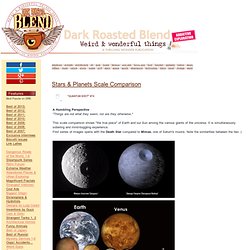
" This scale comparison shows "the true place" of Earth and our Sun among the various giants of the universe. It is simultaneously sobering and mind-boggling experience.First series of images opens with the Death Star compared to Mimas, one of Saturn's moons. Note the similarities between the two :) Earth is small enough to be swallowed by an average sunspot:(picture credt) Second series of images (from this site) shows the similar progression, now in 3-D: Astronomy Picture of the Day. Sirius. Sirius appears bright because of both its intrinsic luminosity and its proximity to Earth.
At a distance of 2.6 parsecs (8.6 ly), as determined by the Hipparcos astrometry satellite,[5][19][20] the Sirius system is one of Earth's near neighbors. Sirius is gradually moving closer to the Solar System, so it will slightly increase in brightness over the next 60,000 years. After that time its distance will begin to recede, but it will continue to be the brightest star in the Earth's sky for the next 210,000 years.[21] Sirius A is about twice as massive as the Sun (M☉) and has an absolute visual magnitude of 1.42. It is 25 times more luminous than the Sun[7] but has a significantly lower luminosity than other bright stars such as Canopus or Rigel. Scope.swf (application/x-shockwave-flash Object)
Space Quarterly - A Magazine Covering Commercial Space, Space Policy, Military Space & Other Timely Topics - SpaceRef Press. SpaceRef - Space News and Reference. Vojto1_pub_eclipse.jpg (JPEG Image, 1604×1130 pixels) The Sagan Series. Space and NASA News – Universe and Deep Space Information.
Asteroid Mining Venture Backed by Google Execs, James Cameron Unveiled. A newly unveiled company with some high-profile backers — including filmmaker James Cameron and Google co-founder Larry Page — has announced plans to mine near-Earth asteroids for resources such as precious metals and water.

Planetary Resources, Inc. intends to sell these materials, generating a healthy profit for itself. But it also aims to advance humanity's exploration and exploitation of space, with resource extraction serving as an anchor industry that helps our species spread throughout the solar system. "If you look at space resources, the logical next step is to go to the near-Earth asteroids," Planetary Resources co-founder and co-chairman Eric Anderson told SPACE.com. "They're just so valuable, and so easy to reach energetically. x47.jpg (JPEG Image, 2100×1400 pixels) - Scaled (72%)