
Yeshua - Wikipedia. Brain signatures detect racially biased and politically correct behaviors. Empathy for others is affected by race but this can be modulated by a secondary cognitive response, according to a study published online this July in Neuroscience.

The study points to the importance of education and social integration to overcome racism. History of medicine. During the Renaissance, understanding of anatomy improved, and the microscope was invented.
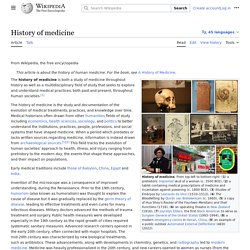
Prior to the 19th century, humorism (also known as humoralism) was thought to explain the cause of disease but it was gradually replaced by the germ theory of disease, leading to effective treatments and even cures for many infectious diseases. Military doctors advanced the methods of trauma treatment and surgery. Public health measures were developed especially in the 19th century as the rapid growth of cities required systematic sanitary measures. Advanced research centers opened in the early 20th century, often connected with major hospitals.
The mid-20th century was characterized by new biological treatments, such as antibiotics. Prehistoric medicine[edit] Experiment confirms quantum theory weirdness. The bizarre nature of reality as laid out by quantum theory has survived another test, with scientists performing a famous experiment and proving that reality does not exist until it is measured.
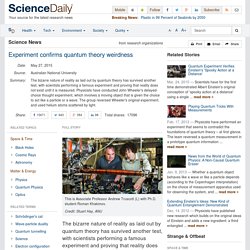
Physicists at The Australian National University (ANU) have conducted John Wheeler's delayed-choice thought experiment, which involves a moving object that is given the choice to act like a particle or a wave. Guess what? More people are living in peace now. Just look at the numbers. Has the world seen moral progress?

The answer should not depend on whether one has a sunny or a morose temperament. Everyone agrees that life is better than death, health better than sickness, prosperity better than privation, freedom better than tyranny, peace better than war. All of these can be measured, and the results plotted over time. Josephus on Jesus. The Antiquities of the Jews/Book XX - Wikisource, the free online library. Containing the Interval of Twenty-Two Years From Fadus, the Procurator, to Florus §Chapter 1[edit]
Women in Philosophy. Jennifer Saul on the psychological biases adversely affecting philosophy – and what we can do about it.
In the UK, women are 46% of undergraduate students in philosophy, but only 24% of permanent staff. Women are approximately 21% of professional philosophers in the US, but only 17% of those employed full-time. These figures are very unlike those for most fields of the humanities, in which women tend to be near or above parity with men. Indeed, they more closely resemble mathematics and physical sciences (biological sciences are much closer to parity). One recent study by Kieran Healy showed philosophy to be more male than mathematics, with only computer science, physics and engineering showing lower percentages of women. Constantine the Great. Willie Soon. Soon is a critic of the scientific consensus on climate change, who gained prominence in the Soon and Baliunas controversy over the methodology of a paper he co-wrote.[6] He disputes the consensus view that human activity is a significant contributor to climate change, and has argued that most global warming is caused by solar variation.[7][8] Climate scientists have rebutted Soon's arguments, and the Smithsonian does not support his conclusions, but he is frequently cited by politicians opposed to climate-change legislation.[2][9] Soon's research has been largely funded by the fossil-fuel industry, which provided over $1.2 million in funding, including $409,000 from The Southern Company, $230,000 from Charles G.
Koch Charitable Foundation, and hundreds of thousands of dollars from Donors Trust. Open Payments Data. Climate change denial. This article is about campaigns to undermine public confidence in scientific opinion on climate change.
For the public debate over scientific conclusions, see global warming controversy. Climate change denial is a denial or dismissal of the scientific consensus on the extent of global warming, its significance, and its connection to human behavior, especially for commercial or ideological reasons.[1][2] Typically, these attempts take the rhetorical form of legitimate scientific debate, while not adhering to the actual principles of that debate.[3][4] Climate change denial has been associated with the fossil fuels lobby, the Koch brothers, industry advocates and free market think tanks, often in the United States.[5][6][7][8][9] Some commentators describe climate change denial as a particular form of denialism.[10][11][12][13][14][15][16] Meanings of the term History.
Jared Psych Laurence. Emeka Aka Peachez - Season 3 - Part 2. How your environment influences you. High Performance Programs. Ontario High Performance Sport Initiative The OHPSI program was designed to support a comprehensive provincial high performance sport system that allows for sustained success of athletes and coaches at the very highest levels of international sport.

The goal of the OHPSI program is to identify and support Ontario athletes who are best capable of achieving future international success on senior national teams in targeted winter and summer Olympic/Paralympic and Pan/Para Pan Am Games sports. Ontario National Centre Strategy The goal of the Ontario National Centre Strategy is to further support Own the Podium targeted sports with National Centres in Ontario and to ensure Ontario remains a leader in the development of Canada’s medal winning athletes. SUPPORT THE PROJECT. When David Beats Goliath: The Advantage of Large Size in Interspecific Aggressive Contests Declines over Evolutionary Time.
Body size has long been recognized to play a key role in shaping species interactions.
For example, while small species thrive in a diversity of environments, they typically lose aggressive contests for resources with larger species. However, numerous examples exist of smaller species dominating larger species during aggressive interactions, suggesting that the evolution of traits can allow species to overcome the competitive disadvantage of small size.
If these traits accumulate as lineages diverge, then the advantage of large size in interspecific aggressive interactions should decline with increased evolutionary distance. Water-shedding surfaces can be made to last. Steam condensation is key to the worldwide production of electricity and clean water: It is part of the power cycle that drives 85 percent of all electricity-generating plants and about half of all desalination plants globally, according to the United Nations and International Energy Agency. So anything that improves the efficiency of this process could have enormous impact on global energy use. It's not the morphine, it's the size of the cage: Rat Park experiment upturns conventional wisdom about addiction - garry's subposthaven. It's not the morphine, it's the size of the cage: Rat Park experiment upturns conventional wisdom about addiction : science. Orangutans plan their future route and communicate it to others.
Male orangutans plan their travel route up to one day in advance and communicate it to other members of their species. In order to attract females and repel male rivals, they call in the direction in which they are going to travel. Anthropologists at the University of Zurich have found that not only captive, but also wild-living orangutans make use of their planning ability. For a long time it was thought that only humans had the ability to anticipate future actions, whereas animals are caught in the here and now. But in recent years, clever experiments with great apes in zoos have shown that they do remember past events and can plan for their future needs. How being called smart can actually make you stupid. A few months ago I posted a piece which has become my most popular blog post by quite a landslide.
Boriswied comments on What do you think is the ideology of the western world today? What advice would you give me if I decide to do a "life experiment" and try to overcome my own ideological traps? Higher social class predicts increased unethical behavior. Author Affiliations Edited* by Richard E. Nisbett, University of Michigan, Ann Arbor, MI, and approved January 26, 2012 (received for review November 8, 2011) Prisoner's Dilemma In Real Life. Black hole caught napping after meal. 12 June 2013Last updated at 08:30 ET. Project MUSE. The Great Debate Contributors: Matt Ridley. An Interview with Patsy Rodenburg, Head of Voice, The Royal National Theatre of Great Britain. Maslow's hierarchy of needs. Propaganda by Edward Bernays (1928) BBC Horizon - What makes us good or evil? (1/4) Jonathan Haidt on the moral roots of liberals and conservatives.
Robert Seyfarth: Theory of Mind. Modern science says homosexuality is not a choice. Paul Mountjoy. Www.ccbi.cmu.edu/reprints/Mason_CerebralCortex-2013_Journal-preprint-TMS-syntax.pdf. OBI. The Henry G. Friesen International Prize in Health Research. The 2012 Henry G. Friesen International Prize is awarded to Canadian Neuroscientist Marc Tessier-Lavigne, President of Rockefeller University.
The Prize, established by the Friends of Canadian Institutes of Health Research (FCIHR) in collaboration with the Canadian Academy of Health Sciences, recognizes exceptional innovation by a visionary health leader of international stature. President Tessier-Lavigne will receive the Prize and deliver a public lecture on September 19, 2012 in Ottawa.
A quintessential translational scientist in the study of brain development, Dr. Marc Tessier-Lavigne. Marc Trevor Tessier-Lavigne (born c. 1960) is a neuroscientist who is president of The Rockefeller University in New York City. He was formerly executive vice president for research and the chief scientific officer at Genentech. Good Thinking Society » Encouraging curious minds and promoting rational enquiry. Stone Age Temple May Be Birthplace of Civilization. It's more than twice as old as the Pyramids, or even the written word. When it was built, saber-toothed tigers and woolly mammoths still roamed, and the Ice Age had just ended. The elaborate temple at Gobelki Tepe in southeastern Turkey, near the Syrian border, is staggeringly ancient: 11,500 years old, from a time just before humans learned to farm grains and domesticate animals.
Turkey: Archeological Dig Reshaping Human History - Newsweek and The Daily Beast. Nathaniel Branden. Early life and education[edit] Nathaniel Branden was born Nathan Blumenthal in Brampton, Ontario, and grew up alongside three sisters, two older and one younger. Reward system. Animal Sleep. Dangers of loneliness: Social isolation is deadlier than obesity. Classical conditioning. Milagrosa recuperación de hombre al que una varilla le atravesó la cabeza.
A VIRUS CALLED FEAR - Student Documentary Short. PUA Training - Become A Pick Up Artist And Pick Up Girls - Mastery With Women and Dating. Aesthetics. Synesthesia. Psychopathy. Shyness. 10 Questions for Nobel Laureate Daniel Kahneman.