
Les semences prennent le maquis, bande annonce. The problem with the sharing economy. Steve@sfbg.com Catbird turned me onto Airbnb almost two years ago, long before I'd ever heard of the "sharing economy" or "collaborative consumption," terms the tech industry is now using for companies that facilitate peer-to-peer rentals or otherwise take transactions once done through Craigslist to a glitzy new commercial level.
We were working together to build the Temple of Flux for Burning Man 2010 and chatting in the shop one evening. I mentioned wanting to find someone to sublet my apartment for the nearly three weeks that I was to spend on the playa that year, and she sang the praises of Airbnb, which she had recently started using to make some extra cash by renting out a room in the house she owns on Potrero Hill.
Le modèle "collaboratif" va détruire des emplois. La culture collaborative accroît la productivité, et après ?
La collaboration est désormais la nouvelle norme de nos sociétés et de nos entreprises. Le processus est en cours d’affinement, mais il est amené à se poursuivre. De plus en plus de gens en perçoivent les bénéfices évidents : il est tout simplement plus facile de collaborer et de coopérer – souvent de façon virtuelle – que d’être enfermé dans des systèmes et hiérarchies. Collaboration, intelligence collective et les concepts qui y sont liés, aident à gagner du temps, à mieux résoudre les problèmes, à raccourcir l’accès à des experts ou à des solutions. En bref, cela nous permet d’obtenir de réels gains de productivité au niveau de l’individu, de la société et de l’entreprise. Les activités reposant sur l’arbitrage des imperfections du marché vont se réduire. The 'sharing economy': The next big business trend. From Airbnb to TaskRabbit to Zimride, sharing is becoming big business. The nation is in a sharing mood — and start-ups are capitalizing on it. Americans with heaps of stuff, skills and time are connecting online with tech-savvy and early adopters eager to share and rent homes, cars, tools and services in exchange for deep savings.
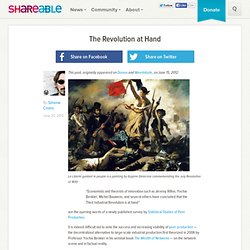
Dubbed "collaborative consumption" — or "the sharing economy" — this movement represents the newly cemented intersection of online social networking, mobile technology, the minimalist movement and heightened penny-pinching brought on by lingering economic uncertainties. Adam Hertz, a cable company executive in San Francisco, and his wife, Joan, have enthusiastically embraced the movement. Pour une énergie propre, libre et accessible ! Fair trade electronics. The Revolution at Hand. La Liberté guidant le peuple is a painting by Eugène Delacroix commemorating the July Revolution of 1830 “Economists and theorists of innovation such as Jeremy Rifkin, Yochai Benkler, Michel Bauwens, and several others have concluded that the Third Industrial Revolution is at hand” are the opening words of a newly published survey by Statistical Studies of Peer Production.
We must avoid a new wrong turn of cooperativism: the strategic danger of collaborative ‘consumption’ Natalia Fernandez of Lasindias.net argues:
Petit problème... Google Chrome n'est pas parvenu à accéder à la page twitter.com. Street Pianos. Go to Paris 2013 street pianos website!
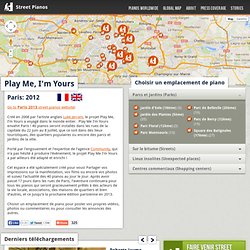
Créé en 2008 par l’artiste anglais Luke Jerram, le projet Play Me, I’m Yours a voyagé dans le monde entier. Play Me I'm Yours envahit Paris ! 40 pianos seront installés dans les rues de la capitale du 22 juin au 8 juillet, que ce soit dans des lieux touristiques, des quartiers populaires ou encore des parcs et jardins de la ville.
Bienvenue sur Open Food Facts. Accueil. Et maintenant, le cinéma 2.0. Les grands auteurs se lancent dans le cinéma participatif. UniShared - Home. Gullibear. TENDANCES 3D : Cinema 4D 13 – Xenodream – Mari – Topogun – Scanner 3D. Un scanner 3D gratuit ?
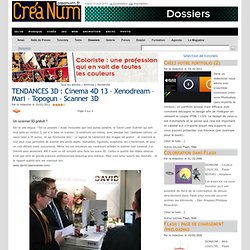
Est-ce une blague ? Est-ce possible ? Aussi incroyable que cela puisse paraître, le David Laser Scanner qui sort tout juste en version 3, est à la base un scanner… à construire soi-même, avec presque rien (quelques cartons, un rayon laser à 20 euros), et qui fonctionne bien ! Le logiciel de traitement des images est gratuit : et vraiment le tout peut vous permettre de scanner des petits objets (statuettes, figurines, sculptures, etc.) facilement, et pour un coût défiant toute concurrence. Même les non bricoleurs qui voudraient acheter le scanner tout construit s’en tireront pour seulement 400 € avec un kit complet pour faire les scans 3D. Xenodream 2.4 : créativité exacerbée ! Les outils les plus créatifs de la 3D ne sont pas toujours ceux qu’on croit ! Une vraie mine d’or pour décupler la créativité, et cette nouvelle version devient vraiment puissante avec plus de 30 nouvelles formes metamorphs notamment. www.xenodream.com.
L’impression 3D fabrique son lobbying. Tuer dans l'oeuf la nouvelle techno disruptive : c'est le risque qui vise les imprimantes 3D.
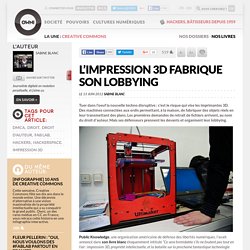
Des machines connectées aux ordis permettant, à la maison, de fabriquer des objets réels en leur transmettant des plans. Les premières demandes de retrait de fichiers arrivent, au nom du droit d'auteur. Mais ses défenseurs prennent les devants et organisent leur lobbying. Les marchés gratuits, la nouvelle tendance anticonso. Argentine / / Amérique du sud Né dans la capitale argentine, le concept fait fureur et a déjà conquis de nombreuses villes à travers tout le pays.
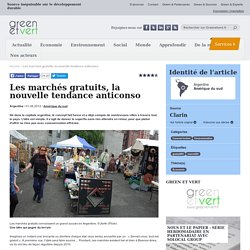
L’idée est simple, il s’agit de donner le superflu sans rien attendre en retour, pour que plaisir d’offrir ne rime pas avec consommation effrénée. Les marchés gratuits connaissent un grand succès en Argentine. © jforth (Flickr) Jeremy Rifkin : « Partageons l'énergie comme l'information » L’Américain, pour qui on est entré dans la « civilisation de l’empathie », donne une leçon de modernité à Sarkozy, chantre du nucléaire. « Une nouvelle conscience pour un monde en crise », sous-titre : « La Civilisation de l’empathie », qui vient de paraître en français (Les Liens qui Libèrent, 29 euros) fera-t-il date ?
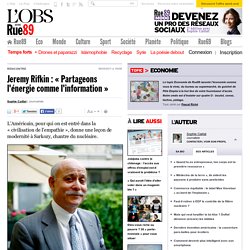
Si l’on en croit le devenir des précédents essais du président de la Fondation pour les tendances économiques, c’est probable. Depuis les années 70, celui qui fait profession de conseiller des grands de ce monde assène quelques vérités, qui lui valent d’être critiqué. An Intro. to a Resource-Based Economy [ TEDx - Peter Joseph ]