
Tal Golesworthy: How I repaired my own heart. Announcing Global Freshman Academy. Study: Media multitaskers pay mental price. Stanford Report, August 24, 2009 Think you can talk on the phone, send an instant message and read your e-mail all at once?

Stanford researchers say even trying may impair your cognitive control. By Adam Gorlick Attention, multitaskers (if you can pay attention, that is): Your brain may be in trouble. People who are regularly bombarded with several streams of electronic information do not pay attention, control their memory or switch from one job to another as well as those who prefer to complete one task at a time, a group of Stanford researchers has found. High-tech jugglers are everywhere – keeping up several e-mail and instant message conversations at once, text messaging while watching television and jumping from one website to another while plowing through homework assignments. But after putting about 100 students through a series of three tests, the researchers realized those heavy media multitaskers are paying a big mental price. Transcendence.
Online Etymology Dictionary. Polymath (n.)

Psychology - Was the experiment with five monkeys, a ladder, a banana and a water spray conducted? - Skeptics Stack Exchange. The earliest mention I could find of this experiment was in the popular business/self-help book, Competing for the future by Gary Hamel and C.

K. Prahalad (1996). Here is the quote from the book: What Monkeys Can Teach Us About Human Behavior: From Facts to Fiction. In Defense of Polymaths - Kyle Wiens. By Kyle Wiens | 8:54 AM May 18, 2012 Polymath is one of those words more likely to show up on the SAT than in everyday conversation.

But the reason we don’t use the word much these days has less to do with vocabulary than it has to do with practicality: there aren’t a lot of polymaths around anymore. In case you don’t have your pocket dictionary handy, a polymath is a person with a wide range of knowledge or learning. Think people like Leonardo da Vinci (artist and helicopter designer), Benjamin Franklin (founding father, inventor, and all-around lady-killer), Paul Robeson (scholar, athlete, actor, and civil rights activist), and even Steve Jobs (engineer, businessman extraordinaire, and marketing mastermind). Still, while we admire the select “geniuses” that can do it all, we tend to disparage the regular folk who attempt to spread their knowledge around a little.
THE LAST DAYS OF THE POLYMATH. People who know a lot about a lot have long been an exclusive club, but now they are an endangered species.
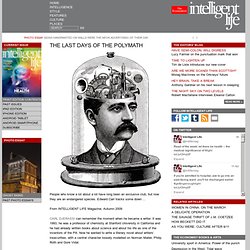
Edward Carr tracks some down ... From INTELLIGENT LIFE Magazine, Autumn 2009 CARL DJERASSI can remember the moment when he became a writer. List of people who have been called a polymath. Noosphere princeton edu Homepage. The Global Consciousness Project, also called the EGG Project, is an international, multidisciplinary collaboration of scientists, engineers, artists and others.

We collect data continuously from a global network of physical random number generators located in 65 host sites around the world. The archive contains more than 12 years of random data in parallel sequences of synchronized 200-bit trials every second. Our purpose is to examine subtle correlations that may reflect the presence and activity of consciousness in the world. We predict structure in what should be random data, associated with major global events. Consciousness, group consciousness, mind. GCP on Wikipedia. Roger Nelson, Oct 27 2009 The Wikipedia article on the Global Consciousness Project is marred, apparently having become the focus of biased editors with an agenda.

Intelligence collective. Collective Intelligence Refs... Collective-intelligence-framework - a framework for warehousing intelligence bits. CIF is a cyber threat intelligence management system.

CIF allows you to combine known malicious threat information from many sources and use that information for identification (incident response), detection (IDS) and mitigation (null route). The most common types of threat intelligence warehoused in CIF are IP addresses, domains and urls that are observed to be related to malicious activity. Overview of collective intelligence. BibTeX @MISC{Wolpert02overviewof, author = {David H.
Wolpert}, title = {Overview of collective intelligence}, year = {2002}} Years of Citing Articles. Best content in Collective Intelligence theory research. Designing for collective intelligence. A collective intelligence application is one that harnesses the knowledge and work of its users to provide the data for the application and to improve its usefulness.
The most hyped examples of collective intelligence applications have been labeled as "Web 2.0" applications. Web 2.0 is an amorphous term used to define a computing paradigm that uses the Web as the application platform and facilitates collaboration and information sharing between users. Classic examples of Web 2.0 applications include: wikis, blogs (or Weblogs), social network services, and social bookmarking. Collective intelligence is not a new concept. As long ago as 1968, computer visionaries foresaw the ability of computers to be applied to cooperation in creative endeavors by allowing people capable of solving specific problems to share their ideas.
MIT Center for Collective Intelligence. A taxonomy of collective intelligence - Handbook of Collective Intelligence. From Handbook of Collective Intelligence One effort to create a taxonomy of collective intelligence is underway in the MIT Center for Collective Intelligence as part of the Handbook for Collective Intelligence project.
So far, this project has included three “generations” of taxonomies. The first generation of this taxonomy was simply the list of examples in the previous sections of this handbook. The second generation was represented in a separate wiki called the Handbook of Organizational Design. The current version of the third generation is summarized in a set of slides presented at the Highlands Collective Intelligence Forum, Carmel Valley, CA, July 23, 2008.
Stubber.math-inf.uni-greifswald.de/pub/full/prep/2001/11.pdf. Sustainable Commons Communication Strategy Debategraph. Objective of the project The objective of this project is to design a communication strategy for the commons as meta-narrative to accelerate the emergence of a sustanable thrivable world. Framing communication, message as well as media, adjusted to different audiences (worldviews, priorities and stakes) so that they are received and acted upon in the most effective and convergent way. Collective Intelligence in Neural Networks and Social Networks « 100 Trillion Connections. Context for this post: I’m currently working on a social network application that demonstrates the value of connection strength and context for making networks more useful and intelligent. Connection strength and context are currently only rudimentarily and mushily implemented in social network apps.
This post describes some of the underlying theory for why connection strength and context are key to next generation social network applications. Cs/9905004v1 [cs.LG] 10 May 1999. 6-Collective Intelligence. Ideas bank. Many ideas banks are provided as free of charge, or set around certain companies in general to work out new inventions. Although ideas are provided by a community of people, problems can arise when people take the ideas of the site and begin developing them. [citation needed] There is no possible way to prove that the idea on the ideas bank was original and not taken from something else. One Billion Minds. Ideas banks... Solve your open innovation challenges by engaging IdeaConnection's problem solvers. Human Systems Dynamics. Ludic fallacy. It is a central argument in the book and a rebuttal of the predictive mathematical models used to predict the future – as well as an attack on the idea of applying naïve and simplified statistical models in complex domains.
According to Taleb, statistics works only in some domains like casinos in which the odds are visible and defined. Taleb's argument centers on the idea that predictive models are based on platonified forms, gravitating towards mathematical purity and failing to take some key ideas into account: It is impossible to be in possession of all the information.Very small unknown variations in the data could have a huge impact. Taleb does differentiate his idea from that of mathematical notions in chaos theory, e.g. the butterfly effect.Theories/models based on empirical data are flawed, as they cannot predict events that have never happened before, but have tremendous impact, e.g., the 911 terrorist attacks, the invention of the automobile, etc.
Examples[edit] See also[edit] Complexity.IO. Complexity. Emerging Trends. Systemica. Global Theories. Slanguage. LORE. Symbolica. Mathematics. Magical Thinking. Esoteric Endeavors. Magica. Cultural References. Polymath Renaissance. Movers and Shakers. Complex Systems. DATA. Crowd Source Controls. CrowdFunDing. Societal Gumbo. Soco Loco. INTERNET. NeWeb. Presentation. Practicum. Ways Places Means. Seven Generations. Spiritual Succor. Agree Ability. Live Long and Prosper. Philosophikos. World Beliefs. Spirits Align. One World. WORLD VIEWS.