
Technological singularity. The technological singularity is the hypothesis that accelerating progress in technologies will cause a runaway effect wherein artificial intelligence will exceed human intellectual capacity and control, thus radically changing civilization in an event called the singularity.[1] Because the capabilities of such an intelligence may be impossible for a human to comprehend, the technological singularity is an occurrence beyond which events may become unpredictable, unfavorable, or even unfathomable.[2] The first use of the term "singularity" in this context was by mathematician John von Neumann.
Proponents of the singularity typically postulate an "intelligence explosion",[5][6] where superintelligences design successive generations of increasingly powerful minds, that might occur very quickly and might not stop until the agent's cognitive abilities greatly surpass that of any human. Basic concepts. Am I a cyborg now? — Idea of the day. 28 July 2012 Some time ago I've read about a guy that had a magnet implanted in the pinky finger.

The author seems to have made the implant mostly for fun only later he discovered that it sometimes "ticks" in and gives a "sixth sense": When people discuss magnet implants giving a “sixth sense,” this is what they’re talking about. “The Future Is Ours” Video Inspires Hope In Technology And Human Progress. "The Future Is Ours" video profiles those who are shaping the future with their vision and optimism. In a recent TED talk titled “Abundance Is Our Future,” Peter Diamandis points out that though the amygdala in our brains may continually draw our attention toward negative news stories — and therefore help perpetuate a pessimistic view that the world is getting worse — the technological progress over that last century should fill us with an incredible optimism about the future.
In homage to Peter’s message as well as the work of many entrepreneurs, innovators, and scientists, a new video called “The Future Is Ours” inspires this hope in technology with a mashup of presentations, speeches, and YouTube videos. Michael Marantz, who created the video, wrote in the comments, “The future excites me so much, that is why I made this video. Bionic Vision: “Sight” Short Movie Explores the Coming Future of Augmented Reality. A picture of an eye with a google glasses style contact lens A pair of graduate students at the Bezaleal Academy of Arts, in Jeruselem, have created a fascinating short video that experiments with concepts of life in a world full of Augmented Reality technology.

There is little doubt that Terminator-style AR is coming. Today’s vision, limited to mere biological functioning, will seem vastly primitive compared to the bionic eyesight of the future. Augmented reality began to capture the attention of mainstream consumers when Google released their Project Glass trailer showcasing their frames capable of layering digital information over a person’s field of vision. SH Interviews Vernor Vinge – How Will We Get To The Technological Singularity? Vernor Vinge Science Fiction: it has been a muse of geeks, techies and scientists for decades. Many of the technologies we explore on Singularity Hub were first imagined and explored in SF (star trek tricorders, the WWW, robot cars, etc), driving technologists to make them real, which in turn inspires a new round of SF.
In thinking about predicting and solving global grand challenges, the storytelling and worldbuilding of SF has much to contribute. Singularity University’s (SU) 1st ever Science Fiction panel took place on July 17th. As a prelude, here’s an interview with Vernor Vinge below, as well as the full footage of his talk about groupminds at SU on June 25, 2012. Cyborg. A cyborg (short for "cybernetic organism") is a theoretical or fictional being with both organic and biomechatronic parts.
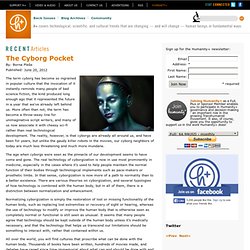
The term was coined in 1960 by Manfred Clynes and Nathan S. Kline.[1] D. S. Technology & the Future. Covering technological, scientific, and cultural trends that are changing–and will change–human beings in fundamental ways. The Cyborg Pocket. Borna Pleše The term cyborg has become so ingrained in popular culture that the invocation of it instantly reminds many people of bad science fiction, the kind produced long enough ago that it represented the future in a year that we've already left behind us.
What’s a Cyborg? On Immortal Being and Nothingness. Matt Swayne Imagine you could live forever.

I'm talking about an infinitely-long lifespan. Imagine you could do whatever you wanted during that timeless stretch. Sounds like a pretty good deal, right? Ready to sign up? Hang on a second. Is the Internet Really Making Me Stupid, Crazy, and Constantly Distracted? Okay, interesting questions indeed. Now, I am not an expert in neurology or anything, but I do have an MS in Biology and do know a little.
Our brains have been shaped by millions of years of evolution. If you think your brain is going to get "wired" differently by using the internet, you are crazy. 2045: A New Era for Humanity. Welcome to Life: the singularity, ruined by lawyers. TRUE SKIN TEASER. Inviting Machines Into Our Bodies. Chris Arkenberg In what amounts to a fairly shocking reminder of how quickly our technologies are advancing and how deeply our lives are being woven with networked computation, security researchers have recently reported successes in remotely compromising and controlling two different medical implant devices.
Such implanted devices are becoming more and more common, implemented with wireless communications both across components and outward to monitors that allow doctors to non-invasively make changes to their settings. Until only recently, this technology was mostly confined to advanced labs but it is now moving steadily into our bodies. As these procedures become more common, researchers are now considering the security implications of wiring human anatomy directly into the web of ubiquitous computation and networked communications. There are now numerous examples of in-the-field connected implants. It seems the TSA is growing concerned about implanted explosive devices. Hidden Smiles and the Desire of a Conscious Machine. Malcolm Ramsay Conscious machines are everywhere in popular culture – countless books, films and TV shows are based in a future where humans have robot or computer companions.

A world with intelligent machines is something nearly everyone can readily picture and, while we may not know how to create these machines at present, it is generally assumed that we will recognize them if they come around. If a conscious machine were created, the argument goes, it could simply tell us itself. The Northpaw, Day 1: A new sense I didn’t know I didn’t have. The magnetic implant had a magical quality to it.

Quinn Said. I Cyborg. Next Book Amazon.co.uk The cybernetic pioneer who is upgrading the human body - starting with himself Professor Kevin Warwick, the world's leading expert in Cybernetics, here he unveils the story of how he became the worlds first Cyborg in a ground breaking set of scientific experiments.

In the years ahead we will witness machines with an intelligence more powerful than that of humans. This will mean that robots, not humans, make all the important decisions.