
Exact Atomic Masses. Name Reactions, Synthones, Protecting Groups. Name Reactions. Combined Uncertainty. For the uncertainty to be truly meaningful, it must address the entire measuring process, which may have uncertainties associated with factors such as equipment calibration, operator skill, sample variation, and environmental factors.
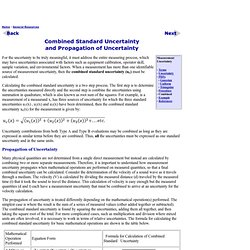
When a measurement has more than one identifiable source of measurement uncertainty, then the combined standard uncertainty (uc) must be calculated. Calculating the combined standard uncertainty is a two step process. The first step is to determine the uncertainties measured directly and the second step is combine the uncertainties using summation in quadrature, which is also known as root sum of the squares. Basicity Table. SciFinder Tutorials.
Bordwell pKa Table (Acidity in DMSO) Molarity of Concentrated Reagents. ACS Mass Spectrometry. Calculation of Isotope Pattern. Unit Converter. An Introduction to Mass Spectrometry. An Introduction to Mass Spectrometry Dr Alison E.
Ashcroft, Mass Spectrometry Facility Manager, Astbury Centre for Structural Molecular Biology, Astbury Building , The University of Leeds. Solvent Strength for TLC. Bond Energy Table. Glassware Tricks. Synthesis (very nice instructional course) Chemistry requires an understanding of molecular structure, knowledge of molecular reactivity, and the creativity to combine them in novel situations.
A synthetic chemist must be able to translate a two-dimensional drawing into a three-dimensional mental image. This three-dimensional image is then unwrapped and divided into key intermediates, each of which will be unwrapped and divided in turn. We cannot see with our eyes the molecules we study. Therefore, we bridge the gap between ordinary vision and visual imagination with models: physical models which embody the metaphorical models. Fluency with visual conventions is developed simultaneously with fluent perception of the concepts expressed in the representation. Spectral Database for Organic Compounds. UCLA Problems in NMR and IR Spectroscopy. NSTA Learning Center. Synthtic Organic Chemists. Chemistry Conferences. The Basics of NMR. NMR Facility at Queen's University. Protein Data Bank.
A Structural View of Biology This resource is powered by the Protein Data Bank archive-information about the 3D shapes of proteins, nucleic acids, and complex assemblies that helps students and researchers understand all aspects of biomedicine and agriculture, from protein synthesis to health and disease.

As a member of the wwPDB, the RCSB PDB curates and annotates PDB data. The RCSB PDB builds upon the data by creating tools and resources for research and education in molecular biology, structural biology, computational biology, and beyond. Use this website to access curated and integrated biological macromolecular information in the context of function, biological processes, evolution, pathways, and disease states. A Molecular View of HIV Therapy January Molecule of the Month Nuclear Pore Complex Deposition Preparation Tools Data Extraction Small Molecules Ligand Expo: Search the Chemical Component Dictionary for the IDs of released ligands. Peptide Molecular Weight Calculator. DNA properties calculator. Water-Soluble Polymers. Fatty Acids. Types of fatty acids[edit] Three-dimensional representations of several fatty acids Fatty acids that have carbon–carbon double bonds are known as unsaturated.
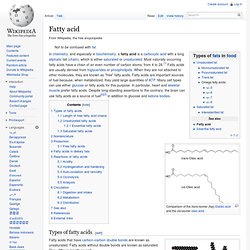
Fatty acids without double bonds are known as saturated. They differ in length as well. Length of free fatty acid chains[edit] Fatty acid chains differ by length, often categorized as short to very long. iSUSTAIN Green Chemistry Index. Drugs. Laser Light Scattering and macromolecular characterization - Wyatt Technology MALS instruments. PyMOL. PyMOL - Wiki. Non-free binaries[edit] On 1 August 2006, DeLano Scientific adopted a controlled-access download system for pre-compiled PyMOL builds (including betas) distributed by the company.
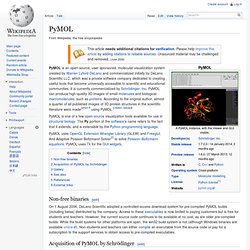
Access to these executables is now limited to paying customers but is free for students and teachers. However, the current source code continues to be available at no cost, as are older pre-compiled builds. While the build systems for other platforms are open, the win32 build system is not (although Windows binaries are available online). Non-students and teachers can either compile an executable from the source code or pay for a subscription to the support services to obtain access to pre-compiled executables. BOINC projects. Climate prediction. Basis Sets for Gaussian. G03 Manual: POPULATION. This properties keyword controls printing of molecular orbitals and several types of population analysis and atomic charge assignments.

The default is to print just the total atomic charges and orbital energies, except for Guess=Only jobs, for which the default is Pop=Full (see below). Populations are done once for single-point calculations and at the first and last points of geometry optimizations. The density that is used for the population analysis is controlled by the Density keyword. Note that only one density and method of charge fitting can be used in a job step. If several combinations are of interest, additional jobs steps can be added which specify Guess=Only Density=Check, to avoid repeating any costly calculations. Population analysis results are given in the standard orientation. Output controlled by the Pop keyword includes: MO vs. NBO - Tutorial Example. Introduction: Relating MOs and NBOs This tutorial illustrates how NBOs and MOs are related and offers comparisons of localized (NBO-based) vs. delocalized (MO-based) pictures of the molecular wavefunction for some simple molecular and intermolecular species.
In Part I, we show how to use the CMO keyword and other matrix output keywords to obtain precise mathematical relationships between MOs and NBOs, NLMOs, or other chosen localized orbitals of formamide (NH2CHO), a resonance-delocalized species. In Part II, we employ the simple methylamine (CH3NH2) species to explore more detailed energetic aspects of analyzing SCF-MO wavefunctions by distinct delocalized vs. localized pathways. Correlated Ab Initio Calculations: Tutorial and Assignments. Ab Initio Quantum Mechanics: Electron Correlation Methods Møller-Plesset Perturbation Theory Møller-Plesset (MP) Theory, or Many-Body Perturbation Theory (MBPT) is an economical way to partially correct for the lack of dynamic electron correlation in the Hartree-Fock Theory.
It improves the description of molecular energies and properties significantly in situations where the single-reference Hartree-Fock wave function already describes the system reasonably well.