
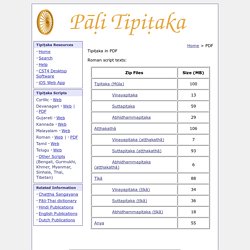
A General Feeling of Disorder by Oliver Sacks. Tipiṭaka in PDF. Home > PDF Tipiṭaka in PDF Roman script texts:
Libros budistas electrónicos. Mahasiddha - Wikipedia. Taishō Tripiṭaka: English Translations. For other file formats including Unicode text files, DjVu documents, and TEI XML files, please see the Buddhist Text Archive.
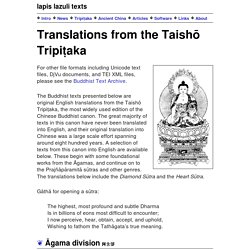
The Buddhist texts presented below are original English translations from the Taishō Tripiṭaka, the most widely used edition of the Chinese Buddhist canon. The great majority of texts in this canon have never been translated into English, and their original translation into Chinese was a large scale effort spanning around eight hundred years. A selection of texts from this canon into English are available below.
Amazon. Amazon. Amazon. Libros temática Ensayo. Internet History Sourcebooks. Update Information 2006: In 2006 the Internet Medieval Sourcebooks and associated sourcebooks are undergoing a major overhaul to remove bad links and add more documents. 1.

This project is both very large and fairly old in Internet terms. At the time it was instigated (1996), it was not clear that web sites [and the documents made available there] would often turn out to be transient. As a result there is a process called "link rot" - which means that a "broken link" is a result of someone having taken down a web page. In some cases some websites have simply reorganized sub-directories without creating forwarding links. 2. 3. The Internet Medieval Sourcebook is organized as three main index pages, with a number of supplementary documents. INTRODUCTION: MEDIEVAL SOURCES ON THE INTERNET Historians teaching medieval history surveys almost always want to combine a textbook, a sourcebook, and additional readings. DOCUMENT SIZE: The size of documents for teaching purposes is an issue.
Internet History Sourcebooks. Internet Archive: Digital Library of Free Books, Movies, Music & Wayback Machine. Medieval Literature Resources. The Online Literature Library. Internet Archive: Digital Library of Free Books, Movies, Music & Wayback Machine. Medieval Literature Resources. The Ex-Classics Web Site. Proyecto Ensayo Hispánico. Welcome to GALILEO. Through GALILEO, Georgia citizens have access to authoritative, subscription-only information that isn't available through free search engines or Web directories.
Here's a sampling of what's inside: Digital Library of Georgia: Digital collections related to the history and culture of Georgia, including photographs, maps, and primary source documents. University of Virginia Library. The U.Va.
Library holds books, e-books, journal and newspaper subscriptions, online databases, digital image collections, videos, CDs, manuscripts, archives and more. Our subject liaisons welcome purchase requests from the U.Va. community, too. Special Collections Information about our Special Collections with ways to help you discover archival and manuscript materials. Proyecto Filosofía en español / www.filosofia.org. Novela hispanoamericana de siglo XIX / Fondo Benito Varela Jácome. Two million documents at your fingertips. PerseusCatalog. Los Autores. Literatura Digital. Obras por categor a. Literatura textos Latindex.com. Free Ebooks. The Tristram Shandy Web. Animal Farm: A Fairy Story. Chomsky.info : The Noam Chomsky Website. Necessary Illusions: Contents.
Cambodia. In 1947, commenting on the rising tide of "anti-Communist" hysteria in the United States, John K.
Fairbank made the following perceptive observations: Our fear of Communism, partly as an expression of our general fear of the future, will continue to inspire us to aggressive anti-Communist policies in Asia and elsewhere, [and] the American people will be led to think and may honestly believe that the support of anti-Communist governments in Asia will somehow defend the American way of life. This line of American policy will lead to American aid to establish regimes which attempt to suppress the popular movements in Indonesia, Indochina, the Philippines, and China…. In North Vietnam. The ICC flight to Hanoi spirals upward around Vientiane until it reaches its assigned altitude, and then passes through a protected corridor over an area that has received some of the most intensive bombing in history.
A Phantom jet streaked close by—much to the annoyance of the crew and regular passengers—but apart from that we saw nothing in the heavy clouds until the lights of Hanoi appeared below. The passengers on the flight were a curious mixture: Chinese diplomats; Russian journalists, an Italian novelist, several Poles, and three American visitors. We arrived on April 10, and departed on the same flight, a week later. Since my visit to Vietnam was so brief, my impressions are necessarily superficial. .pdf (objeto application/pdf) Introductory Comment.
A Visit to Laos. Notes on Anarchism. Foreword. ‘We are not judges.
We are witnesses. Our task is to make mankind bear witness to these terrible crimes and to unite humanity on the side of justice in Vietnam.’ With these words, Bertrand Russell opened the second session of the International War Crimes Tribunal, in November 1967. The American people were given no opportunity, at that time, to bear witness to the terrible crimes recorded in the proceedings of the Tribunal. After Pinkville. The Menace of Liberal Scholarship. In a recent essay, Conor Cruise O'Brien speaks of the process of "counterrevolutionary subordination," which poses a threat to scholarly integrity in our own counterrevolutionary society, just as "revolutionary subordination," a phenomenon often noted and rightly deplored, has undermined scholarly integrity in revolutionary and post-revolutionary situations.
He observes that "power in our time has more intelligence in its service, and allows that intelligence more discretion as to its methods, than ever before in history," and suggests that this development is not altogether encouraging, since we have moved perceptibly towards the state of "a society maimed through the systematic corruption of its intelligence. " He urges that "increased and specific vigilance, not just the elaboration of general principles, is required from the intellectual community toward specific growing dangers to its integrity.
"1 The impact of professionalization is also clear. In Defense of the Student Movement. The student movement today is the one organized, significant segment of the intellectual community that has a real and active commitment to the kind of social change that our society desperately needs. On Resistance. Several weeks after the demonstrations in Washington, I am still trying to sort out my impressions of a week whose quality is difficult to capture or express. Perhaps some personal reflections may be useful to others who share my instinctive distaste for activism, but who find themselves edging toward an unwanted but almost inevitable crisis. Mayday: The Case for Civil Disobedience. Secrets, Lies and Democracy. Year 501: Contents. Cocina macrobiótica - lacocinadeile 2º LIBROS NUEVOS. Project Gutenberg - free ebooks. Rare Book Room - StumbleUpon. Free Classic AudioBooks. Digital narration for the 21st Century - StumbleUpon.
Tolstói o Dostoievski - George Steiner. Cultural & Social Anthropology - Download free content from Arizona... - StumbleUpon.