
Glenn Gould Portrait (1985) Gould Portrait 2/12. Gould Portrait 11/12. Gould Portrait 10/12. Gould Portrait 9/12. Gould Portrait 8/12. Gould Portrait 7/12. Gould Portrait 6/12. Gould Portrait 5/12. Gould Portrait 4/12. Glenn Gould Portrait 3/12. Gould: Portrait 2/12. Glenn Gould. Glenn Gould Glenn Herbert Gould[fn 1][fn 2] (25 September 1932 – 4 October 1982) was a Canadian pianist who became one of the best-known and most celebrated classical pianists of the 20th century.[1] He was particularly renowned as an interpreter of the keyboard music of Johann Sebastian Bach.
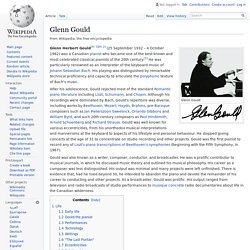
His playing was distinguished by remarkable technical proficiency and capacity to articulate the polyphonic texture of Bach's music. Gould was also known as a writer, composer, conductor, and broadcaster. He was a prolific contributor to musical journals, in which he discussed music theory and outlined his musical philosophy. His career as a composer was less distinguished. Life[edit] Early life[edit] Gould's interest in music and his talent as a pianist became evident very early. It was Hofmann. Glenn Gould Foundation. Glenn Gould - Bing Wikipedia.
Glenn Gould ALLMUSIC. Glenn Gould Short Bio. The remarkable Canadian pianist (also organist, conductor, and composer), Glenn (Herbert) Gould, was born into a musical family: Edvard Grieg was a first cousin of his mother's grandfather, his father was an amateur violinist, and his mother played piano and organ.

Gould's mother was his only teacher until he was ten. When he was three years old, it became evident that he possessed exceptional musical aptitude, including absolute pitch and even the ability to read staff notation. At five, he began to compose, and played his own little compositions for family and friends. At the age of six Gould was taken to his first live musical performance which was Josef Hofmann's last appearance in Toronto.
It created a lasting and important impression upon the boy. Robert Fulford, a distinguished Canadian author, met Gould when they were both nine and the two families were next-door neighbours. A Day in the Life of Glenn Gould. The piety of Glenn GOULD. The soul of Glenn GOULD. Glenn Gould. Glenn Gould - Weird and Wondrous, Classical Notes, Peter Gutmann. Please click here for a September 2002 update (new Glenn Gould Anniversary Edition of Bach!)

The late Canadian pianist Glenn Gould was weird. Compared to his bizarre routines, the petulant attitudes and outrageous demands of spoiled rock and movie stars seem downright normal. But often it takes a spark of madness to kindle the fires of genius, especially in the arts. Dutton on Glenn Gould. Cult of Glenn Gould. Glenn Gould Talks to Children about Interpreting Music. Glenn Gould on Concerts. Throwing Down the Baton. “A performance is not a contest but a love affair.”

Glenn Gould The Calder Quartet, whose members are graduates of the renowned Julliard School in Manhattan, performed Mozart’s G-minor Quintet at Zipper Hall in Los Angeles on March 22, 2009. People adore this particular composition. Mozart evokes suffering and irony in a minor key and then, in a major key, resolves the tragic themes. Imagine you are in the Los Angeles audience listening closely to the subtleties of the music. Pianist Gould foresaw tech role in music. Forty-five years ago this week, the great Canadian pianist Glenn Gould stepped off the stage of the Wilshire Ebell Theatre and became the prophet of a new technology.

Gould's act was an act of omission, not commission. That April 10, 1964, recital in the Los Angeles hall was the last concert he ever gave -- a forsaking of the tradition of public performance that was unprecedented for such a young (31) and eminent interpreter of Bach and Beethoven. I thought this milestone of Southern California cultural history worth revisiting not only because Glenn Gould happens to be one of my personal heroes, but also because his vision of music and the music business has been so thoroughly validated over the years. For Gould's withdrawal from the concert stage did not mean his withdrawal from the music world. Rather, it enhanced his stature in that world, making him an inspiration for the digital recording era.
Why Mozart? “Mozart was a bad composer who died too late rather than too early.”Um… excuse me?

Should you really be saying something like that right after his 250th birthday…? Well, yes… because today I’m declaring open season on Mozart. It was legendary pianist Glenn Gould who made that surprisingly blasphemous proclamation, and I think it’s a subversive delight to behold amid all the hype and marketing surrounding Mozart’s 250th this year. Wolfgang Amadeus Mozart. He composed over 600 works, many acknowledged as pinnacles of symphonic, concertante, chamber, operatic, and choral music.
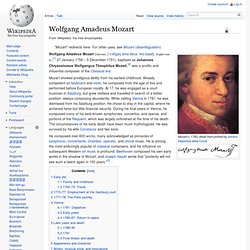
He is among the most enduringly popular of classical composers, and his influence on subsequent Western art music is profound; Beethoven composed his own early works in the shadow of Mozart, and Joseph Haydn wrote that "posterity will not see such a talent again in 100 years. "[3] Early life Family and childhood Anonymous portrait of the child Mozart, possibly by Pietro Antonio Lorenzoni; painted in 1763 on commission from Leopold Mozart Wolfgang Amadeus Mozart was born on 27 January 1756 to Leopold Mozart (1719–1787) and Anna Maria, née Pertl (1720–1778), at 9 Getreidegasse in Salzburg.
Leopold Mozart, a native of Augsburg,[7] was a minor composer and an experienced teacher. When Nannerl was seven, she began keyboard lessons with her father while her three-year-old brother looked on. These early pieces, K. 1–5, were recorded in the Nannerl Notenbuch. 1762–73: Travel. Gould plays Mozart. Glenn Gould – Free videos, Glenn Gould - Bach - Concerto in D minor - a Music video. Glenn Gould - A State Of Wonder - Goldberg Variations (1955 & 19. The title of this set, A State of Wonder, probably would induce in Glenn Gould a state of hysterics, never mind that the name originates with him (perhaps he was unconsciously recalling the words of the theme song to the 1960s dolphin drama "Flipper").

But that's classical music marketing today: always emphasize the mystery and spirituality rather than the expressive directness, humanity, and real world fun to be had. And god knows there's fun aplenty in these two classic performances of the Goldberg Variations, not to mention the extensive discussion between critic Tim Page and Gould that comes on a third bonus disc. And there's another irony here: the 1982 remake is advertised as being reissued for the first time Read more in "pristine analog" sound, when of course one of the major selling points when originally issued was the fact that it was one of Sony's first major productions in stunning, crystalline, super high fidelity digital.
Ahem. --David Hurwitz, ClassicsToday.com Read less. Glenn Gould plays Bach. Bernstein & Glenn Gould. Glenn Gould Chair. Gould chair pic. Gould chair pic. Remnants of Glenn Gould. Goldberg variations. Making the chair. Glenn Gould plays the Goldberg Variations. "Goldberg Variations" by J.S. Bach. Johann Sebastian Bach. Bach's abilities as an organist were highly respected throughout Europe during his lifetime, although he was not widely recognised as a great composer until a revival of interest and performances of his music in the first half of the nineteenth century.
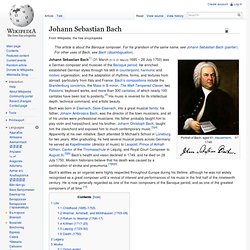
He is now generally regarded as one of the main composers of the Baroque period, and as one of the greatest composers of all time.[10] Life Childhood (1685–1703) At the age of 14, Bach, along with his older school friend George Erdmann, was awarded a choral scholarship to study at the prestigious St. Michael's School in Lüneburg in the Principality of Lüneburg.[19] Although it is not known for certain, the trip was likely taken mostly on foot.[18] His two years there were critical in exposing him to a wider facet of European culture. While in Lüneburg, Bach had access to St. Weimar, Arnstadt, and Mühlhausen (1703–08) In January 1703, shortly after graduating from St. In 1706, Bach was offered a post as organist at St. Köthen (1717–23) Goldberg Variations. Title page of the Goldberg Variations (first edition) Composition[edit] The tale of how the variations came to be composed comes from an early biography of Bach by Johann Nikolaus Forkel:[1] [For this work] we have to thank the instigation of the former Russian ambassador to the electoral court of Saxony, Count Kaiserling, who often stopped in Leipzig and brought there with him the aforementioned Goldberg, in order to have him given musical instruction by Bach.

The Count was often ill and had sleepless nights. J. S. Bach: The Goldberg Variations. The "Goldberg" Variations is the last of a series of keyboard music Bach published under the title of Clavierübung, and is often regarded as the most serious and ambitious composition ever written for harpsichord. Based on a single ground bass theme, the variations display not only Bach's exceptional knowledge of diverse styles of music of the day but also his exquisite performing techniques. Being also the largest of all clavier pieces published during the Baroque period, the work soars high above others in terms of its encyclopaedic character.
From this, it is often considered that it sums up the entire history of Baroque variation, the Diabelli Variations by Beethoven being the Classical counterpart. However, doomed perhaps by its requirements of virtuoso techniques from a performer, it was not as popularly known as the Well-Tempered Clavier, which was not even published during the composer's lifetime.
A+30+a' Goldberg Variations. Gould IMDB. Gould Home #1/9. Gould Home #2/9. Gould Home #3/9. Gould Home #9/9. Gould home #4/9. Gould Home #8/9. Gould Home #5/9. Gould Home #7/9. Gould Home #6/9. Gould vs. Chopin. Chopin sonata no.3 Glenn Gould. Glenn gould. Glenn Gould Youtube videos. Glenn gould bach. Glenn Gould working. Bernstein about Gould. (Brahms)Gould &Bernstein. Glenn Gould Database. Glenngould.co.uk. Thirty Two Short Films About Glenn Gould - Wikipedia, the free e. Thirty Two Short Films About Glenn Gould is an award-winning 1993 film about the pianist Glenn Gould played by Colm Feore. The film's screenplay was written by François Girard (who also directed) and Don McKellar. The film does not present a single narrative, rather a series of thirty-one short films. These include documentaries (five interviews with people who knew him), re-creations of scenes from Gould's life, and various odd items (such as "Gould Meets McLaren", in which animated spheres reminiscent of those in Norman McLaren's animations move to Gould's music).
The segments range in length from six minutes to less than one minute. According to Girard: "As Gould was such a complex character, the biggest problem was to find a way to look at his work and deal with his visions. The film won four Genie Awards[2] and Best Canadian Feature Film at the Toronto International Film Festival. Segments[edit] References[edit] External links[edit] Thirty Two Short Films About Glenn Gould (1993) Glenn Gould. Glenn Gould Links. Glenn Gould Archive. Archived Content This archived Web page remains online for reference, research or recordkeeping purposes. This page will not be altered or updated. Web pages that are archived on the Internet are not subject to the Government of Canada Web Standards. As per the Communications Policy of the Government of Canada, you can request alternate formats of this page on the Contact Us page.
Introduction This site was developed by Library and Archives Canada, which is the official repository for the archives of the late concert pianist, Glenn Gould. Glenn Gould Discography at Discogs. Glenn Gould - Discography, biography, music, MP3s, credits, pict. Glenn Gould Discography. Glenn Gould > Overview ))) Glenn Gould. I believe that the justification of art is the internal combustion it ignites in the hearts of men and not its shallow, externalized, public manifestations. The purpose of art is not the release of a momentary ejection of adrenalin but is, rather, the gradual, lifelong construction of a state of wonder and serenity.
Glenn Herbert Gould (25 September 1932 – 4 October 1982) was a Canadian pianist, noted especially for his recordings of the music of Johann Sebastian Bach. He gave up concert performances in 1964, dedicating himself to the recording studio for the rest of his career, and performances for television and radio. Quotes[edit] The trouble begins when we start to be so impressed by the strategies of our systematized thought that we forget that it does relate to an obverse, that it is hewn from negation, that it is but very small security against the void of negation which surrounds it. My private motto has always been that behind every silver lining there is a cloud.