
25 Things Every Writer Should Know. An alternate title for this post might be, “Things I Think About Writing,” which is to say, these are random snidbits (snippets + tidbits) of beliefs I hold about what it takes to be a writer.

I hesitate to say that any of this is exactly Zen (oh how often we as a culture misuse the term “Zen” — like, “Whoa, that tapestry is so cool, it’s really Zen“), but it certainly favors a sharper, shorter style than the blathering wordsplosions I tend to rely on in my day-to-day writing posts. Anyway. Peruse these. Absorb them into your body. Let your colonic flora digest them and feed them through your bloodstream to the little goblin-man that pilots you. Feel free to disagree with any of these; these are not immutable laws. Buckle up. 1. The Internet is 55% porn, and 45% writers. 2. A lot of writers try to skip over the basics and leap fully-formed out of their own head-wombs. 3. Time Does Not Bring Relief: You All Have Lied by Edna St. Vincent Millay. Writing Is Not Lonely, But Avoiding It Is. You’ll never know what you’re made of until you sit long enough with the writing to move through the pulls for companionship (whether virtual or “real”). — Laraine Herring I am agitated at the core of myself these days.

Obviously, something is happening in my spirit – some cleansing, some burning off of the chaff, some rearranging of the fragments of myself – and I am tired, teary, and baffled with life most minutes of most days. If I was smart, I’d be buried in words because of this. 25 Things You Should Know About Plot. Previous iterations of the “25 Things” series: 25 Things Every Writer Should Know 25 Things You Should Know About Storytelling 25 Things You Should Know About Character And now… 1.
A plot is the sequence of narrative events as witnessed by the audience. 2. Some folks will ask, incorrectly, “What’s the plot?” 3. D. W. Mills Jr. Neuroses run rampant in me.

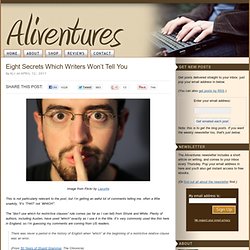
I Write Like James Joyce. Make your own book. Make it great. Find Similar or Opposite words at WordHippo.com. Poetry. Writing Exercies. Eight Secrets Which Writers Won’t Tell You. Image from Flickr by Lazurite This is not particularly relevant to the post, but I’m getting an awful lot of comments telling me, often a little snarkily, “it’s ‘THAT’ not ‘WHICH’”.
The “don’t use which for restrictive clauses” rule comes (as far as I can tell) from Strunk and White. Plenty of authors, including Austen, have used “which” exactly as I use it in the title. » 10 Things To Do To Become a Better Writer in 10 Days. Read These Seven Books, and You’ll be a Better Writer. Donald Miller I used to play golf but I wasn’t very good.
I rented a DVD, though, that taught me a better way to swing, and after watching it a few times and spending an hour or so practicing, I knocked ten strokes off my game. I can’t believe how much time I wasted when a simple DVD saved me years of frustration. I’d say something similar is true in my writing career. If you read these books, your writing will improve to the point people who read your work will begin to comment on how well you write. . • The War of Art by Steven Pressfield: This book is aimed at writers, but it’s also applicable to anybody who does creative work. Pressfield leaves out all the mushy romantic talk about the writing life, talk I don’t find helpful. . • On Writing Well by William Zinsser: Zinsser may be the best practical writing coach out there.
Writer’s Digest - Writing Prompts. Write a scene that includes a character speaking a different language, speaking in a thick accent, or otherwise speaking in a way that is unintelligibe to the other characters.
(Note: You don't necessarily need to know the language the character is speaking—be creative with it!) Random Word Generator (Plus) Inspired To Journal. English 50 Exercises for Story Writers. English 50 – Intro to Creative Writing: Exercises for Story Writers Basic Theory: What is a short story?
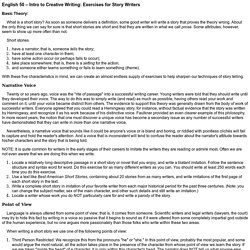
As soon as someone delivers a definition, some good writer will write a story that proves the theory wrong. About the only thing we can say for sure is that short stories are short and that they are written in what we call prose. Some attributes, however, seem to show up more often than not. Short stories have a narrator; that is, someone tells the story; have at least one character in them; have some action occur (or perhaps fails to occur); take place somewhere; that is, there is a setting for the action; and someone either learns something or fails to learn something (theme).With these five characteristics in mind, we can create an almost endless supply of exercises to help sharpen our techniques of story telling. Narrative Voice Twenty or so years ago, voice was the "rite of passage" into a successful writing career. If you've written a story in third person, try it in first. The Story Starter provides more than one billion different story ideas.
40 of the Best Websites for Young Writers. Jun 09, 2011 Looking for writing help, peer review, grammar tips or just a little bit of advice from the World Wide Web?
Don't miss these 40 helpful websites for young writers. Writing Communities and Courses Young Writer's Society - Dedicated to scribes between the ages of 13 and 25, the Young Writer's Society is the world's largest website for young writers. The members-only community encourages submissions and offers tips that will help anyone become a better writer. Grammar and Reference Websites The Purdue Online Writing Lab - Purdue University's Online Writing Lab is a wonderful place to learn all of the various rules of grammar and usage. Creativity Boosters. FundsforWriters.