
Polio. Hams Hall Pond (Primary) Thirstin's Water Cycle. It's in your nature. - wildearth.tv. The Blobz Guide to Electric Circuits. StudyJams. Schools Science Clips - Solids and liquids. Schools Science Clips - Grouping and changing materials. Schools Science Clips - Characteristics of materials. Game for science - Virtual world devoted to science, technology and free educational games online. Kids - Exploration - Highlights. K-12 animated storybooks animations science educational childrens online homestudy curriculum free.
Discover Primary Science - teacher training, classroom resources, primary science education, science awards. Carbon footprint, carbon offsets, carbon neutral. Lemelson Center’s Invention at Play: Invention Playhouse. Untitled Document. Name:______________________________________________ Objective: Simulate changes in moth population due to pollution and predation, and observe how species can change over time.
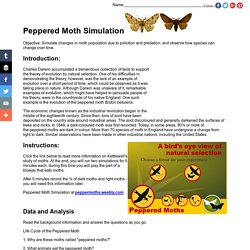
Introduction: Charles Darwin accumulated a tremendous collection of facts to support the theory of evolution by natural selection. One of his difficulties in demonstrating the theory, however, was the lack of an example of evolution over a short period of time, which could be observed as it was taking place in nature. Although Darwin was unaware of it, remarkable examples of evolution, which might have helped to persuade people of his theory, were in the countryside of his native England. The economic changes known as the industrial revolution began in the middle of the eighteenth century. Instructions: Click the link below to read more information on Kettlewell's study of moths.
After 5 minutes record the % of dark moths and light moths - you will need this information later. Data and Analysis 1. 2. 3. 4. 5. 6. 7. Tool Index. Nutrition Explorations: Kids. Welcome to Fuel Up to Play 60 — the new home of all your favorite games and lessons from Nutrition Explorations!
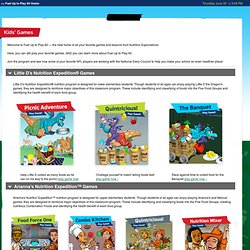
Here, you can still play your favorite games, AND you can learn more about Fuel Up to Play 60. Join the program and see how some of your favorite NFL players are working with the National Dairy Council to help you make your school an even healthier place! Little D's Nutrition Expedition® Games Little D's Nutrition Expedition® nutrition program is designed for lower elementary students. Though students of all ages can enjoy playing Little D the Dragon's games, they are designed to reinforce major objectives of this classroom program. Help Little D collect as many foods as he can on his way to the picnic! Arianna's Nutrition Expedition™ Games Arianna's Nutrition Expedition™ nutrition program is designed for upper elementary students. Go on a global adventure to find ingredients for combination foods! Earthquakes for Kids.
Earthquakes: Make a Quake. MOLECULARIUM. Royal Society. The story of the Royal Society is the story of modern science.
Our origins lie in a 1660 ‘invisible college’ of natural philosophers and physicians. Today we are the UK’s national science academy and a Fellowship of some 1,600 of the world’s most eminent scientists. Nullius in verba The very first ‘learned society’ meeting on 28 November 1660 followed a lecture at Gresham College by Christopher Wren. Joined by other leading polymaths including Robert Boyle and John Wilkins, the group soon received royal approval, and from 1663 it would be known as 'The Royal Society of London for Improving Natural Knowledge'. The Royal Society's motto 'Nullius in verba' is taken to mean 'take nobody's word for it'.
Advancements and adventure The early years of the Society saw revolutionary advancements in the conduct and communication of science. We published Isaac Newton’s Principia Mathematica, and Benjamin Franklin’s kite experiment demonstrating the electrical nature of lightning. Independence. Best Online Interactive Museum Exhibits for Students. Feb28 Today’s post is another teacher freebie gathered to help enrich learning through multimedia web tools.
These links provide your students opportunities to virtually experience some of the world’s finest art, science, and historical museums. Some sites are image galleries, some are learning games, and others are unique multisensory journeys through the past. It’s important to differentiate the difference between virtual field trips and online exhibits. Virtual field trips allow the student to explore a museum on the web, as if he were physically at the location. The criteria to make the list included: Interactivity – does the site allow the student to do something other than read text?
Visually Stimulating – does the site draw the student to explore more? Content Validity – will the content support state standards? Coolness factor – would this be a site teachers would talk about and share with others? Of course, even with this list, there are probably some that I have missed. OLogy. Smog City. Coolfood kidz. Top 10 Scientific Music Videos. Museum Box Homepage. Interactive Weather for Kids - The Weather Channel Kids. The Rock Cycle . Introduction. Science Experiments, Videos, and Science Fair Ideas at Sciencebob.com.
The Carbon Cycle Game. Exploring the Secret Life of Trees. Dr. Arbor Talks Trees. Lemelson Center presents Invention at Play. Simulations. Insects on the Web. Science Netlinks: K-2 E-Sheet. Activities - Animals - Beginner. Reading Rainbow . Games . Seashore Concentration. Reading Rainbow . Games. Build a Habitat. Activities - Bats - Beginner - Evolution.