
Well School. Body-Mind Integration as Change Methodology. The Map of Meaning. Sacred Economics with Charles Eisenstein - A Short Film. Wall Photos. Bernie DeKoven. Jonathan Haidt: Religion, evolution, and the ecstasy of self-transcendence. Obstacles to Mindfulness as a Key to a Healthier Society. Before I launch my series on how, in my view, mindfulness is a very powerful tool for closing what the RSA calls the ‘social aspiration gap’, I want to bring some perspective.
I want to list the main reasons why mindfulness – if it is actually as great as I will argue it is – is not so popular yet: It can be difficult, especially initially. It draws you out of your comfort zone. It is terribly boring. – Again initially, and especially for people who are accustomed to constant stimulation. It requires discipline, which eventually will be attained through getting established in the practice, so it’s a bit of a ‘catch 22’ situation.
Mindfulness as becoming the ‘whisperer’ of J. Haidt’s elephant. I find the metaphor of an elephant and a rider, which has been used by psychologist Jonathan Haidt and embraced by Mathew Taylor, to be especially useful in thinking about the mind.
Everythings Amazing & Nobodys Happy. Stand on the edge. Our Media, Ourselves: Are We Headed For A Matrix? Hide captionDesign Within Reach?
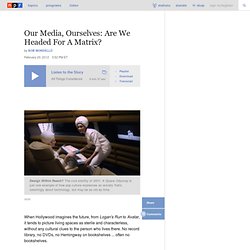
The cool sterility of 2001: A Space Odyssey is just one example of how pop culture expresses an anxiety that's seemingly about technology, but may be as old as time. When Hollywood imagines the future, from Logan's Run to Avatar, it tends to picture living spaces as sterile and characterless, without any cultural clues to the person who lives there. No record library, no DVDs, no Hemingway on bookshelves ... often no bookshelves. And here we are, catching up to that vision of the future. Sales of physical books dropped 30 percent last year, while e-book sales more than doubled. A MESSAGE FOR ALL OF HUMANITY ~ Charlie Chaplin. America's Youth Uprising. The renewal of labor militancy and radical politics is being led by a rising generation with its own rock-and-rap passion.

Protesters at the state Capitol in Madison, Wis., Sunday, Feb. 27, 2011, during a demonstration to oppose the governor's bill to eliminate collective bargaining rights for many state workers. (AP Photo/Andy Manis) This essay is adapted from John Nichols’s Uprising: How Wisconsin Renewed the Politics of Protest, From Madison to Wall Street, published in February by Nation Books. "Dalai Lama Renaissance" Documentary (with Harrison Ford) #1. Who’s Really Violent? Tips for Controlling the Narrative. Occupy Wall Street is similar to many movements in contending that its opponent—for Occupy, the 1 percent—is maintaining a system whose structural, systematic violence far exceeds any violence exhibited by the movement itself.
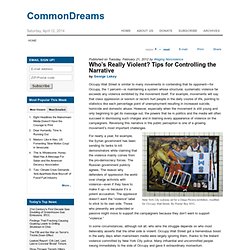
For example, movements will say that class oppression or sexism or racism hurt people in the daily course of life, pointing to statistics like each percentage point of unemployment resulting in increased suicide, homicide and domestic abuse. However, especially when the movement is still young and only beginning to get its message out, the powers that be in politics and the media will often succeed in dismissing such charges and in blaming every appearance of violence on the campaigners. Reversing this narrative in the public perception is one of a growing movement’s most important challenges. New York City subway ad for a Diego Rivera exhibition, modified for Occupy Wall Street. By Poster Boy NYC. Rebecca Solnit, Why the Media Loves the Violence of Protesters and Not of Banks.
Resiliency Part VII: Building Your Children’s Resiliency. If - Rudyard Kipling. Applied Hope. Amory Lovins2/21/12 The early bioneer Bill McLarney was stirring a vat of algae in his Costa Rica research center when a brassy North American lady strode in.
The Triumph of the Commons: 55 Theses on the Future. Pancho Ramos Stierle: Nonviolence Is Radical by Sarah van Gelder. An interview with the activist who made headlines when he was arrested while meditating at Occupy Oakland. posted Feb 23, 2012 Pancho Ramos was arrested while meditating when police raided the Occupy Oakland encampment in November 2011.

Painter Ly Vũ Hoàng based her work on press photos of the arrest. Painting used by permission of the artist. The Self-Attribution Fallacy. If wealth was the inevitable result of hard work and enterprise, every woman in Africa would be a millionaire.
The claims that the ultra-rich 1 per cent make for themselves – that they are possessed of unique intelligence or creativity or drive – are examples of the self-attribution fallacy. This means crediting yourself with outcomes for which you weren’t responsible. Many of those who are rich today got there because they were able to capture certain jobs. This capture owes less to talent and intelligence than to a combination of the ruthless exploitation of others and accidents of birth, as such jobs are taken disproportionately by people born in certain places and into certain classes.
The findings of the psychologist Daniel Kahneman, winner of a Nobel economics prize, are devastating to the beliefs that financial high-fliers entertain about themselves. Such results have been widely replicated. So much for the financial sector and its super-educated analysts. Ira Glass on Storytelling.