
Geoff Lawton Speaks at TEDx in the UAE Permaculture Research Institute. Dave Jacke. Jean Pain. Jean Pain (12 December 1928 – 30 July 1981) was a Swiss-born[1] French inventor and innovator who developed a compost-based bioenergy system that produced 100% of his energy needs.
He heated water to 60 degrees Celsius (140 degrees Fahrenheit) at a rate of 4 litres per minute (0.88 imp gal/min; 1.1 US gal/min) which he used for washing and heating. He also distilled enough methane to run an electricity generator, cooking elements, and power his truck. This method of creating usable energy from composting materials has come to be known as "Jean Pain Composting", or the "Jean Pain Method". Personal life[edit] Jean and his wife, Ida, lived near Domaine des Templiers, on a 241-hectare (596-acre) timber tract near the Alpes de Provence. Jean Pain Composting[edit] Pain's compost power plant supplied 100% of Jean and Ida's rural household's energy needs. It took about 90 days to produce 500 cubic metres (18,000 cu ft) of gas - enough to keep two ovens and three burner stoves going for a year. Peter Bane & Keith Johnson. David Holmgren. David Holmgren (born 1955) is an Australian environmental designer, ecological educator and writer.
He is best known as one of the co-originators of the permaculture concept with Bill Mollison. Life and work[edit] Holmgren was born in the state of Western Australia to political parents who were very active in the movement against Australia's involvement in the Vietnam war. Political activism against injustice provided a background to his own life's work with Permaculture as positive environmental activism. (ref Permaculture pioneers) After graduating from John Curtin High School (Academic dux 1972) he spent a year hitch hiking around Australia which exposed him to the first wave of "Back To The Land" rural resettlement. I wrote the manuscript, which was based partly on our constant discussions and on our practical working together in the garden and on our visits to other sites in Tasmania... The book was a mixture of insights relating to agriculture, landscape architecture and ecology. Masanobu Fukuoka. Masanobu Fukuoka (福岡 正信?)
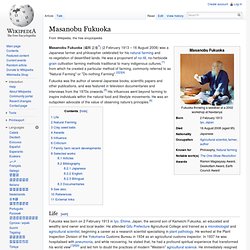
(2 February 1913 – 16 August 2008) was a Japanese farmer and philosopher celebrated for his natural farming and re-vegetation of desertified lands. He was a proponent of no-till, no-herbicide grain cultivation farming methods traditional to many indigenous cultures,[1] from which he created a particular method of farming, commonly referred to as "Natural Farming" or "Do-nothing Farming".[2][3][4] Fukuoka was the author of several Japanese books, scientific papers and other publications, and was featured in television documentaries and interviews from the 1970s onwards.[5] His influences went beyond farming to inspire individuals within the natural food and lifestyle movements. He was an outspoken advocate of the value of observing nature's principles.[6] Bill Mollison. Bruce Charles 'Bill' Mollison (born 1928 in Stanley, Tasmania, Australia) is a researcher, author, scientist, teacher and Biologist.
He is considered to be the 'father of permaculture',[1] however Joseph Russell Smith, was the first to write about a system of Permanent Agriculture in a book entitled Tree Crops, published in 1929.[2] Permaculture is an integrated system of design, Mollison co-developed with David Holmgren, that encompasses not only agriculture, horticulture, architecture and ecology, but also economic systems, land access strategies and legal systems for businesses and communities.
In 1978, Mollison collaborated with David Holmgren, and they wrote a book called Permaculture One. Bill Mollison founded The Permaculture Institute in Tasmania, and created a training system to train others under the umbrella of Permaculture. He received the Right Livelihood Award in 1981 with Patrick van Rensburg. Bibliography[edit] Articles Mollison, Bill (15–21 September 1978). Sepp Holzer.
Josef "Sepp" Holzer (born July 24, 1942 in Ramingstein, Province of Salzburg, Austria) is a farmer, author, and an international consultant for natural agriculture.
After an upbringing in a traditional Catholic rural family, he took over his parents' mountain farm business in 1962 and pioneered the use of ecological farming, or permaculture, techniques at high altitudes (1100 to 1500 meters above sea level)[1] after being unsuccessful with regular farming methods. Holzer was called the "rebel farmer" because he persisted, despite being fined and even threatened with prison,[2] with practices such as not pruning his fruit trees (unpruned fruit trees survive snow loads that will break pruned trees).[3] He has created some of the world's best examples of using ponds as reflectors to increase solar gain for Passive solar heating of structures, and of using the microclimate created by rock outcrops to effectively change the hardiness zone for nearby plants.
See also[edit]