
Bohemia. Coordinates: Bohemia (Czech: Čechy;[1] German: Böhmen ; Polish: Czechy; French: Bohême; Latin: Bohemia) is a historical country of Central Europe, occupying the western two-thirds of the traditional Czech lands.
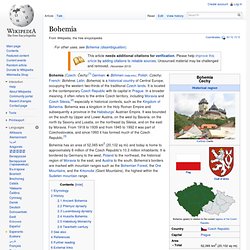
It is located in the contemporary Czech Republic with its capital in Prague. In a broader meaning, it often refers to the entire Czech territory, including Moravia and Czech Silesia,[2] especially in historical contexts, such as the Kingdom of Bohemia. Bohemia was a kingdom in the Holy Roman Empire and subsequently a province in the Habsburgs’ Austrian Empire. Etymology[edit] History[edit] Ancient Bohemia[edit] Bohemia, like neighbouring Bavaria, is named after the Boii tribe, who were a large Celtic nation known to the Romans for their invasion and settlement in northern Italy. The 9th century was crucial for the future of Bohemia. Přemysl dynasty[edit] The Coat of arms of the Bohemian King and Kingdom. Luxembourg dynasty[edit]
Písek. Old houses in city center Písek (Czech pronunciation: [ˈpiːsɛk]; German: Pisek) is a middle-sized town in the South Bohemian Region of the Czech Republic.
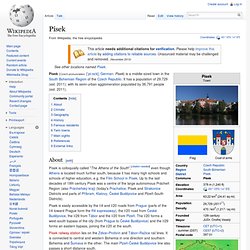
It has a population of 29,729 (est. 2011); with its semi-urban agglomeration populated by 36,791 people (est. 2011). About[edit] Písek is colloquially called "The Athens of the South",[citation needed] even though Athens is located much further south, because it has many high schools and schools of higher education, e.g. the Film School in Písek. Up to the last decades of 19th century Písek was a centre of the large autonomous Prácheň Region (also Prácheňský kraj) (today's Prachatice, Písek and Strakonice Districts and parts of Příbram, Klatovy, České Budějovice and Plzeň-South Districts). Písek railway station lies on the Zdice–Protivín and Tábor–Ražice rail lines. Climate[edit] The climate in Písek is known to have a milder and drier microclimate because it is well protected from all sides against winds. Unearthing Bohemia's Celtic heritage ahead of Samhain, the 'New Year'
The first recorded name for Bohemia has its roots in the Celtic word 'Boiohaemum', meaning home of the Boii people, a Celtic tribe which settled in Central Europe centuries before the Slavic peoples arrived.
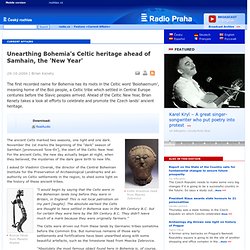
Ahead of the Celtic New Year, Brian Kenety takes a look at efforts to celebrate and promote the Czech lands' ancient heritage. Celtic limestone head from Msecke Zebrovice The ancient Celts marked two seasons, one light and one dark. November the 1st marks the beginning of the "dark" season of Samhain [pronounced 'Sow-En'], the start of the Celtic New Year. For the ancient Celts, the new day actually began at night, when they believed, the mysteries of the dark gave birth to new life. I asked Dr Vladimir Ctverak, the director of the Central Bohemian Institute for the Preservation of Archaeological Landmarks and an authority on Celtic settlements in the region, to shed some light on the history of these ancient tribes. To learn more about the project, please see www.celticeurope.cz. Boii. Map showing the approximate location of the Boii in Bohemia and in Italy.

The contemporary La Tène Culture is indicated in green tones, the preceding Hallstatt Culture in yellow. The Boii (Latin plural, singular Boius; Greek Βόϊοι) were a Gallic tribe of the later Iron Age, attested at various times in Cisalpine Gaul (northern Italy), Pannonia (Hungary and its western neighbours), in and around Bohemia (after whom the region is named in most languages), and Transalpine Gaul. In addition the archaeological evidence indicates that in the 2nd century BC Celts expanded from Bohemia through the Kłodzko Valley into Silesia, now part of Poland.[1] They first appear in history in connection with the Gallic invasion of north Italy, 390 BC, when they made the Etruscan city of Felsina their new capital, Bononia (Bologna). After a series of wars they were decisively beaten by the Romans in a battle near Mutina (Modena) and their territory became part of the Roman province of Cisalpine Gaul. HISTORY OF BOHEMIA.