SMRU. Welcome to whalesong.net. Home page of the International Whaling Commission. Society for Marine Mammalogy - Home. CIRCE - Conservation, Information & Research on Cetaceans. CIBRA - Interdisciplinary Center for Bioacoustics - University of Pavia. Rare Photographs of Extinct Animals. Last Thylacine yawning: Note the unusual extent to which it was able to open its jaws From panthers and pandas to rhinos and tigers, dwindling animal numbers speak of the need to step up conservation efforts – if it’s not already too late.
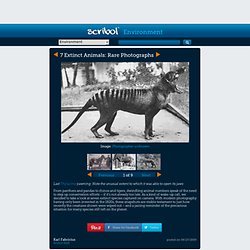
As a kind of wake-up call, we decided to take a look at seven extinct species captured on camera. With modern photography having only been invented in the 1820s, these snapshots are visible testament to just how recently the creatures shown were wiped out – and a jarring reminder of the precarious situation for many species still left on the planet. Karl Fabricius Scribol Staff.
Clouded leopard declared extinct in Taiwan. Ministry of Foreign Affairs, Republic of China (Taiwan) A Formosan cloud leopard, now extinct in Taiwan.
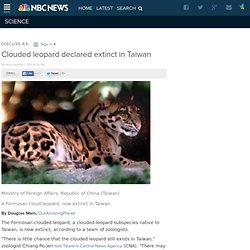
By Douglas Main, OurAmazingPlanet The Formosan clouded leopard, a clouded-leopard subspecies native to Taiwan, is now extinct, according to a team of zoologists. "There is little chance that the clouded leopard still exists in Taiwan," zoologist Chiang Po-jen told Taiwan's Central News Agency (CNA). "There may be a few of them, but we do not think they exist in any significant numbers. " Zoologists from Taiwan and the United States have looked for the animal on and off since 2001, to no avail. Now, the only one left in the country is a stuffed specimen at the National Taiwan Museum, zoologist Liu Jian-nan told CNA. Tree of Life Web Project. The Tree of Life Web Project (ToL) is a collaborative effort of biologists and nature enthusiasts from around the world.
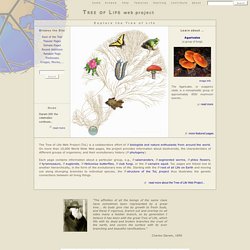
On more than 10,000 World Wide Web pages, the project provides information about biodiversity, the characteristics of different groups of organisms, and their evolutionary history (phylogeny). Each page contains information about a particular group, e.g., salamanders, segmented worms, phlox flowers, tyrannosaurs, euglenids, Heliconius butterflies, club fungi, or the vampire squid. ToL pages are linked one to another hierarchically, in the form of the evolutionary tree of life. Starting with the root of all Life on Earth and moving out along diverging branches to individual species, the structure of the ToL project thus illustrates the genetic connections between all living things.
Home » Marine Conservation Institute. Global biodiversity information facility. Try out the new GBIF portal!
Why not try out the new GBIF portal at www.gbif.org, which has many more features and includes lots of information about the GBIF community, including great examples of data uses in research and interesting applications? The old GBIF data portal which you are viewing now will continue to be supported until we are satisfied it can be taken down without causing major inconvenience. Be aware that the content here is static and has not been updated since the launch of the new portal on 9 October 2013. If and when a date is confirmed for discontinuing the old data portal, we will post it here with plenty of prior notice. Welcome to the (former) GBIF Data Portal Access 416,242,316 data records (363,215,360 with coordinates) shared via the GBIF network.
Explore Species. International Association for Impact Assessment. Ecological Footprint Quiz by Center for Sustainable Economy. Projecto Delfim. Tree of Life Web Project. Welcome to CITES. Home. CBD Home. IPIECA MGB - Home. The ARIES approach. Overview With growing interest in using ecosystem services for decision making, demand has grown for systematic methods and tools to quantify ecosystem service values.
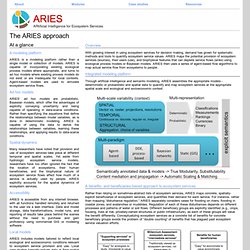
ARIES maps the potential provision of ecosystem services (sources), their users (use), and biophysical features that can deplete service flows (sinks) using ecological process models or Bayesian models. ARIES then uses a series of agent-based flow algorithms to map actual service flow from ecosystems to people. Emergency and Disaster Information Service. ADW: Home. HERMES: Hotspot Ecosystem Research on the Margins of European Seas. HERMES - an international, multidisciplinary research programme investigating Europe's deep marine ecosystems and their environment Funded by the European Commission, HERMES brought together expertise in biodiversity, geology, sedimentology, physical oceanography, microbiology and biogeochemistry so to better understand the relationships between biodiversity and ecosystem functioning.
HERMES study sites extend from the Arctic to the Black Sea and include biodiversity hotspots such as cold seeps, cold-water coral mounds and reefs, canyons and anoxic environments, and communities found on open slopes. These important systems were chosen as a focus for research due to their possible biological fragility, unique genetic resources, global relevance to carbon cycling and susceptibility to global change and human impact. HERMES started work in April 2005, and ran for 4 years, with completion in March 2009. CBD Home. Intergovernmental Science-Policy Platform on Biodiversity and Ecosystem Services (IPBES)