
Numéro spécial International Journal : The Arctic is Hot. Part II - Institut d'études internationales de Montréal (IEIM) RIA Novosti. Crowdsourcing and Crowdfunding - The Industry Website. Government of Greenland. Ice and Water Data. Sikunews. News - BarentsObserver. Nordregio. Arctic Portal.
Éducation populaire à l'environement. #CLIMAT et ENVIRONNEMENT. The girl who silenced the world for 5 minutes. Informations aux laboratoires - Bourses et Postdocs. Offre contrat post-doctoral junior, pour Projet "Hatemeter ": Prévenir et combattre le racisme, la xénophobie et d'autres formes d'intolérance sur internet La Maison des Sciences de l'Homme et de la Société (MSHS-T) et son antenne à Ut1 Capitole recrute une, un, jeune chercheure, chercheur junior, temporaire à la croisée des sciences sociales et des « digital/computational studies » (niveau postdoctoral) pour une période de 12 mois pour aider à produire, mettre en oeuvre et évaluer un outil destiné à réguler les discours de haine en ligne dans le cadre du projet interdisciplinaire dénommé Hatemeter.
Arctic Studies. Global Carbon Emissions. Global CO2 Budget 2013 GlobalCarbonProject.org posted data for the 2013 Global Carbon Budget on November 20, 2013.

Key findings are listed here: *Global emissions due to fossil fuel alone are set to grow in 2013 at a slightly lower pace of 2.1% than the average 3.1% since 2000, reaching a level that is 61% above emissions in 1990 *Growth rates for major emitter countries in 2012 were 5.9% (China), −3.7% (USA), −1.3% (EU28), and 7.7% (India). *The 2012 carbon dioxide emissions breakdown is coal (43%), oil (33%), gas (18%), cement (5.3%) and gas flaring (0.6%). *Atmospheric carbon dioxide levels increased in 2012 at a faster rate than the average over the past 10 years because of a combination of continuing growth in emissions and a decrease in land carbon sinks from very high levels in the previous two years. * Dr.
*Key Sources: GlobalCarbonBudget.org CDIAC 2013 Global Carbon Budget >>>> Links to the source data, credits and high-resolution images are given below. CO2Now.org | Download >>> Climate Change Math in Treaties Flawed by Suspect Calculations. Euan Nisbet, a University of London earth sciences professor who has traveled the world testing the air for greenhouse-gas pollution, makes his way to a rocky outcropping on the eastern coast of Hong Kong Island on a sunny November afternoon.

He takes out a battery-operated pump connected to a thin tube and a plastic bag to capture traces of the wind. “This is a good day for collecting samples,” says Nisbet, 61, looking out to sea. “There’s a good, strong breeze blowing in from the mainland. It’s the breath of China.” Hooking up his air-sucking device, Nisbet says the world puts too much faith in government estimates of carbon dioxide, methane and other heat-trapping gases blamed for climate change, Bloomberg Markets magazine reports in its January issue. “We’re counting all the calories, believing the bottom-up calculations are right and not making any effort to test by getting on the scale.”
How Do We Measure? ‘Centuries or Millennia’ ‘Fault Lines’ Cap and Trade. How the Carbon Dioxide Budget Trading Program Works. Skip to main navigation Reducing CO2 Emissions Establishing and lowering emissions caps.

RGGI participating states agreed upon a cap (regional CO2 emissions budget) amounting to approximately 188 million tons of CO2. That number is the total amount of CO2 that power plants in the region were expected to emit in 2009. Beginning in 2015, this cap will be reduced by 2.5 percent each year, for a total reduction of 10 percent by 2019. Supporting Clean Energy Establishing and distributing allowances. Carbon Dioxide Information Analysis Center (CDIAC) - Frequently Asked Questions. This page lists global change questions that have been received at CDIAC and the answers that were provided to a diverse audience.

If you have a question relating to carbon dioxide and global change and cannot find the answer you need here, you may "Ask Us a Question", and we will be glad to try and help you. Q. Should we grow trees to remove carbon in the atmosphere? A. Carbon cycle. This diagram of the fast carbon cycle shows the movement of carbon between land, atmosphere, and oceans in billions of tons of carbon per year.
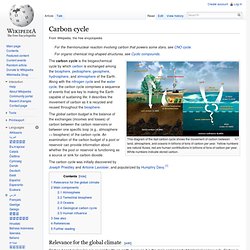
Yellow numbers are natural fluxes, red are human contributions in billions of tons of carbon per year. White numbers indicate stored carbon. The carbon cycle is the biogeochemical cycle by which carbon is exchanged among the biosphere, pedosphere, geosphere, hydrosphere, and atmosphere of the Earth. Along with the nitrogen cycle and the water cycle, the carbon cycle comprises a sequence of events that are key to making the Earth capable of sustaining life; it describes the movement of carbon as it is recycled and reused throughout the biosphere. The global carbon budget is the balance of the exchanges (incomes and losses) of carbon between the carbon reservoirs or between one specific loop (e.g., atmosphere ↔ biosphere) of the carbon cycle. Emissions trading. A coal power plant in Germany.
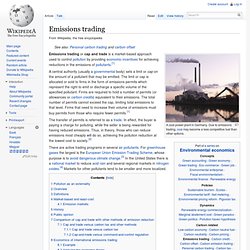
Due to emissions trading, coal may become a less competitive fuel than other options. CMP7 - About COP17/CMP7 - UN Convention on Climate Change (UNFCCC) In 1992, the United Nations Framework Convention on Climate Change (UNFCCC) sets an overall framework for intergovernmental efforts to address climate change.

It is called a framework convention because it is seen as a starting point of addressing the problem of climate change. The Convention entered into force on 21 March 1994. The ultimate objective of the Convention is “to stabilise greenhouse gas concentrations at a level that will prevent dangerous human interference with the climate system”. gather and share information on greenhouse gas emissions, national policies and best practices; launch national strategies for addressing greenhouse gas emissions and adapting to expected impacts, including the provision of financial and technological support to developing countries; and cooperate in preparing for adaptation to the impacts of climate change. For more information:www.unfccc.int. IPCC - Intergovernmental Panel on Climate Change.