
Can You Boost Your Self-Control? As far as examples of willpower go, one of the most impressive you'll ever find is the "incredible Buddha boy"chronicled in GQ a few years back by George Saunders.

The boy had been meditating under a tree for seven months, evidently without food or water. It was a display of self-control so haunting that readers couldn't help but wonder how such a person could exist while the rest of us find it so hard--really, impossible--to rise from the couch and go to the gym, or read a book, or in some cases just reach the remote.
The prevailing scientific wisdom says that people operate with a finite supply of self-control. In an insta-classic study from the 1990s, psychologists found that test participants who pushed themselves to suppress a thought for six minutes subsequently gave up more quickly on an unsolvable anagram than those who came into the puzzle fresh. Exerting self-control on an initial task evidently drained people of persistence for a second one. [Image: Lazy boy via Shutterstock] Could boredom be curable? - Ideas. Philip Zimbardo prescribes a healthy take on time. Philip Zimbardo shows how people become monsters ... or heroes. July/August 2011 > Features > Stanford Prison Experiment. What happened in the basement of the psych building 40 years ago shocked the world.

How do the guards, prisoners and researchers in the Stanford Prison Experiment feel about it now? It began with an ad in the classifieds. Male college students needed for psychological study of prison life. $15 per day for 1-2 weeks. The Power of Conformity_mpeg2video.mpg. Psychology studies relevant to everyday life - PsyBlog.
The Ten Most Revealing Psych Experiments. Psychology is the study of the human mind and mental processes in relation to human behaviors - human nature.

Due to its subject matter, psychology is not considered a 'hard' science, even though psychologists do experiment and publish their findings in respected journals. Some of the experiments psychologists have conducted over the years reveal things about the way we humans think and behave that we might not want to embrace, but which can at least help keep us humble. That's something. 1. 10 Brilliant Social Psychology Studies. Ten of the most influential social psychology experiments.
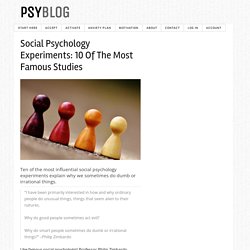
“I have been primarily interested in how and why ordinary people do unusual things, things that seem alien to their natures.Why do good people sometimes act evil? 10 More Brilliant Social Psychology Studies: Why Smart People Do. Many of whom take a moral high ground. 2009 may well be remembered for its scandal-ridden headlines, from admissions of extramarital affairs by governors and senators, to corporate executives flying private jets while cutting employee benefits, and most recently, to a mysterious early morning car crash in Florida.
The past year has been marked by a series of moral transgressions by powerful figures in political, business and celebrity circles. New research from the Kellogg School of Management at Northwestern University explores why powerful people - many of whom take a moral high ground - don't practice what they preach. Researchers sought to determine whether power inspires hypocrisy, the tendency to hold high standards for others while performing morally suspect behaviors oneself. 10 Practical Uses For Psychological Research in Everyday Life. People love to give each other advice.
The web is full to bursting with all types of pseudo-psychological advice about life. The problem is, how much of this is based on real scientific evidence? Well, here on PsyBlog we’ve got the scientific evidence. So here’s my top 10 list of what you can learn practically from the psychological research discussed here recently. 1. 2. 3. 4. 5. 6. 7. 8. 9. 10. Asch Experiment - Conformity in Groups. The Asch Experiment, by Solomon Asch, was a famous experiment designed to test how peer pressure to conform would influence the judgment and individuality of a test subject.
The experiment is related closely to the Stanford Prison and Milgram Experiments, in that it tries to show how perfectly normal human beings can be pressured into unusual behavior by authority figures, or by the consensus of opinion around them. For the experiment, eight subjects were seated around a table, with the seating plan carefully constructed to prevent any suspicion. Only one participant was actually a genuine subject for the experiment, the rest being confederates, carefully tutored to give certain pre-selected responses. Careful experimental construction placed a varying amount of peer pressure on the individual test subject. The experiment was simple in its construction; each participant, in turn, was asked to answer a series of questions, such as which line was longest or which matched the reference line.
Introducing "enclothed cognition" - how what we wear affects how we think. Whether donning a suit for an interview or a sexy outfit for a date, it's obvious that most of us are well aware of the power of clothing to affect how other people perceive us.

But what about the power of our clothes to affect our own thoughts? Relevant to this question is the growing "embodied cognition" literature showing that the position and state of our bodies can affect our thoughts - for example, cleaning their hands makes people feel morally purer. In a new study Hajo Adam and Adam Galinsky propose that clothes can have similar effects on our thoughts - a phenomenon they call "enclothed cognition".