
FiveThirtyEight. Creatures avoiding planks. The Sense of Confidence during Probabilistic Learning: A Normative Account. The Open Source Data Science Masters. How to Become a Data Scientist for Free. 600 Free eBooks for iPad, Kindle & Other Devices. Download 800 free eBooks to your Kindle, iPad/iPhone, computer, smart phone or ereader.

Collection includes great works of fiction, non-fiction and poetry, including works by Asimov, Jane Austen, Philip K. Dick, F. Scott Fitzgerald, Neil Gaiman, Tolstoy, Dostoevsky, Shakespeare, Ernest Hemingway, Virginia Woolf & James Joyce. Also please see our collection 1,000 Free Audio Books: Download Great Books for Free, where you can download more great books to your computer or mp3 player. Learn how to load ebook (.mobi) files to your Kindle with this video Religious Texts. Extracting-paraphrases-from-twitter.pdf. Mcb80x. A Master List of 1,000 Free Courses From Top Universities: 30,000 Hours of Audio/Video Lectures.
Cognitive Science. Topic Editors: Wolfgang Ambach, Institute for Frontier Areas of Psychology and Mental Health (IGPP), Germany Matthias Gamer, University Medical Center Hamburg-Eppendorf, Germany Submission Closed.
This action requires you to be registered with Frontiers and logged in. You Can Now Access All Of Richard Feynman's Physics Lectures For Free. PsycNET - Display Record. What Predicts Success? It's Not Your IQ. True Grit: The Best Measure of Success and How to Teach It. Can you predict academic success or whether a child will graduate?

10 tips for better slide decks. Aaron created this slide deck for a recent presentation on how TED’s tech team avoids problems by preparing well for all the possible pitfalls.

He picked this stunning image—of a container ship about to tip—to begin it. View the whole slidedeck from this presentation. Aaron Weyenberg is the master of slide decks. How to make SPSS produce all tables in APA format automatically! — Stats Make Me Cry. Within the "Table Properties" screen, we are going to adjust elements of both the "Cell Formats" tab (above) and the "Borders" tab ([1] below).
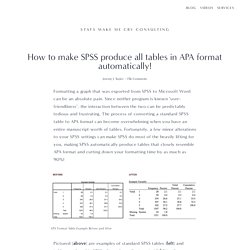
First, the "Cell Formats" tab (above): On the "Cell Formats" screen, you are able to adjust: the tables "Text" (font), the "Alignment" (justifications) of the text, the background color (which we will not be adjusting), and the "Inner Margins". We will only be changing the "Text" and "Alignment" settings. We'll deal with the "Text" first. The default of all text in SPSS tables is 8 pt ([4] above), while the appropriate APA format font is 12 point, so the first thing we'll need to to is change all of the text in the table from 8 pt ([4] above) to 12 pt. Unfortunately, you are required to change each text element separately by either clicking on the element in the "Sample" table on the right side of the screen ([1] above), or by selecting different elements in the "Area" drop-down menu ([2] above).
Six Famous Thought Experiments, Animated in 60 Seconds Each. By Maria Popova From the fine folks at the Open University comes 60-Second Adventures in Thought, a fascinating and delightfully animated series exploring six famous thought experiments.

The Paradox of the Tortoise and Achilles comes from Ancient Greece and explores motion as an illusion: The Grandfather Paradox grapples with time travel: Chinese Room comes from the work of John Searle, originally published in 1980, and deals with artificial intelligence: Scrivener Writing Software. Would Like To Teach. Be a better writer in 15 minutes: 4 TED-Ed lessons on grammar and word choice.
There’s no denying it — the English language can be mighty tricky.

When writing a paper, a novel or even an e-mail, you might look at a sentence you just wrote and think, “Is that comma supposed to be there?” Or “Is that really the best word to use?” Fear not! TED-Ed has put together a list of four of our favorite grammar and language lessons to get your next piece of writing in tip-top shape.
Experimental evidence of massive-scale emotional contagion through social networks. Author Affiliations Edited by Susan T.
Fiske, Princeton University, Princeton, NJ, and approved March 25, 2014 (received for review October 23, 2013) Facebook altered 689,000 users' News Feeds for a psychology experiment. According to new paper in the Proceedings of the National Academy of Science, Facebook altered the News Feeds for hundreds of thousands of users as part of a psychology experiment devised by the company's on-staff data scientist.
By scientifically altering News Feeds, the experiment sought to learn about the way positive and negative effect travels through social networks, ultimately concluding that "in-person interaction and nonverbal cues are not strictly necessary for emotional contagion. " "Each emotional post had between a 10% and 90% chance...of being omitted. " To test the hypothesis, the researchers identified 689,003 different English-language Facebook users, and began removing emotionally negative posts for one group and positive posts for another. Cognitive Biases. Effects of mindfulness and distraction on pain de... [Eur J Pain. 2014] Babies Learning Language: Shifting our cultural understanding of replication.
Tl;dr - I agree that replication is important – very important!
But the way to encourage it as a practice is to change values, not to shame or bully. 5 Communication Skills that Open People’s Minds. "Those People" We are at a crossroads. We face many important problems in our world, in our country, and in our personal lives. Now THIS Is a Synapse. Every time I read about the synapse, the all-important junction between two neurons, the cartoon above pops into my head. It shows the gist of how a synapse works: An electrical pulse enters the cell on the left and activates those little blue balls, called vesicles, to release their chemical contents, called neurotransmitters.
The neurotransmitters spill out into the space between the cells, called the cleft, and activate those blue rectangles, called ion channels. The channels trigger the cell on the right to fire its own electrical pulse, or action potential, and this message travels on to the next cell. It’s pretty neat. Oral approach-avoidance: Affective conseq... [J Pers Soc Psychol. 2014] 10 Epic Lessons Derren Brown Taught Us About Life. Derrenbrown.co.uk. Evaluate yourself: Meta analyses from promoters of treatments. Hello there! If you enjoy the content on Mind the Brain, consider subscribing for future posts via email or RSS feed. The Metropolitan Museum of Art Puts 400,000 High-Res Images Online & Makes Them Free to Use. On Friday, The Metropolitan Museum of Art announced that "more than 400,000 high-resolution digital images of public domain works in the Museum’s world-renowned collection may be downloaded directly from the Museum’s website for non-commercial use.
" SP2014.special_issue.pdf. Reflecting on Work Improves Job Performance. Things that correlate. Kidding ourselves on educational interventions? Journals, especially high-impact journals, are notorious for not being interested in publishing replication studies, especially those that fail to obtain an interesting result. The Control Group Is Out Of Control. Allan Crossman calls parapsychology the control group for science. [20] We cannot afford to study effect size in the lab. 290 Bites podcast interviews arranged by theme. Dementia Facebook app to raise awareness of the illness. 28 April 2014Last updated at 19:32 ET. How to Criticize with Kindness: Philosopher Daniel Dennett on the Four Steps to Arguing Intelligently.
Using TED-Ed to Create Mini Lessons. Interpreting Cohen's d effect size. Scientific method: Statistical errors. The 101 Most Useful Websites on the Internet. What scientific idea is ready for retirement? How to Get a(n academic) Job: Applications. The Numbers Tell It All: Students Don't Like Numbers! Take college and university courses online completely free. Policy: Twenty tips for interpreting scientific claims. The Science of Smart: Forget About Learning Styles, Here's Something Better. Children are suffering a severe deficit of play – Peter Gray.
15 of Psychology’s Greatest Masterpieces. How do we deal with unwilling corporate learners? How to break into science writing using your blog and social media (#sci4hels) Overview of statistics. 10 Important Differences Between Brains and Computers – Developing Intelligence. Cognitive Science Movie Index. 13 Free Web Tools Students and Teachers Should Know About. First Words. "Just a Theory": 7 Misused Science Words. How to read and understand a scientific paper: a guide for non-scientists. The Tyrion Lannister Paradox: How Small Effect Sizes can be Important.
How being called smart can actually make you stupid. 50 Questions About Messy Rooms and Clean Data. Like, You Know? An Illustrated Book of Bad Arguments. Why public dissemination of science matters. Halpern Critical Thinking Assessment - Diane Halpern. Real Life PhD Student- jobs.ac.uk career blog. Randomise Me. Just the Facts? - Do Your Job Better. The myth of learning styles. 7 Academic Search Engines Not Named Google. Brain Atlas - 3D Brain Model of Anatomy & Injuries. Yale University - Psychology 131 - Human Emotion. Journal of Applied Research in Higher Education. How not to write a PhD thesis. Neil deGrasse Tyson Lists 8 (Free) Books Every Intelligent Person Should Read. 700 Free Online Courses from Top Universities.