
Thomas Carlyle. Thomas Carlyle: Sitemap. Charles Dickens. Poor Law Amendment Act 1834. The Amendment Act was passed two years after the 1832 Reform Act extended the franchise to the middle-classes.
Ralph Waldo Emerson. Ralph Waldo Emerson (May 25, 1803 – April 27, 1882) was an American essayist, lecturer, and poet, who led the Transcendentalist movement of the mid-19th century.
The Correspondence of Thomas Carlyle and Ralph Waldo Emerson, 1834-1872, Vol II. The Correspondence of Thomas Carlyle and Ralph Waldo Emerson, 1834-1872, Vol. I. Transcendentalism. Transcendentalism is a religious and philosophical movement that developed during the late 1820s and '30s[1] in the Eastern region of the United States as a protest against the general state of spirituality and, in particular, the state of intellectualism at Harvard University and the doctrine of the Unitarian church as taught at Harvard Divinity School.
Among the transcendentalists' core beliefs was the inherent goodness of both people and nature. They believe that society and its institutions—particularly organized religion and political parties—ultimately corrupt the purity of the individual. They have faith that people are at their best when truly "self-reliant" and independent. It is only from such real individuals that true community could be formed. History[edit] Origins[edit] Transcendentalism is closely related to Unitarianism, the dominant religious movement in Boston at the early nineteenth century.
Emerson's Nature[edit] John Stuart Mill. John Stuart Mill, FRSE (20 May 1806 – 8 May 1873) was an English philosopher, political economist and civil servant.
He was an influential contributor to social theory, political theory and political economy. Utilitarianism. Utilitarianism is influential in political philosophy.
Bentham and Mill believed that a utilitarian government was achievable through democracy. Mill thought that despotism was also justifiable through utilitarianism as a transitional phase towards more democratic forms of governance. As an advocate of liberalism, Mill stressed the relationship between utilitarianism and individualism.[10] Historical background[edit] Past and Present (book) Past and Present is a book by Thomas Carlyle.
It was published in April 1843 in England and the following month in the United States. It combines medieval history with criticism of 19th-century British society. Carlyle wrote it in seven weeks as a respite from the harassing labor of writing Cromwell. John Ruskin. John Ruskin (8 February 1819 – 20 January 1900) was the leading English art critic of the Victorian era, also an art patron, draughtsman, watercolourist, a prominent social thinker and philanthropist.
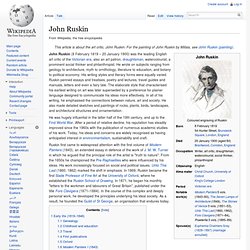
He wrote on subjects ranging from geology to architecture, myth to ornithology, literature to education, and botany to political economy. His writing styles and literary forms were equally varied. Ruskin penned essays and treatises, poetry and lectures, travel guides and manuals, letters and even a fairy tale. The elaborate style that characterised his earliest writing on art was later superseded by a preference for plainer language designed to communicate his ideas more effectively.
In all of his writing, he emphasised the connections between nature, art and society. John Ruskin (Sitemap) Unto This Last. "Unto This Last" is an essay on economy by John Ruskin, first published in December 1860 in the monthly journal Cornhill Magazine in four articles.
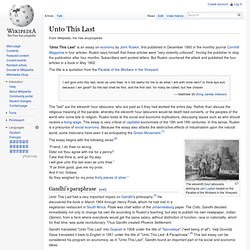
Ruskin says himself that these articles were "very violently criticized", forcing the publisher to stop the publication after four months. Subscribers sent protest letters. Mohandas Karamchand Gandhi. Mohandas Karamchand Gandhi (pronounced [ˈmoːɦənd̪aːs ˈkərəmtʃənd̪ ˈɡaːnd̪ʱi] ( ); 2 October 1869 – 30 January 1948) was the preeminent leader of Indian nationalism in British-ruled India.
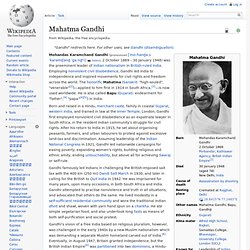
Employing nonviolent civil disobedience, Gandhi led India to independence and inspired movements for civil rights and freedom across the world. The honorific Mahatma (Sanskrit: "high-souled", "venerable"[2])—applied to him first in 1914 in South Africa,[3]—is now used worldwide. He is also called Bapu (Gujarati: endearment for "father",[4] "papa"[4][5]) in India. On Heroes, Hero-Worship, and The Heroic in History. It is a collection of six lectures give in May 1840. 1. (5 May) The Hero as Divinity.
Odin. Paganism: Scandinavian Mythology 2. (8 May) The Hero as Prophet. Muhammad: Islam. Great Man theory. Napoleon, a typical "great man" said to have determined an era Overview[edit] Friedrich Nietzsche. Friedrich Wilhelm Nietzsche (/ˈniːtʃə/[1] or /ˈniːtʃi/;[2] German: [ˈfʁiːdʁɪç ˈvɪlhɛlm ˈniːt͡sʃə]; 15 October 1844 – 25 August 1900) was a German philosopher, cultural critic, poet, composer and Latin and Greek scholar. He wrote several critical texts on religion, morality, contemporary culture, philosophy and science, displaying a fondness for metaphor[3] and irony.
Nietzsche's key ideas include perspectivism, the will to power, the death of God, the Übermensch and eternal recurrence. One of the key tenets of his philosophy is "life-affirmation", which embraces the realities of the world in which we live over the idea of a world beyond. Nietzsche began his career as a classical philologist—a scholar of Greek and Roman textual criticism—before turning to philosophy. Beyond Good and Evil. Beyond Good and Evil: Prelude to a Philosophy of the Future (German: Jenseits von Gut und Böse: Vorspiel einer Philosophie der Zukunft) is a book by philosopher Friedrich Nietzsche, first published in 1886. Übermensch. The Übermensch (German for "Overman, Overhuman, Above-Human, Superman, Super-human"; German pronunciation: [ˈˀyːbɐmɛnʃ]) is a concept in the philosophy of Friedrich Nietzsche.
Nietzsche had his character Zarathustra posit the Übermensch as a goal for humanity to set for itself in his 1883 book Thus Spoke Zarathustra (German: Also Sprach Zarathustra), although Nietzsche clearly disagreed with many things he had Zarathustra say. On Heroes and Hero Worship and the Heroic in History by Thomas Carlyle. Sartor Resartus.