
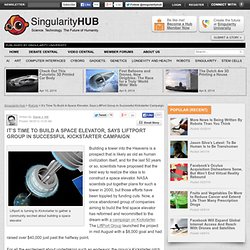
It’s Time To Build A Space Elevator, Says LiftPort Group In Successful Kickstarter Campaign. Liftport is turning to Kickstarter to gather a community excited about building a space elevator.
Cloned Horses Given Okay For Olympics – A New Era Of Cloned Competition? Tomorrow is built today. 10 ways technology will change travel by 2020. Warp Drive Engine Would Travel Faster Than Light. It is possible to travel faster than light.
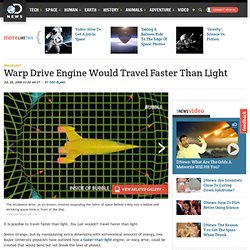
You just wouldn't travel faster than light. Seems strange, but by manipulating extra dimensions with astronomical amounts of energy, two Baylor University physicists have outlined how a faster-than-light engine, or warp drive, could be created that would bend but not break the laws of physics. All Watched Over by Machines of Loving Grace: Adam Curtis on How Technology Limits Us. By Maria Popova What Ayn Rand has to do with the Occupy movement.
Though the film has strong techno-dystopian undertones akin to the Orson-Welles-narrated Future Shock series of the 1970s and neglects how technology enables such powerful phenomena like networked knowledge and crowd-accelerated learning, it offers a dimensional context for many of our present political, economic, and technological givens. Coupled with Curtis’s signature immersive storytelling and exquisite use of historical materials, rare footage, and revealing soundbites, the series is an invaluable primer for much of today’s most pressing sociocultural issues. We are now living through a very strange moment. Future Shock: Techno-Paranoia Narrated by Orson Welles. By Maria Popova What the dawn of computing has to do with Herbie Hancock and humanoid robotics.
In 1970, sociologist and futurist Alvin Toffler, the Ray Kurzweil of his day, wrote a book entitled Future Shock, which proposed a certain distressing psychological state , induced by change so rapid the human mind can’t digest it, and introduced the notion of “information overload” for the first time. In 1972, the book, already a bestseller, was adapted into a little-known documentary of the same name, narrated by Orson Welles. Group Set To Sequence 1000 Genomes By The End Of The Year. Begun in 2008, the "1000 Genomes Project" aims to sequence 1000 genomes and gain a deeper understanding of what genetic variations may put people at risk for disease.
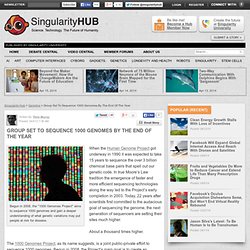
When the Human Genome Project got underway in 1990 it was expected to take 15 years to sequence the over 3 billion chemical base pairs that spell out our genetic code. In true Moore’s Law tradition the emergence of faster and more efficient sequencing technologies along the way led to the Project’s early completion in 2003. Today, 22 years after scientists first committed to the audacious goal of sequencing the genome, the next generation of sequencers are setting their sites much higher.
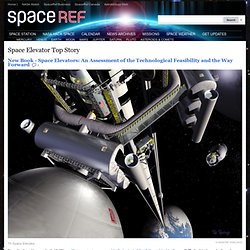
Beyond Binary Computing? IBM’s Watson Expands Commercial Applications, Aims to Go Mobile. The Space Elevator Reference. TEDx Talk: An Elevator to Space © Alan Chan Space Elevator and Earth.
Future of computing has Schrödinger’s cat inside. Editor's note: This article originally appeared on Reuters Opinion under the title "A Nobel that points us toward our quantum future.
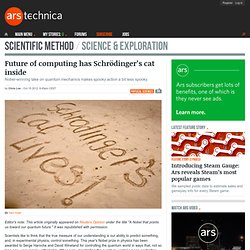
" It was republished with permission. Scientists like to think that the true measure of our understanding is our ability to predict something, and, in experimental physics, control something. Space lifts: A lunatic idea? Tracking light in, essentially, a tiny pinball machine. If you want to communicate a lot of information very fast and in a very short time, then you have to use light.
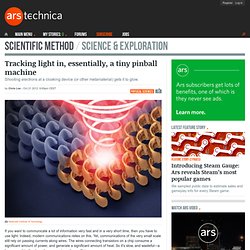
Indeed, modern communications relies on this. Yet, communications of the very small scale still rely on passing currents along wires. Space Elevator Science - Climb to the Sky - A Tethered Tower by Michael Laine. For further information about Earth’s Space Elevator, LiftPort Group’s Tethered Tower system or the Lunar Space Elevator Infrastructure, please visit us at www.LiftPort.com .
While you’re there, please stop by our forums – ask or answer a question! You might also want to look over LiftPort in the media; a long list of links can be found here. This campaign ended on the 50th Anniversary of President Kennedy's famous Moon Speech. LiftPort Group. New technique for nanostructure assembly. The grid of 2030: all renewable, 90 percent of the time. You've probably heard the argument: wind and solar power are well and good, but what about when the wind doesn't blow and the sun doesn't shine?
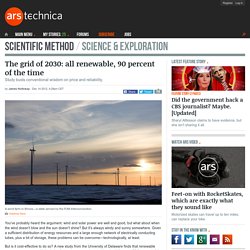
But it's always windy and sunny somewhere. Given a sufficient distribution of energy resources and a large enough network of electrically conducting tubes, plus a bit of storage, these problems can be overcome—technologically, at least. Gamers prove equal to surgeons in operating robotic surgery tools. Leo Reynolds A maternal nag familiar to the ears of many young gamers usually follows the lines of "you're wasting your life in front of a console. " Browbeaten controller wielders rejoice—a new study from the University of Texas Medical Branch (UTMB) has proven the superior hand-eye coordination skills honed from hours of joystick-based gaming are the same talents required to master the world's most advanced robotic surgery tools. The study sought to identify the developmental effect video games have on training future surgeons.
"A new era has started," explained Sami Kilic, lead author of the study and associate professor and director of minimally invasive gynecology at UTMB. Exclusive: 21 Proposals For A Better Future From Singularity U’s 2012 Class. GSP students of the Care9 team present their core innovation to transform global health. This year’s Graduate Studies Program (GSP) at Singularity University — the learning institution focused on future-shaping technologies — is wrapping up an intense 10-week summer. To celebrate, an expo event, including the Closing Ceremony, was held at the Computer History Museum.
The GSP is the biggest program that the University runs every year, filtering through over 3,000 applications to identify 80 students tasked with impacting the lives of a billion people in the next 10 years along eight grand challenges: education, global health, energy, environment, food, water, security, and poverty. Singularity U Launches 2012 Class: Bring On The Future! Last Friday evening, I had the pleasure of attending the Closing Ceremony of the Graduate Studies Program at Singularity University (SU). This event is the pinnacle of a marathon-like 10-week program, in which 80 of the most promising and talented individuals from 36 countries have been challenged to change the world. And the students did not disappoint.
Innovations in global health, emerging technologies, infrastructure, education, employment, and poverty were presented to the distinguished crowd, and no doubt many of these ideas will translate into real companies and movements in the coming years. Weekend Diversion: Be Safe, Be Free! Billboards and TVs Detect Your Face: Advertisers Salivate. As part of Plan UK's outreach campaign, advertisements played different messages to men and women. We Live in a Time. Chasing Moore's Law with 90-nm: More Than Just a Process Shrink. One and done: Single-atom transistor is end of Moore's Law; may be beginning of quantum computing. A controllable transistor engineered from a single phosphorus atom has been developed by researchers at the University of New South Wales, Purdue University and the University of Melbourne. The atom, shown here in the center of an image from a computer model, sits in a channel in a silicon crystal. The atomic-sized transistor and wires might allow researchers to control gated qubits of information in future quantum computers.
(Purdue University image) Download image. The future of computing power – from DNA hard drives to quantum chips. Future developments in nanotechnology are predicted to come from probing a scale one hundred times smaller than the cells in current silicon chips. Photograph: U. Bellhsuser/Getty Images/ScienceFoto RM It seems inconceivable that the floppy disk was once the flag-bearerfor digital storage devices. Space Colonization Basics. The Tyranny of the Rocket Equation. Audacious & Outrageous: Space Elevators. Inspired partly by science fiction, NASA scientists are seriously considering space elevators as a mass-transit system for the next century. Listen to this story (requires RealPlayer) Augmented Reality: Scanners, Gesture-Control, and High Precision 3D-Interaction. Handheld 3D Scanner Lets You Digitize Objects And Rooms In Minutes.
MatterPort handheld scanner allows you to scan a room and quickly render 3D maps. A Silicon Valley startup wants to give you the power to “scan your world” with a handheld scanner that rapidly creates 3D maps of objects and rooms, complete with colors and textures. Quadcopters Make 3D Scans Of Historic Buildings. Google gets the jump on better 3D maps with a “fleet of planes” Throwable Panoramic Ball Camera // Jonas Pfeil. What’s In A Picture? The Descriptive Camera Will Tell You. Facial Recognition Software Distinguishes Between Real And Phony Smiles. GDC: The Future of Graphics and Unreal Engine 3 - TBA Feature at IGN.
How close are we to truly photorealistic, real-time games? SOLAR IMPULSE - AROUND THE WORLD IN A SOLAR AIRPLANE. Sun Powers First Fueless Intercontinental Flight. TacoCopter – Tacos Delivered Straight to Your Home With GPS Guided Quadcopters. From D.C. To Beijing In 2 Hours – Evacuated Tube Transport Could Revolutionize How We Travel. PAL-V ONE – The Car-Plane That’s Easy To Fly And Cheap – We’re Kidding About The Cheap Part. Leap Motion gesture control technology hands-on. Founders of Leap Motion: Our Amazing 3D Tracking Will Be Everywhere. Kinect tech built into laptop prototypes. The Eye Tribe - Eye Control for Mobile Devices (formerly known as Senseye) Controlling a Computer with Your Eyes. Inventor Of Biochip That Makes 10,000 Simultaneous Measurements Wins “Oscar For Inventors” – And $500,000.
Awesome Video Explains Synthetic Biology. The 'chemputer' that could print out any drug. Future bio-nanotechnology will use computer chips inside living cells. How Sci-Fi Becomes Reality. Thomas Edison's To-Do List, 1888. French Polymath Henri Poincaré on How the Inventor's Mind Works, 1908. Great Aviation Quotes: Predictions of the Future. Five Human Achievements That Could Top Walking on the Moon. 23 incredible new technologies youll see by 2021. Raising the prospects for quantum levitation. Speech Jamming Gun From Japan Silences People From Up To 34 Meters Away.
Corrosion Control & Waterproof Coatings. Wireless Electricity Is Here (Seriously) SH Interviews Vernor Vinge – How Will We Get To The Technological Singularity? Internet History Timeline: ARPNET to the World Wide Web. Memorandum For Members and Affiliates of the Intergalactic Computer Network. Dead Media Beat: Minitel. ASCII by Jason Scott / GeoStupid. Kevin Kelly: Predicting The Next 5000 Days Of The Web. 640 Gbps - How Fast Can The Internet Get? How Fast Will Your Internet Be in 2020? New Surveillance System Identifies Your Face By Searching Through 36 Million Images Per Second. Face.com Brings Facial Recognition to the Masses, Now with Age Detection: Interview With CEO. Can Geeks Defeat Lies? Thoughts on a Fresh New Approach to Dealing With Online Errors, Misrepresentations, and Quackery. Willow Garage. iCub.org - an open source cognitive humanoid robotic platform. Meet The Author Of “Robots Will Steal Your Job, But That’s OK”
Robot Fails. The Next Revolution in Artificial Intelligence. International Journal of Social Robotics. Robo-Ethicists Want to Revamp Asimovs 3 Laws. On-Demand Robots From A 3D Printer. Flying Robotic Swarm of Nano Quadrotors Gets Millions of Views, New Company. Electroactive Polymers (EAP) as Artificial Muscles (EPAM) for Robot Applications. Plastic Muscles for Robots.
Programming.