
MIDI ON THE ROAD. Technique : Miscellaneous.

Daft Punk open up in exclusive interview with French magazine; ‘We make music for the fans’ As the release of “Random Access Memories” inches closer, the hype machine around Daft Punk‘s latest album continues to reach meteoric proportions.
Open Source Music. DJing Is Hard. Sometimes, even in the coolest of venues, it can all fall apart for the DJ.

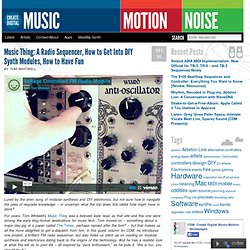
As I saw happen to one DJ recently… Pic: SoBoUK Ever felt utterly dejected with your DJing? Complete Works\by BWV Number-All. Skrillex: The $15 Million DJ. Music Thing: A Radio Sequencer, How to Get Into DIY Synth Modules, How to Have Fun. Lured by the siren song of modular synthesis and DIY electronics, but not sure how to navigate the piles of requisite knowledge – or uncertain what the trip down this rabbit hole might have in store?
Deadmau5 Shares His Modular Synthesizer Secrets Synthtopia. Moogfest - Mavericks of Sound Design Panel. Secrets Of Kitchen Music How To Turn Ordinary Stuff Into MIDI Controllers Synthtopia. How To Build A Custom MIDI Controller Synthtopia. The Hand-Cranked, Antique MIDI Sequencer (High-Res Images, Details) Music, ephemeral and fleeting, to many of us wants tangible embodiment, some physical sense of the tug we feel from its unseen vibrations.
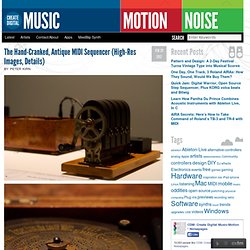
We’ve regularly featured the image of the circle as a sequence; even as music software prefers left-to-right piano rolls and scores and tracks, it’s a logical shape. Here, Finnish sound artist Martin Bircher looks to a last-century invention to build a mechanical expression of the sequencer. From an antique music box, comes MIDI, as in the video above. 2012 Guthman Musical Instrument Competition Winners Challenge Your Preconceptions About Music.
Winners have been announced in the 2012 Margaret Guthman Musical Instrument Competition – an annual event to find the world’s best new ideas in musicality, design, and engineering.
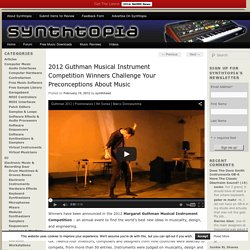
Competition finals were held February 17, 2012 at Georgia Tech in Atlanta, GA. Project Blog Blog Archive Alex Nowitz > The Strophonion Instrument Development (2010-2011) The Strophonion is an electronic instrument which was developed and built by STEIM from 2010 until 2011.
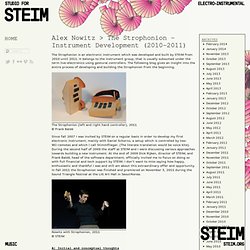
It belongs to the instrument group, that is usually subsumed under the term live-electronics using gestural controllers. The following blog gives an insight into the entire process of developing and building the Strophonion from the beginning. The Strophonion (left and right hand controller), 2011 © Frank Baldé. Din is noise. New Software Synth, Cosmosƒ, Designed For ‘Non-Standard Synthesis’ SonicLab has introduced Cosmosƒ – a new software synth with a real-time ‘dynamic stochastic synthesis engine’.
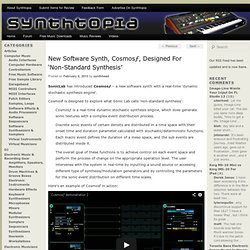
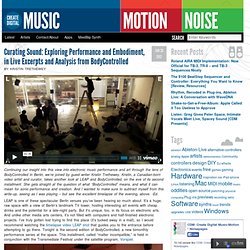
Cosmosf is designed to explore what Sonic Lab calls ‘non-standard synthesis’: Cosmosƒ is a real-time dynamic stochastic synthesis engine, which does generate sonic textures with a complex event distribution process. Discrete sonic events of certain density are distributed in a time space with their onset time and duration parameter calculated with stochastic/deterministic functions. Each macro event defines the duration of a meso space, and the sub events are distributed inside it. The overall goal of these functions is to achieve control on each event space and perform the process of change on the appropriate operation level. Curating Sound: Exploring Performance and Embodiment, in Live Excerpts and Analysis from BodyControlled. Continuing our insight into this view into electronic music performance and art through the lens of BodyControlled in Berlin, we’re joined by guest writer Kristin Trethewey.
Like a Wheel Within a Wheel: Beautiful Optical Turntables Generate Spinning Rhythms. Music is deeply tied up with motion; seeing that in a machine is somehow satisfying.
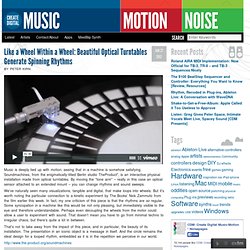
Soundmachines, from the enigmatically-titled Berlin studio TheProduct*, is an interactive physical installation made from optical turntables. By moving the “tone arm” – really in this case an optical sensor attached to an extended mount – you can change rhythms and sound sweeps. New Music Interface – The CCC-Pad (Sneak Preview) Håkan Lidbo tipped us off to the CCC-Pad, described as “a creative media interface where sounds and video can be played in a new and intuitive way”. The first version will be on the market in fall 2012, but the big touch screen prototype was tested at the Swedish Eurovision Song Contest, Jan 11, embedded above. The CCC-PAd is a prototype and part of an extensive research project by Dr Rikard Lindell in collaboration with Lidbo, programmers and designers.
The concept of the CCC-Pad project is that everyone can interact with each other. Most live electronic music is about musicians playing on separate units without the possibility to effect each others music. Same for visual artists. From Beautiful Ambient Modern Dance to Dubstep, Gestures to Music in Kinect (Download the Tool) It started as some compelling demos or proof of concept, but it’s plenty real now: the tools for translating movement, gesture, and dance from the body to interactive music march forward. Empowered by Microsoft’s Kinect and an artist-friendly toolchain, even a single, clever developer can do a lot. Sound designer, music producer, and Max/MSP developer Chris Vik of Melbourne has been one of those busy early pioneers, with an incredible tool called Kinectar.
So, the tech is cool and shiny and impressive: what about the actual music? And, even more importantly, what if all the hand waving and moving about could be meaningful? That’s the next step. And as for you: the software’s alpha, but you can fire up your copy of software like Ableton Live and grab this software for Mac or Windows and try it yourself. At top, Chris shows off an early test of the dance collab. Robotic Quintet Composes And Plays Its Own Music. Sound Machines 2.0 is Festo's latest effort to create robotic musicians. The German engineering firm Festo has developed a self-playing robotic string quintet that will listen to a piece of music and generate new musical compositions in various musical styles effortlessly.
Dubbed Sound Machines 2.0, the acoustic ensemble is made up of two violins, a viola, a cello, and a double bass, each consisting of a single string that is modulated by an electric actuator for pitch, a pneumatic cylinder that acts as a hammer to vibrate the string, and a 40 watt speaker. Making Digital One-of-a-Kind: Inside Icarus’ Generative Album in 1000 Variations.
Even the artwork changes. This is my personal copy – #148. Digital: disposable, identical, infinitely reproducible. Across the Universe: Mind-Blowing AV Performance Makes Music a Spacey Trip. Turning music and sound into three-dimensional worlds often yields something that fields like a trip through space. But this feels like a real trip. Through pulsing, glowing starfields, “Versum”‘s audiovisual movements are brain-bendingly transformative. Artist Tarik Barri has created an integrated world of sound and image that makes the interface and the compositional realms seamless. FRACT, 3D Adventure Game Played with Synths and Sequencers: Myst Meets Music Making. FRACT is a curious combination of music studio and puzzle game, merging elements of games like Myst with the sorts of synths and pattern editors you’d expect somewhere like Ableton Live. A Primer on Creating Interactive Music for Games.
As the game industry continues to grow and change, composers and musicians are increasingly interested in learning more about ''how to break into the game industry'. What many novice composers and musicians do not realize is how sophisticated and involved the process of writing music for games has become. In the very early days of games, there may have been a single-line melody for a game, played during the menu or at the end of a level. Soundation — Make music online. A Guide to Producing an Epic Orchestral Track. Although I'm not a huge fan of epic productions, they are definitely the thing that producers/directors/game developers search for nowadays.
How to Listen to Music: A Vintage Guide to the 7 Essential Skills. Mike Garson On Ultimate Improvisation. By Stephen Fortner. Deadmau5, Honest About His Own Press-Play Sets, Misses Out On “Scene” Prodigies Leaping Beyond Electronic Dance Music.