
One set of data, many stories – Zan. In March 2017, Brookings Institute put out a paper by Case & Deaton on Mortality and Morbidity in the 21st Century.
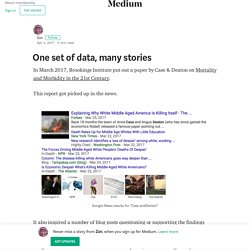
This report got picked up in the news. [65] Spotlight on Science Journalism: The Health Benefits of Volunteering. Io9.gizmodo. Infographic: The Best and Worst Science News Sites. A common question I hear again and again is, "How do I know if a news story is fake?
" Science journalism can be evidence-based, compelling — and wrong. Many science journalists rely on peer review to check their stories are true.
There has been much gnashing of teeth in the science-journalism community this week, with the release of an infographic that claims to rate the best and worst sites for scientific news. According to the American Council on Science and Health, which helped to prepare the ranking, the field is in a shoddy state. “If journalism as a whole is bad (and it is),” says the council, “science journalism is even worse. Was that new Science paper hyped and over-interpreted because of its liberal message? – Research Digest. By guest blogger Stuart Ritchie It would be very concerning if “girls as young as six years old believe that brilliance is a male trait”, as The Guardian reported last week, especially if “this view has consequences”, as was argued in The Atlantic.
Both stories implied girls’ beliefs about gender could be part of the explanation for why relatively few women are found working in fields such as maths, physics, and philosophy. These news stories, widely shared on social media, were based on a new psychology paper by Lin Bian at the University of Illinois at Urbana-Champaign and colleagues, published in Science, entitled “Gender stereotypes about intellectual ability emerge early and influence children’s interests”. The paper reported four studies, which at first appear to have simple, clear-cut conclusions. The importance of earnestly studying science. By Dr Suzi Gage, experimental psychologist and member of the British Science Association's Council.
In the Telegraph on Saturday, Cristina Odone argues that her 12 year old daughter, who has a ‘literary bent’, shouldn’t be forced to do GCSEs in science if she wants to pursue a career in the arts. There’s plenty of misinformation in the article, which seems almost willful in its attempts to troll (from thinking the ‘E’ in STEM represents Economics – it should be Engineering, to claiming that Alan Turing killed himself because he was a mathematician, to claiming this is a ‘women in science’ issue), but to me the most egregious mistake that Odone makes is to think that GCSE science is only worthy of undertaking if you plan a career in the field, and that to anyone interested in the arts it’s a waste of time.
Science and the arts don’t exist in silos. They influence and inform each other, and have done throughout history. Vox retracts story based on fraudulent research. Vox | The Washington Post | The Huffington Post | “This American Life” | The New York Times | The Wall Street Journal At least five news organizations have re-examined stories based on fraudulent research published in the academic journal “Science” that purported to show people could be swayed to accept same-sex marriage by talking to gay individuals.
The re-evaluations came to light after the research, conducted by scholars Michael LaCour and Donald Green, came under scrutiny by political scientists David Broockman and Joshua Kalla. They found problems with the publication, which was covered by “This American Life,” The New York Times, Vox, The Huffington Post, The Washington Post and others. A Vox.com story by senior correspondent Dylan Matthews published in April 2014 now carries the following retraction: Update: It turns out that the Michael LaCour and Donald Green study described here really was “miraculous”: it wasn’t true.
There’s A Gap Between What The Public Thinks And What Scientists Know. Scientists lament that public opinion on scientific issues is often shaped by fear and ignorance about science.
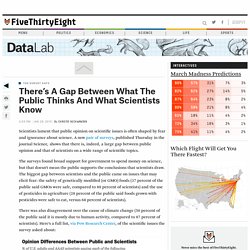
A new pair of surveys, published Thursday in the journal Science, shows that there is, indeed, a large gap between public opinion and that of scientists on a wide range of scientific topics. The surveys found broad support for government to spend money on science, but that doesn’t mean the public supports the conclusions that scientists draw. The biggest gap between scientists and the public came on issues that may elicit fear: the safety of genetically modified (or GMO) foods (37 percent of the public said GMOs were safe, compared to 88 percent of scientists) and the use of pesticides in agriculture (28 percent of the public said foods grown with pesticides were safe to eat, versus 68 percent of scientists). There was also disagreement over the cause of climate change (50 percent of the public said it is mostly due to human activity, compared to 87 percent of scientists).
Finger length 'not a pointer' for future sexual behaviour. Friday February 6 2015 Finger length is related to hormone levels.
How the Toronto Star massively botched a story about the HPV vaccine — and corrected the record. If there was ever a textbook case in how to botch a health story, the Toronto Star's investigation into the "dark side of the HPV vaccine" is it.
The report not only misrepresented the science behind the vaccine, but when well-meaning critics (including me) tried to point out the flaws, we were ignored, insulted, or maligned. (See our story below about what unfolded over the last two weeks, or listen to this podcast, this one, or this one.) This study of hype in press releases will change journalism.
Many scientists greet the prospect of media coverage with a combination of excitement and trepidation.
The attention can be heady and show the importance of a researcher’s findings. But there’s also the chance that the news media will hype the scientist’s findings. A lab study in rats ending up in the paper with the claim that more bacon jerky could prevent cancer can be embarrassing at best. More importantly, an over-hyped finding, especially in areas related to human health, could mislead readers and patients, some of whom may end up changing their behavior based on unfounded information. It’s easy to point fingers and blame journalists, media-hungry fame seekers or the endlessly hungry news cycle.
Brain Injuries: what NICE doesn't tell you. The title of this post is a play on the title of the magazine "What doctors don't tell you" (a rag so packed to the brim with pseudoscience and anti-vaccine propaganda that it's practically a quack's guidebook, but that's a story for another day). As regular readers will be aware, I believe doctors generally do tell you absolutely what you need to know. Unfortunately, it seems the UK's governing body that assesses among other things, what doctors should tell you, has been resisting calls from a range of experts to inform people who have had brain injuries about a piece of information that could save their life.
Nice is the acronym for the UK's National Institute for Health and Clinical Excellence, the body that decides the guidelines British doctors should follow. If Newspaper Headlines Were Scientifically Accurate. Researchers: your guide to hitting the headlines - Health News. Friday December 27 2013. What a difference a day makes: How social media is transforming scientific debate (with tweets) · deevybee. The seven deadly sins of health and science reporting. Benjamin Franklin said two things are certain in life: death and taxes. Another one we could add to this list is that on any given news website and in almost all print media there will be articles about health and nutrition that are complete garbage.
Some articles that run under the health and nutrition “news” heading are thought provoking, well researched and unbiased, but unfortunately not all. And to help you traverse this maze – alongside an excellent article about 20 tips for interpreting scientific claims – we will look at seven clichés of improper or misguided reporting. If you spot any of these clichés in an article, we humbly suggest that you switch to reading LOLCats, which will be more entertaining and maybe more informative too. 1. Whomp! Using invited editorial commentary to neutralize negative findings. Hello there! If you enjoy the content on Mind the Brain, consider subscribing for future posts via email or RSS feed. William Hollingworth and his colleagues must been pleased when they were notified that their manuscript had been accepted for publication in the prestigious (Journal impact factor =18!)
Journal of Clinical Oncology. Their study examined whether screening for distress increased cancer patients’ uptake of services and improved their mood. The study also examined a neglected topic: how much did screening cost and was it cost-effective? These authors presented their negative findings in a straightforward and transparent fashion: screening didn’t have a significant effect on patient mood. This finding has significant implications for clinical and public policy. Lessons from the L'Aquila earthquake. Sex Makes You Rich? Why We Keep Saying “Correlation Is Not Causation” Even Though It’s Annoying. Sex and money: the Bearina IUD, a conceptual intrauterine device design that would incorporate a copper coin. One of the most effective forms of reversible contraception is the copper IUD.
For more information, click the picture. Image: Ronen Kadushin. Risks of placing scientists 'on message' 17 February 2012Last updated at 17:16 By Pallab Ghosh Science correspondent, BBC News Government science agencies exist to serve the public good and usually do. Evgeny Morozov: The Naked And The TED. What Jonah Lehrer reveals about popular science writing » Daniel Bor. New Yorker's Jonah Lehrer quits over fake Dylan quotes. 31 July 2012Last updated at 01:21 GMT. 'Chemical nonsense': Leading scientists refute Lord Monckton's attack on climate science. A coalition of leading climate scientists yesterday filed a 48-page document to the US Congress refuting an attack on climate science made earlier this year by the Ukip deputy leader, Lord Christopher Monckton. The detailed rebuttal addresses nine key scientific claims made by Monckton, a prominent climate sceptic, to a house select committee hearing in May.
It includes the responses of 21 climate scientists who variously conclude that Monckton's assertions are "very misleading", "profoundly wrong", "simply false", "chemical nonsense", and "cannot be supported by climate physics". Monckton, a former journalist and policy adviser to Margaret Thatcher, who has been the deputy leader of the UK Independence party (Ukip) since June, was invited by the Republican party to give evidence to the house select committee on energy independence and global warming. Interdira-t-on les prévisions climatiques. What eight years of writing the Bad Science column have taught me. Can we trust scientists who give TED talks?
I came across an interesting article this morning in Slate questioning recent papers on the “contagiousness” of factors ranging from obesity to divorce. Climate change education can still be part of a slimmed-down curriculum. Would it be in pupils' best interests to drop climate change from the national curriculum, as a key government adviser suggested today? Such a move would not, of course, mean that climate change is banished from school lessons, but it would remove a legal requirement for pupils to learn about it. The Great Beyond: New intelligent design centre launches in Britain. Why I spoofed science journalism. Pornography in hospitals. Journalism warning labels. Journalism Warning Labels. Creationists seek to insert their own brand of 'truth' into education. Not fit for television. In which I continue to whine about crappy science journalism blogging.
This is a news website article about a scientific finding. When did announcing science become the same as publishing science? Faked data, unsubstantiated claims, and spirituality add up to a math journal retraction.