
Punctuation. 20 Common Grammar Mistakes That (Almost) Everyone Makes. I’ve edited a monthly magazine for more than six years, and it’s a job that’s come with more frustration than reward.
If there’s one thing I am grateful for — and it sure isn’t the pay — it’s that my work has allowed endless time to hone my craft to Louis Skolnick levels of grammar geekery. As someone who slings red ink for a living, let me tell you: grammar is an ultra-micro component in the larger picture; it lies somewhere in the final steps of the editing trail; and as such it’s an overrated quasi-irrelevancy in the creative process, perpetuated into importance primarily by bitter nerds who accumulate tweed jackets and crippling inferiority complexes. But experience has also taught me that readers, for better or worse, will approach your work with a jaundiced eye and an itch to judge.
While your grammar shouldn’t be a reflection of your creative powers or writing abilities, let’s face it — it usually is. Who and Whom. List of English-language idioms. This is a list of notable idioms in the English language.
An idiom is a common word or phrase with a culturally understood meaning that differs from what its composite words' denotations would suggest. For example, an English speaker would understand the phrase "kick the bucket" to mean "to die" – and also to actually kick a bucket. Furthermore, they would understand when each meaning is being used in context. An idiom is not to be confused with other figures of speech such as a metaphor, which invokes an image by use of implicit comparisons (e.g., "the man of steel" ); a simile, which invokes an image by use of explicit comparisons (e.g., "faster than a speeding bullet"); and hyperbole, which exaggerates an image beyond truthfulness (e.g., like "missed by a mile" ).
50 Problem Words and Phrases. - StumbleUpon. Unusual Words. Unusual Words A by no means exhaustive list of rare, obscure, strange and sometimes funny words and their meanings that only seem to crop up in crosswords and dictionaries. How many words do you know? British English/American English Vocabulary. Magic Vocabulary: English vocabulary games and worksheets. Free Online Lesson Planning Software for Teachers!
Create a lesson plan with Word. Printable Lesson Plan On Adjectives, Anyone. Onestopenglish: Number one for English language teachers. ESL/ELL-English Grammar and Vocabulary Tests, Worksheets, Free ESL Resources. English Worksheets. BBC Learning - English: Free resources and online courses. IdiomSite.com - Find out the meanings of common sayings. Odd Origins of Idioms. In the heyday of sailing ships, all war ships and many freighters carried iron cannons.
Those cannons fired round iron cannon balls. It was necessary to keep a good supply near the cannon. However, how to prevent them from rolling about the deck? The best storage method devised was a square-based pyramid with one ball on top, resting on four resting on nine, which rested on sixteen. Thus, a supply of 30 cannon balls could be stacked in a small area right next to the cannon.
The solution was a metal plate called a 'Monkey' with 16 round indentations. Few landlubbers realize that brass contracts much more and much faster than iron when chilled. Funny Word Origins - Word Origin Jokes. Funny Word Origins (These are actual origins of commonly used words) FUCK The word "FUCK" is said to actually be an acronym that originated in medieval times, durng the black plague to keep the population from dwindling (shrinking).
It stood for: Fornicate Under Command of the King, The true origin of this word predates "Fornication Under Consent of the King". Originally the Acronym FUCK was the term used to decribe the act of rape. Fun With Words > The Wordplay Web Site. Diction Exercises - Tongue Twisters to Learn How to Speak Clearly.
- articulation drills to make sure they get your message Why should you do diction exercises?
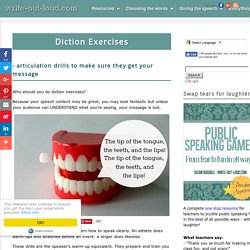
Because your speech content may be great, you may look fantastic but unless your audience can UNDERSTAND what you're saying, your message is lost. 697Save Diction exercises will help you learn how to speak clearly. "Shall" Versus "Will" This episode concerns your future: whether you should use shall or will.

Guest-writer Bonnie Trenga writes, there are two sets of rules: the stickler version and the people’s version. There is also the British version and the American version. Shall in Britain. Find the Meanings and Definitions of Words at Dictionary.com. Table of Contents - Peck's English Pointers - TERMIUM Plus® - Bureau de la traduction. The englishtalk style guide - Et_wiki. Controversial Essay Topics - Great Selection of Topics for Your Controversial Essay!
Controversial essay topics are burning, hot issues, which raise heated debate and provoke confrontation concerning an ambiguous subject of a current interest.

These are issues about which people have very strong yet divergent feelings and opinions, which lead to much dispute and argument. These feelings and opinions may exist due to religious, social, or political beliefs. Controversial essay topics tend to polarize people, who often make strong arguments for and against the subjects. They come from concepts or ideas that have various points of view that make up the issue. In a nutshell, these are issues of the day, which are elucidated in the mass media, newspapers, magazines, TV, which you come across in all sites in Net. 40 Topics for an Argument Essay - Writing Topics - Argument & Persuasion - Forty Prompts for Argumentative Paragraphs, Essays, and Speeches. Essay Topics. Argument Essay Topics - 50 Controversial Topics for Argument Essays and Speeches. Regents' Testing Program. Following is a complete list of the essay topics approved for use on the Regents' Test.
The Essay Test requires students to choose among four topics drawn from this list. Last updated: May 3, 2004 Discuss the influence that advertising has had on your life or the lives of your friends. If you were asked to make a fair evaluation of your teachers, what criteria would you use for the evaluation? Discuss. What influence should students have in the determination of college policies? Simple Present - Present Continuous/Progressive - contrasted. English exercises - grammar exercises - learn english online. Formation of Negative Sentences – Part I. Learn English Speaking and Improve your Spoken English with Free English Speaking Lessons Online!
English Lesson Plans - Free ESL EFL Lessons in Grammar, Reading, Writing, Speaking and Listening. Lesson plans. Rebus Puzzles (Pictogram Puzzles) Fun With Words. Draw a parallel : D : American Idioms @ Learn English Language with us! Skillswise - English. 70 ways to improve your English - Articles.
How to improve your English skills - Learn English Free. Grammar | Vocabulary | Listening | Pronunciation | Speaking | Reading | Writing Learning Skills | Other Tips Our most important piece of advice is: "Do something (anything).
If you don't do anything, you won't get anywhere. Make it your hobby, not a chore. Above all have fun! Oh, and don't be in too much of a hurry. There are many ways to improve your level of English, but only you can find the right way for you. Improve your Learning Skills Learning is a skill and it can be improved. Your path to learning effectively is through knowing yourself your capacity to learn processes you have successfully used in the past your interest, and knowledge of what you wish to learn.
EFL.NET Improve your English. How to Format a UK Business Letter. By Ali Hale I covered writing US business letters, but I know we have a number of readers in the United Kingdom too – or readers who might want to write to companies within the UK.
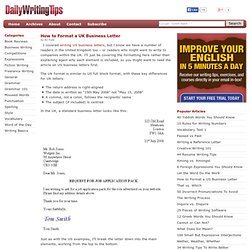
I’ll just be covering the formatting here rather than explaining again why each element is included, so you might want to read the article on US business letters first. The UK format is similar to US full block format, with these key differences for UK letters: The return address is right-alignedThe date is written as “15th May 2008” not “May 15, 2008”A comma, not a colon, follows the recipients’ nameThe subject (if included) is centred In the UK, a standard business letter looks like this: Just as with the US examples, I’ll break the letter down into the main elements, working from the top to the bottom.
World English : test, learn and study the English language online. Punctuation Rules. Commas and periods are the most frequently used punctuation marks. Commas customarily indicate a brief pause; they're not as final as periods. Rule 1. Use commas to separate words and word groups in a simple series of three or more items. Example: My estate goes to my husband, son, daughter-in-law, and nephew. Note: When the last comma in a series comes before and or or (after daughter-in-law in the above example), it is known as the Oxford comma. 1,600 Sayings, phrases and expressions - with their meanings and origins explained.
The Best of British - The American's guide to speaking British... Online Speed Reading tools and software. Simply start by clicking on the Play button on the left. Reading is that one activity that we do every day but we don't really practice. Most people learn the basics of reading in kindergarten and never graduate to the next levels. You are probably using the same basic rudimental tools and techniques that you learned when you were 6. The average American person reads at an average speed of 180 to 240 words per minute and has done so since he was 16 years old. Expand your vocabulary! Word Search: Random Words (Medium) Learn Your Damn Homophones. Frequently Asked Questions. 100 Most Often Mispronounced Words and Phrases in English.
There are spelling rules in English, even if they are difficult to understand, so pronouncing a word correctly usually does help you spell it correctly. Here are the 100 most often mispronounced English words ("mispronunciation" among them). Several common errors are the result of rapid speech, so take your time speaking, correctly enunciating each word. Section I - Useful Phrases. Etymologic: the toughest etymology (word origin) game on the Web.