
Plan Your Free Online Education at Lifehacker U: Summer Semester 2012. Move Over Harvard And MIT, Stanford Has The Real “Revolution In Education” Lectures are often the least educational aspect of college; I know, I’ve taught college seniors and witnessed how little students learn during their four years in higher education.
50 resources for iPad use in the classroom. MIT Debuts Video Lectures For Students, By Students - Education. With its top-notch science, technology, engineering and math programs, Massachusetts Institute of Technology has plenty resources to share.
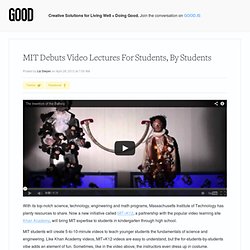
Now a new initiative called MIT+K12, a partnership with the popular video learning site Khan Academy, will bring MIT expertise to students in kindergarten through high school. MIT students will create 5-to-10-minute videos to teach younger students the fundamentals of science and engineering. Like Khan Academy videos, MIT+K12 videos are easy to understand, but the for-students-by-students vibe adds an element of fun.
Sometimes, like in the video above, the instructors even dress up in costume. MIT+K12 already has about 36 videos on a variety of science and engineering topics. Will Free Benefit the Rich? How Free and Open Education Might Widen Digital Divides. Tuesday, Janary 17, 12:30 pmBerkman Center, 23 Everett Street, second floorThe event is at capacity; this event will be webcast live at 12:30 pm ET and archived on our site shortly after.
The explosion of open education content resources and freely available collaboration and media production platforms represents one of the most exciting emerging trends in education. Publishing with iBooks Author. Change.mooc.ca. Case Studies on Connected Learning. Connected Learning: Reimagining the Experience of Education in the Information Age. Boundless Learning Raises $8 Million to Make Expensive College Textbooks Free. Let me get this out of the way: Boundless Learning, a Boston-based startup, just raised $8 million from Venrock, bringing the company's total funding to just under $10 million.
Okay, onto the juicy stuff. In our earliest days, Pando went a little crazy covering books. Connexions - About Us. Connexions is a dynamic digital educational ecosystem consisting of an educational content repository and a content management system optimized for the delivery of educational content.
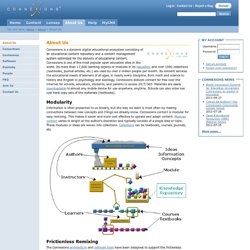
Connexions is one of the most popular open education sites in the world. Its more than 17,000 learning objects or modules in its repository and over 1000 collections (textbooks, journal articles, etc.) are used by over 2 million people per month. Its content services the educational needs of learners of all ages, in nearly every discipline, from math and science to history and English to psychology and sociology. Connexions delivers content for free over the Internet for schools, educators, students, and parents to access 24/7/365. Materials are easily downloadable to almost any mobile device for use anywhere, anytime. Open Learning Network. Activities. Europe > Neelie Kroes. European Institute of Innovation and Technology: Overview. Udacity - Educating the 21st Century. Technology Cannot Disrupt Education From The Top Down. Editor’s note: Guest contributor Patrick Gibbons is a Las Vegas-based writer and researcher focusing on education policy and reform.
Computer technology has penetrated the classroom for thirty years with little impact. After hundreds of “disruptive” education startups, the best innovation in education is still the chalkboard. This isn’t the fault of the entrepreneurs, but the fault of an education system which resists innovation at every turn. Many K-12 education technology startups target teachers and administrators by offering tools to become more productive: Lesson plan sharing, gradebooks, training tools, whiteboards and more.
Blinklearning secures €350k of R&D funding to personalise education. Blinklearning, the e-tutoring platform, has raised €350k of public money from the Spanish CDTI NEOTEC program for further R&D into how Artificial Intelligence can be leveraged to offer a more personalised education for learners.
Based on the premise that education must be adapted to the needs of each individual student who may learn at a different pace to their peers, the Spain and UK-based startup currently gives teachers better tools to create learning content along with technology to “track the individual performance of every student and subsequently provide those students with tailor-made content and exercises.”
The new funding will enable Blinklearning to conduct R&D into new product developments with the goal to help teachers to reduce underachievement and the failure of school for many students. The company is also in the process signing agreements with additional publishers and international expansion in markets like Colombia, Peru and Chile. (via Loogic) Now On iOS And Android, 2tor Brings Higher Education To Mobile Students.
There’s a growing focus on the intersection of education and technology, from Apple’s initiatives to reinvent the textbook and Inkling’s efforts to take virtualized textbooks to professional publishers to Bertelsmann and others backing a $100 million fund for innovative education.
All of these projects, in one way or another, focus on higher education. A Step Forward? Bertelsmann & Others Back $100 Million Venture Fund For Innovative Education. Just as (mobile) technology is bringing some exciting changes to the health industry, it’s simultaneously over in the classroom trying to save education before it’s too late.
I’m not sure we’re even close to “too late”, but it’s hard to ignore the fact that, like the health industry, the educational system (and I don’t limit that to the U.S.) is broken. Millions of young people are entering a system that just isn’t built to handle the diversity of learning styles — or the speed of innovation. Peter Thiel is right: Higher education is in a bubble. I’m not sure dropping/stopping out is the always the best answer, but the point remains. MITx ou les premiers pas de la vraie révolution éducative en ligne ? Perspectives on Contemporary American Democracy by Jeb Barnes.
After receiving his law degree from the University of Chicago Law School, Jeb clerked for a federal bankruptcy judge and then practiced as a commercial litigator in Boston and San Francisco.
In 1994, he left the practice of law to pursue a doctorate at the University of California, Berkeley. His research centers on the intersection between law and politics and how policy emanates from interactions among the various levels and branches of government. His research has been published peer-reviewed articles in a variety of journals, including Political Research Quarterly, Law & Society Review, Law & Social Inquiry, and Annual Review of Political Science, and three books: Dust-Up: Asbestos Litigation and the Failure of Commonsense Policy Reform (2011), Overruled? Create a Course on Udemy. Dramatically Bringing Down the Cost of Education with OER. SOURCE: AP/ Jim Mone A Blaine (MN) High School student is shown with a printed online textbook. Instead of mass-produced textbooks, the more than 3,100 sophomores in the state's largest district are learning from an online curriculum developed by their teachers over the summer with free software distributed over the web.
By David Wiley, Cable Green, and Louis Soares | February 7, 2012 Open Educational Resources Download this issue brief (pdf) Class Central - Google+ - Stanford professors +Daphne Koller and +Andrew Ng are… Peter Thiel: We're in a Bubble and It's Not the Internet. It's Higher Education. Fair warning: This article will piss off a lot of you. I can say that with confidence because it’s about Peter Thiel. And Thiel – the PayPal co-founder, hedge fund manager and venture capitalist – not only has a special talent for making money, he has a special talent for making people furious. Some people are contrarian for the sake of getting headlines or outsmarting the markets. Will We Need Teachers Or Algorithms? Editor’s note: This is Part III of a guest post written by legendary Silicon Valley investor Vinod Khosla, the founder of Khosla Ventures. In Part I, he laid the groundwork by describing how artificial intelligence is a combination of human and computer capabilities In Part II, he discussed how software and mobile technologies can augment and even replace doctors.
Now, in Part III, he talks about how technology will sweep through education. In my last post, I argued that software will take over many of the tasks doctors do today. And what of education? We find a very similar story of what the popular – and incredibly funny! Ken Robinson: Changing education paradigms. Sir Ken Robinson: Bring on the learning revolution!