

Writing Microcopy: Tips and Pointers Do you spend hours writing a four or five word phrase or brief instructions? Do you feel like an obsessive perfectionist? Actually, that’s normal. Clear and concise microcopy is one of the most difficult types of writing to achieve. Microcopy refers to the brief copy that we use in instructions and user interfaces to guide and direct user actions as well as to respond to input. We use it in eLearning, mobile apps, web pages and anywhere there is a screen-based user interface. Importance of Microcopy Microcopy can make or break your learning product. In addition to providing instructions and way finding, microcopy can assure users that things are safe and secure. Writing Quality Microcopy Good microcopy gives your audience the information they need in a small space and it can be read at a glance. First, clarify your intention or objective. Remember its value. What are your tips for writing good microcopy?
TEDxLondon presents the Education Revolution David Rowan Editor of Wired magazine You've seen the extraordinary TED talk by Sir Ken Robinson, on how to repair our education system to boost creativity (what? You haven't? With new tools around that harness the power of technology to truly democratise learning, and the sum total of human knowledge only a web browser away, the role of teachers is changing dramatically. The event is organised in collaboration with Sir Ken Robinson, and aims to explore ways to re-invent an outmoded model of learning. It's an impressive list of speakers that's been announced so far, including: Jude Kelly - artistic director of the Southbank Centre in London; Scott Snibe - One of the app developers involved in creating Bjork's recent Biophila project, as covered in Wired; Sir Ken Robinson - via a video link; Ken Spours - Professor of education at the Institute of Education, University of London; Salman Khan - founder of the Khan Academy, via video link; Geoff Stead - Head of Innovation of Tribal Group.
PCOT Gateway Apply proven strategies to enhance teaching and learning at a distance with emphasis in instruction and instructional design The Professional Certificate in Online Education (PCOE) will help you apply proven strategies to enhance your knowledge, skill, and credibility in teaching online. Key topics: Contextual factors of online education Essential teaching and learning principles for online environments Effects of technology on education at a distance Writing learning objectives, creating online activities and designing online assessments The certificate culminates in an ePortfolio in which you will demonstrate both your skills in planning online learning and your ability to articulate the rationale underlying your choices. Why earn the PCOE? Practical: This totally online, flexible certificate prepares you with foundational knowledge, understandings and skills that are essential for any instructor or designer working in online environments. How the PCOE works Course Descriptions Yes! Yes!
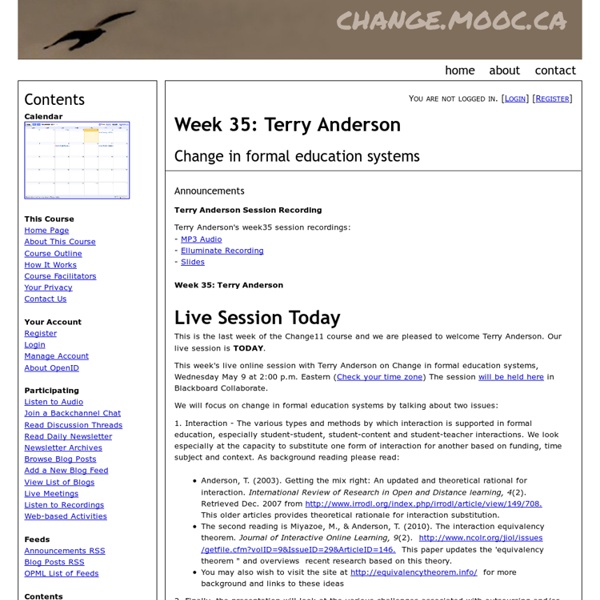
The Rise of MOOCs Responses to interview questions posed by Kevin Charles Redmon, Independent Journalist and Middlebury Fellow in Environmental Journalism 1. Are MOOCs an idea that were floating around the halls of universities for some time now, or was the first one in 2008 really a watershed moment? Many of the ideas that go into a MOOC were around before CCK08 but that course marks the first time the format came together. What makes the MOOC offered by George Siemens and myself different was that it was a distributed course. What made CCK08 a watershed moment was the realization that the use of distributed open resources would support - with ease - an attendance in the thousands. 2. I'm not sure whether I expected the format to take off so quickly, but I was not surprised at all that once it proved successful it would be adopted by the Ivy Leagues (who would receive credit for its 'discovery') because this follows a well-established pattern in our field. 3. What does this mean in practice? 4. Yes.
Moving UX into a position of corporate influence: Whose advice really works? I'll be leading an "interactive session" at CHI 2007 entitled, "Moving UX into a Position of Corporate Influence: Whose Advice Really Works?" Here is the abstract: "Professionals working to move user experience (UX) into a position of corporate influence are impeded by conflicting recommendations, including those regarding the roles of documenting and evangelizing UX work, ownership of UX, organizational positioning, calculating return on investment, and conducting "ethnographic" research. In this interactive session, a group of senior UX management personnel who have moved UX into positions of rapidly increasing influence in their varied places of work debate their different perspectives and approaches to help resolve the conflicting recommendations and generate some new and improved guidance." A four-page description of this session will be published and will become available in ACM's digital library. "What has been your experience where you work?
Institute for Social and Network Literacy | Life Skills for Knowledge Citizenship Learning out in the Open Colloque REFAD 2013 Nouveaux horizons en FAD : que nous réserve l’avenir? Pavillon Simon-Larouche, local PSL105 (Salle multifonctionnelle CCNB-UMCE) Université de Moncton, Campus d'Edmundston 165, boulevard Hébert Edmundston (Nouveau-Brunswick) En collaboration avec Édupôle Edmundston, le Réseau d'enseignement francophone à distance du Canada (REFAD) a le plaisir de vous inviter à son colloque annuel qui aura lieu le jeudi 30 mai et le vendredi 31 mai 2013 dans la ville d’Edmundston au Nouveau-Brunswick. Les changements actuels dans la société et leurs impacts directs annoncent de nouveaux horizons pour la formation à distance (FAD). C’est donc maintenant qu’il faut préparer l’avenir en FAD ! Durant ces deux journées de colloque, des conférences, des ateliers, des communications et des tables rondes tenteront donc d’apporter un éclairage sur les défis auxquels fait face la FAD dans ce monde de changements et sur la mise en œuvre de solutions innovantes pour y répondre. (Animation : Mme Lise Bégin-Langlois)
Hail to the Chief! From a press release of last week: "Cleveland Clinic has named M. Bridget Duffy, M.D., Chief Experience Officer, a newly created role designed to ensure all aspects of the patient experience at Cleveland Clinic meet the highest standards.'We recognize that delivering World Class healthcare requires a lot more than providing patients with access to leading-edge treatments and technologies,' said Delos M. During May of 2005, I posted an article entitled "The Chief Experience Officer" in my blog, refering to Challis Hodge's 2001 description of the role ("...should ensure that an organization delivers the appropriate experience at every point of contact it makes with the public") and to Jeffrey Rayport's March 2005 related description and his recommendation that companies create the position: "To ensure desirable customer experiences, companies must appoint dedicated chief experience officers. In an article published later that year, Bill Buxton argued for the need for a CDO: Hmm...