
Combining Cloud Computing and Service-Oriented Architecture. A cloud has some key characteristics: elasticity, self-service provisioning, standards based interfaces, and pay as you go.

This type of functionality has to be engineered into the software. To accomplish this type of engineering requires that the foundation for the cloud be well designed and well architected. What about cloud architecture makes this approach possible? The fact is that the services and structure behind the cloud should be based on a modular architectural approach. A modular, component-based architecture enables flexibility and reuse. Category:Distributed computing architecture. Architectural, organisational, and engineering aspects of distributed computing.
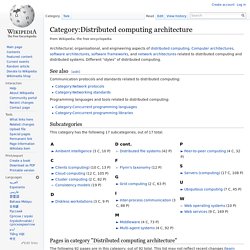
Computer architectures, software architectures, software frameworks, and network architectures related to distributed computing and distributed systems. Different “styles” of distributed computing. Understanding Service-Oriented Architecture. David Sprott and Lawrence Wilkes CBDI Forum January 2004 Summary: Gives a concise explanation of service-oriented architecture, what it is, and how it affects what architects, CIOs, project managers, business analysts, and lead developers do. (13 printed pages) Contents.
A Quick Look at Architectural Styles and Patterns. Chapter 3: Architectural Patterns and Styles. For more details of the topics covered in this guide, see Contents of the Guide.

This chapter describes and discusses high level patterns and principles commonly used for applications today. These are often referred to as the architectural styles, and include patterns such as client/server, layered architecture, component-based architecture, message bus architecture, and service-oriented architecture (SOA). For each style, you will find an overview, key principles, major benefits, and information that will help you choose the appropriate architectural styles for your application.
List of software architecture styles and patterns. List of software architecture styles and patterns From Wikipedia, the free encyclopedia Jump to: navigation, search Contents [hide] Catalog of architectural patterns[edit]

Tuple space. A tuple space is an implementation of the associative memory paradigm for parallel/distributed computing.

It provides a repository of tuples that can be accessed concurrently. As an illustrative example, consider that there are a group of processors that produce pieces of data and a group of processors that use the data. Producers post their data as tuples in the space, and the consumers then retrieve data from the space that match a certain pattern. Event-driven architecture. Building applications and systems around an event-driven architecture allows these applications and systems to be constructed in a manner that facilitates more responsiveness, because event-driven systems are, by design, more normalized to unpredictable and asynchronous environments.[2] Event-driven architecture can complement service-oriented architecture (SOA) because services can be activated by triggers fired on incoming events.[2][3] This paradigm is particularly useful whenever the sink does not provide any self-contained executive[clarify].
SOA 2.0 evolves the implications SOA and EDA architectures provide to a richer, more robust level by leveraging previously unknown causal relationships to form a new event pattern. [vague] This new business intelligence pattern triggers further autonomous human or automated processing that adds exponential value to the enterprise by injecting value-added information into the recognized pattern which could not have been achieved previously. Service-oriented architecture. See also the client-server model, a progenitor concept A Service-Oriented Architecture (SOA) is a design pattern in which software/application components provide services to other software/application components via a protocol, typically over a network and in a loosely-coupled way.
The principles of service-orientation are independent of any vendor, product or technology.[1] A service is a self-contained unit of functionality, such as retrieving an online bank statement.[2] By that definition, a service is a discretely invokable operation. However, in the Web Services Definition Language (WSDL), a service is an interface definition that may list several discrete services/operations. And elsewhere, the term service is used for a component that is encapsulated behind an interface.
Representational state transfer. Representational State Transfer (REST) is a software architecture style consisting of guidelines and best practices for creating scalable web services.[1][2] REST is a coordinated set of constraints applied to the design of components in a distributed hypermedia system that can lead to a more performant and maintainable architecture.[3] REST has gained widespread acceptance across the Web[citation needed] as a simpler alternative to SOAP and WSDL-based Web services.
RESTful systems typically, but not always, communicate over the Hypertext Transfer Protocol with the same HTTP verbs (GET, POST, PUT, DELETE, etc.) used by web browsers to retrieve web pages and send data to remote servers.[3] The REST architectural style was developed by W3C Technical Architecture Group (TAG) in parallel with HTTP 1.1, based on the existing design of HTTP 1.0.[4] The World Wide Web represents the largest implementation of a system conforming to the REST architectural style.
Space-based architecture. The SBA model is closely related to other patterns that have been proved successful in addressing the application scalability challenge, such as shared nothing architecture (SN), used by Google, Amazon.com and other well-known companies.

The model has also been applied by many firms in the securities industry for implementing scalable electronic securities trading applications. Components of Space-Based Architecture[edit] An application built on the principles of space-based architecture typically has the following components: Peer-to-peer. A peer-to-peer (P2P) network in which interconnected nodes ("peers") share resources amongst each other without the use of a centralized administrative system Peer-to-peer (P2P) computing or networking is a distributed application architecture that partitions tasks or work loads between peers.
Peers are equally privileged, equipotent participants in the application. They are said to form a peer-to-peer network of nodes. Peers make a portion of their resources, such as processing power, disk storage or network bandwidth, directly available to other network participants, without the need for central coordination by servers or stable hosts.[1] Peers are both suppliers and consumers of resources, in contrast to the traditional client-server model in which the consumption and supply of resources is divided. Multitier architecture. In software engineering, multi-tier architecture (often referred to as n-tier architecture) is a client–server architecture in which presentation, application processing, and data management functions are physically separated.
The most widespread use of multi-tier architecture is the three-tier architecture. N-tier application architecture provides a model by which developers can create flexible and reusable applications. By segregating an application into tiers, developers acquire the option of modifying or adding a specific layer, instead of reworking the entire application. A three-tier architecture is typically composed of a presentation tier, a domain logic tier, and a data storage tier.
While the concepts of layer and tier are often used interchangeably, one fairly common point of view is that there is indeed a difference. Client–server model. Examples of computer applications that use the client–server model are Email, network printing, and the World Wide Web. Client and server roles[edit] The client–server characteristic describes the relationship of cooperating programs in an application.
The server component provides a function or service to one or many clients, which initiate requests for such services. Distributed computing. "Distributed Information Processing" redirects here. For the computer company, see DIP Research. Distributed computing is a field of computer science that studies distributed systems. A distributed system is a software system in which components located on networked computers communicate and coordinate their actions by passing messages.[1] The components interact with each other in order to achieve a common goal.
Three significant characteristics of distributed systems are: concurrency of components, lack of a global clock, and independent failure of components.[1] Examples of distributed systems vary from SOA-based systems to massively multiplayer online games to peer-to-peer applications. Distributed systems.