
Pyotr Ilyich Tchaikovsky. Portrait of Pyotr Ilyich Tchaikovsky Pyotr Ilyich Tchaikovsky (/ˈpjɔːtər ɪˈliɪtʃ tʃɪˈkɒfski/; Russian: Пётр Ильи́ч Чайко́вский;[a 1] tr.
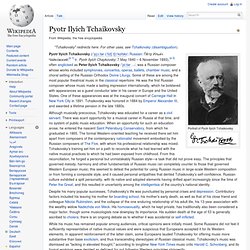
Pyotr Ilyich Chaykovsky; 7 May 1840 – 6 November 1893),[a 2] often anglicised as Peter Ilyich Tchaikovsky /ˈpiːtər .../, was a Russian composer whose works included symphonies, concertos, operas, ballets, chamber music, and a choral setting of the Russian Orthodox Divine Liturgy. Some of these are among the most popular theatrical music in the classical repertoire. He was the first Russian composer whose music made a lasting impression internationally, which he bolstered with appearances as a guest conductor later in his career in Europe and the United States. One of these appearances was at the inaugural concert of Carnegie Hall in New York City in 1891. While his music has remained popular among audiences, critical opinions were initially mixed. Life[edit] Childhood[edit] The Tchaikovsky family in 1848. LGBT rights in Russia. Lesbian, gay, bisexual, and transgender (LGBT) people's rights in Russia face legal and social challenges as well as discrimination not experienced by non-LGBT people.
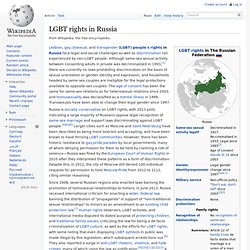
Although same-sex sexual activity between consenting adults in private was decriminalized in 1993,[1] there are currently no laws prohibiting discrimination on the basis of sexual orientation or gender identity and expression, and households headed by same-sex couples are ineligible for the legal protections available to opposite-sex couples. The age of consent has been the same for same-sex relations as for heterosexual relations since 2003, and homosexuality was declassified as a mental illness in 1999. Transsexuals have been able to change their legal gender since 1997.
History[edit] Current situation[edit] The age of consent currently stands at 16 since 2003, regardless of sexual orientation.Transsexual and transgender people can change their legal gender after corresponding medical procedures since 1997. Russian anti-gay law prompts rise in homophobic violence. Russia has experienced an upsurge in homophobic vigilantism following the introduction of legislation outlawing "homosexual propaganda" in June, gay and lesbian groups say.

The new laws, which have cast a shadow over the Winter Olympics to be held in Sochi early next year, ban the promotion of "non-traditional sexual relations" among minors. Activists say the legislation has emboldened rightwing groups who use social media to "ambush" gay people, luring them to meetings and then humiliating them on camera – sometimes pouring urine on them. These groups often act against gay teenagers, several of whom told the Guardian that rising homophobia and vigilante activity force them to lead lives of secrecy. The Russian LGBT Network said the harassment of gay people was being organised nationally for the first time through groups known as Occupy Gerontophilia and Occupy Paedophilia, who claim to be trying to "reform" homosexuals.
"It is an action to terrorise the entire LGBT community," he added. Russia's Anti-Gay Law, Spelled Out in Plain English. On June 30 this year, Russian President Vladimir Putin signed into law a bill banning the "propaganda of nontraditional sexual relations to minors," thus opening a new, dark chapter in the history of gay rights in Russia.
The law caps a period of ferocious activities by the Russian government aimed at limiting the rights of the country’s lesbian, gay, bisexual, transgender, and intersex people. The violations of fundamental, constitutionally protected rights of Russia’s gay citizens have included multiple bans on gay pride parades in Moscow and other cities, hefty fines to gay rights groups accused of acting as a “foreign agent,” denial of registration to nongovernmental organizations, and regional laws banning the propaganda of homosexuality to minors, which served as a basis for the federal law enacted by Mr. Putin and unanimously passed by the State Duma. Against this backdrop, violent attacks on gays or “suspect gays” are becoming commonplace. The cornerstone of Mr. Huh? Vitaly Milonov. V.

V. Milonov Vitaly Valentinovich Milonov (Russian: Виталий Валентинович Милонов), (born 23 January 1974 in Leningrad, Soviet Union) is a Russian politician and Member of the Legislative Assembly of Saint Petersburg ("United Russia" faction).[1][2] After studying Local Governance Administration in the North-West Academy of Public Administration in St. Petersburg, from which he graduated in 2006, he completed a correspondence course at the St. His political career began in 1991, when he joined the Free Democratic Party of Russia. He is married and has two children. On March 19, 2014, Milonov reportedly made anti-Semitic statements to St. Russia Anti Gay Laws. Russia Not Only Country With Anti-Gay Laws. A new Russian law that criminalizes "propaganda of non-traditional sexual relations among minors" has sparked growing calls from the global gay community and its supporters for a boycott of Russia's upcoming Winter Olympics.
While heads of state like U.S. President Barack Obama and British Prime Minister David Cameron have resisted such calls, they and other high-profile figures and institutions have criticized what appears to be Moscow's increasing anti-gay posture. On Tuesday, FIFA, the federation governing world soccer competition, requested "clarification and more details" from the Russian government concerning the law, passed in July with vocal support from Russian President Vladimir Putin. Set to the host the World Cup in 2018, Russia had recently received a similar request from the International Olympic Committee concerning the 2014 Sochi Winter Games after Russian sports minister Vitaly Mutko said that the new law would be enforced during the Olympics.
Cameroon Uganda Burundi.