
Ideas for creating a makerspace in a box. We were recently asked by a community partner what we would put in a makerspace in a box – something portable that could be transported for location to location to create pop-up maker experiences.

For this thought experiment let’s assume that in addition to our makerspace-in-a-box you would have access to basic equipment like computers, a tablet, and office supplies. We’re also focusing on equipment that work well with groups of learners – while things like Raspberry Pi’s are fantastic learning tools, it can be difficult to get large groups of people engaged in using one. Here are some ideas for building a makerspace-in-a-box: 1.
Kickstart a Kids’ Makerspace. This article first appeared in MAKE Volume 38, on pages 28–29.
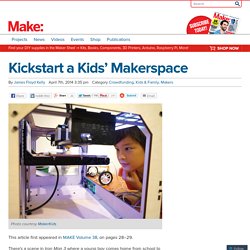
There’s a scene in Iron Man 3 where a young boy comes home from school to discover that his workshop has been outfitted with just about every cool maker gadget and tool imaginable, all provided by billionaire Tony Stark as a thank-you to the boy for assistance earlier in the movie. Only a handful of tools are recognizable — what’s memorable is the huge grin on the kid’s face when he opens that door and sees all the possibilities that are available to him. Yes, he’s a fictional character, but his real-life counterparts are out there — millions of American kids just waiting for their own workshops and hungry to learn and experiment and build. How many of the nation’s 54 million elementary and secondary students have access to the state-of-the-art tools that can spark creativity, nurture curious minds, and ignite the next wave of innovators? Creating a Classroom Makerspace Image composite: mysondanube/sreville/viktor_vector/iStock/ThinkStock by Luz Rivas I first became interested in computer programming when I was in 5th grade.
This influenced my career path, leading to 10 years working as an electrical engineer and in science and engineering education. Resources - Mason Makerspace - Elementary School Libraries at Leander ISD Elementary Schools. Makerspace. SDPL Labs: A Third Place for Creative Expression Our friends Monnee Tong and Uyen Tran at San Diego Public Library are the fearless teen (and tech!)

Advocates behind our series on the SDPL IDEA Lab. Today, Monnee gives an overview of how the IDEA Lab works– from equipment & software, to partnerships, to staffing. Enjoy! ~Erinn by Monnee Tong The IDEA Lab—it started with an... Build a Makerspace. Introduction by Dale Dougherty, founder of MAKE How do we give young people more opportunities to become makers and learn practical skills they can apply to their own creative projects?
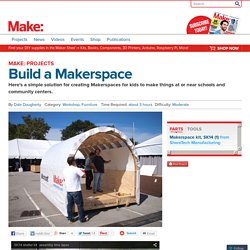
The question comes up after each Maker Faire, when I see how young people are inspired by other makers. I know they leave and want to start making things. Could schools offer more opportunities for making things? Could we provide potential makers a physical space to meet — a “makerspace” that can be organized with tools and supplies, so they can work on projects?
Our Makerspace Projects on Pinterest. Makerspace Resources. All the Makerspace resources you could hope for (and more) I first started learning about the Maker Movement in education and makerspaces in late 2013.
Since then, I’ve been using this page to compile and curate some of the best articles, videos, blogs, books and other resources that have helped me along the way. My hope is that you will consider this a go-to resource as you progress along your own Maker journey. No matter whether you’re just getting started with makerspaces or are looking to grow your program, there’s something here for you. What is the Maker Movement? Stocking Up School Makerspaces: Tools + Materials (Back to School) Lots of teachers have been asking us how to set up a Makerspace at their school.
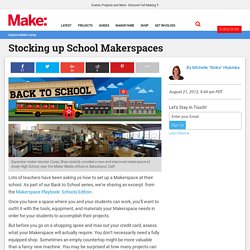
As part of our Back to School series, we’re sharing an excerpt from the Makerspace Playbook: Schools Edition. Once you have a space where you and your students can work, you’ll want to outfit it with the tools, equipment, and materials your Makerspace needs in order for your students to accomplish their projects. But before you go on a shopping spree and max out your credit card, assess what your Makerspace will actually require. You don’t necessarily need a fully equipped shop. Sometimes an empty countertop might be more valuable than a fancy new machine. Pinterest. Library MakerSpaces on Pinterest. Attempts at using tech effectively in our classrooms. On October 1st I started on my efforts toward creating a set of Makerspaces in our school district.
I immediately jumped into visiting the d.school at Stanford, collecting every book I could on the topic, and applied to attend the FabLearn conference. A Makerspace has been my goal since the first day I started as STEM Coordinator last year, so when I was recently given the flexibility and permission to move forward, I jumped on the opportunity immediately. 3 Key Qualities for a School Makerspace. Over the past year I had the privilege of leading a team to create makerspaces in 15 high schools around the Bay Area.
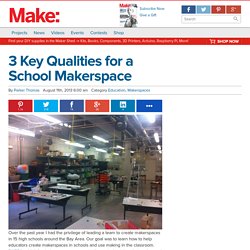
Our goal was to learn how to help educators create makerspaces in schools and use making in the classroom. DARPA, which funded our program, eventually wanted to take what we learned and create makerspaces in 1,000 schools. Want to Start a Makerspace at School? Tips to Get Started. As the Maker Movement starts to gain momentum, schools that are trying to find ways to foster the do-it-yourself environment can learn a few lessons from another nexus in the universe: public libraries.
Dale Dougherty, founding editor and publisher of Make Magazine — and the de facto leader of the Maker Movement — has a vision to create a network of libraries, museums, and schools with what he calls “makerspaces” that draw on common resources and experts in each community. Libraries and museums, he said, are easier places to incorporate makerspaces than schools, because they have more space flexibility and they’re trying to attract teens with their programs. Create a school makerspace in 3 simple steps. As maker education gains steam, many educators are looking for ways to incorporate making and tinkering into their schools and classrooms — often on a shoestring budget. “Kids are saying they want to learn more about technology and science, but they also want to experience it creatively and use it personally,” said Dale Dougherty, founder of Make Media, which produces Maker Faire and Make Magazine. He’ll address how educators can deliver these types of experimental learning experiences during ISTE 2014’s EdTekTalks, a provocative series of mini-keynotes from thought leaders beyond the world of ed tech.
“One of the ways we can do that is create more makerspaces for kids. Designing a School Makerspace. Makerspaces, STEAM labs and fab labs are popping up in schools across the country. Makerspaces provide hands-on, creative ways to encourage students to design, experiment, build and invent as they deeply engage in science, engineering and tinkering. A makerspace is not solely a science lab, woodshop, computer lab or art room, but it may contain elements found in all of these familiar spaces.
The maker movement: A learning revolution. By Sylvia Martinez and Gary Stager 7/21/2014 Topics: Maker movement, Project-based learning The impulse to create is one of the most basic human drives. As far back as the Stone Age, we were using materials in our environment to fashion tools for solving the problems we encountered. And in the millions of years since then, we have never stopped creating. In fact, the rise of civilization is largely defined by the progress of technology of one kind or another. Maker Movement Reinvents Education. Lectures are so old school; the Maker Movement is reinventing education You’ve hit your limit of 5 free articles this month.Try our subscription options: Weekly home delivery with free shipping, access to Newsweek’s web site, and the complete online archive. How the Maker Movement Is Moving into Classrooms. The Maker movement is a unique combination of artistry, circuitry, and old-fashioned craftsmanship.
Certainly, learning by doing or "making" has been happening since our ancestors refined the wheel. Don’t treat making as a sidebar to an already overtaxed curriculum. As you investigate the principles behind teaching STEAM via making, you'll see sound research from many educators throughout history, including Jean Piaget who, in 1973, wrote: What's the Maker Movement and Why Should I Care? Making Matters! How the Maker Movement Is Transforming Education. Makerspace-Playbook-Feb-2013.pdf. Makerspace Educational Library Ideas.
Why the 'Maker Movement' is Popular in Schools. ReMaking Education: Designing Classroom Makerspaces for Transformative Learning.