
Anchors, dynamic scroll and a menu that "knows" where you are on the page. Scroll & Pin Navigation - Scroll To Image Map Region + Pin to Browser.
Website Templates. Parallax Scrolling. Walt Disney: The World’s First UX Designer. I'm a huge fan of the Walt Disney park experience, and my family has traveled to Walt Disney World and Disneyland multiple times.
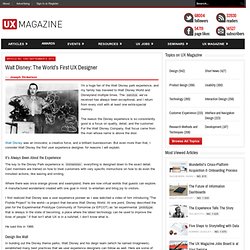
The service we’ve received has always been exceptional, and I return from every visit with at least one extra-special memory. The reason the Disney experience is so consistently good is a focus on quality, detail, and the customer. For the Walt Disney Company, that focus came from the man whose name is above the door.
Walt Disney was an innovator, a creative force, and a brilliant businessman. But even more than that, I consider Walt Disney the first user experience designer, for reasons I will explain. It’s Always Been About the Experience The key to the Disney Park experience is immersion: everything is designed down to the exact detail. Where there was once orange groves and swampland, there are now virtual worlds that guests can explore. He said this in 1966. Design like Walt Always be plussing: Disney was never completely satisfied.
Image courtesy Frank Horst. Why User Experience Cannot Be Designed. Advertisement A lot of designers seem to be talking about user experience (UX) these days.
We’re supposed to delight our users, even provide them with magic, so that they love our websites, apps and start-ups. User experience is a very blurry concept. Consequently, many people use the term incorrectly. Furthermore, many designers seem to have a firm (and often unrealistic) belief in how they can craft the user experience of their product. Heterogeneous Interpretations of UX I recently visited the elegant website of a design agency. The perception might not be representative of our industry, but it illustrates that UX is perceived in different ways and that it is sometimes used as a buzzword for usability (for more, see Hans-Christian Jetter and Jens Gerken’s article “A simplified model of user experience for practical application1”). Some research indicates that perceptions of UX are different.
Hassenzahl’s Model Of UX.
Investigating Cross-Channel Consistency. The gestalt principle of consistency has served designers well for generations.

But today, the designer’s canvas is expanding to include entire ecosystems where digital channels such as web and mobile must work in harmony with physical channels, from print media to the natural environment. As our remit expands, we must revisit the principles that have made us successful in the past, and reinterpret them for the future. The Merriam-Webster Dictionary defines consistency as the “agreement or harmony of parts or features to one another or a whole.”
As designers, we have an intuitive understanding of how to achieve consistency. As we move from designing simple to increasingly complex systems, however, our intuition must be bolstered with a more systematic approach. I suggest that consistency can be divided into two dimensions, which I call the realm of consistency and the nature of consistency. The Power of Value Stream Maps. Our experience as customers of a product or service is shaped by the various interactions that we have with it. Some of these touch points add value to customers while others do not. For example, a doctor's office may offer patients the ability to book appointments online, which likely adds value. However patients may find themselves waiting for an hour in the doctor’s office, clearly an instance of non-value added. From a business perspective, understanding these various touch points and their impact on customer experience offers useful insights.
The goal should be to eliminate or reduce all the non-value added activities to deliver an exceptional experience, and one tool for generating the required insights is a value stream map. A New Formula for Quantitative UX Decision Making. Imagine a formula that would allow you to take data from a very small pool of users (often as few as 8; possibly as few as 3) and figure out why, for instance, Autodesk customers are calling support, whether Budget.com visitors can rent a car in under a minute, or why cardholders were reluctant to use a mobile payment site.

Such a formula exists, and it’s not some abstract “formula for success” in management strategy or a design technique. We’re talking about a mathematical formula that’s easy to use but can transform the way you measure and manage the user experience. The formula is called the Adjusted-Wald Binomial Confidence Interval (“Adjusted-Wald Interval” for short), but its name isn’t as important as what it can do. Its power is in helping estimate the behavior of an entire user population, even when the sample size is small. It does this by taking a simple proportion as input and producing a confidence interval. Five Case Studies And Now, the Math Conclusion.