
Www.bced.gov.bc.ca/irp/docs/exp_curr_design. Connected Learning: Tying Student Passions to School Subjects. Big Ideas Teaching Strategies Quest to Learn By Ashley Williams, Youth Radio What if your extracurricular activities weren’t just extra but a part of your academics too?

New thinking on education intends to bring students’ interests into the classroom. It’s called Connected Learning and promotes the idea that students will excel in school if what they are learning is relevant to their lives, experiences, and passions. While students would still learn core subjects like math and science, Connected Learning provides ways for students to link their classroom lessons to their lives outside the school. “It’s important to diversify the kinds of entry points for the kinds of pathways that young people have.” Ito uses the Harry Potter Alliance to demonstrate how Connected Learning’s can be effective.
Ito says another prime example of Connected Learning is at Youth Radio. Here’s where Connected Learning could help close the opportunity gap. Related. How to Apply Design Thinking in Class, Step By Step. By Anne Stevens For educators ready to try the idea of design thinking, you’ll be glad to know it does not require extensive transformation of your classroom.
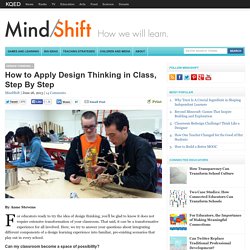
That said, it can be a transformative experience for all involved. Here, we try to answer your questions about integrating different components of a design learning experience into familiar, pre-existing scenarios that play out in every school. Can my classroom become a space of possibility? For students, the best classroom experience is a space of possibility. It can be challenging to transition a traditional classroom into a space of possibility. But in a classroom that is a space of possibility, the students have agency, and the products and processes can be moving targets. What Does ‘Design Thinking’ Look Like in School? Design Thinking Getty Images Design thinking can seem a bit abstract to teachers.

It’s not part of traditional teacher training programs and has only recently entered the teachers’ vernacular. Design thinking is an approach to learning that includes considering real-world problems, research, analysis, conceiving original ideas, lots of experimentation, and sometimes building things by hand. But few schools have the time or wherewithal to integrate these processes into the school day. But at the Nueva School in Hillsborough, Calif., a small, private school for grades K-8, design thinking is part of every class and subject, and has been integrated throughout the curriculum with support from a dedicated Innovation Lab or the iLab. “It’s really a way to make people more effective and to supercharge their innate capabilities,” said Kim Saxe, director of Nueva’s iLab, and one of the champions of design thinking.
Design Thinking in the Classroom. As children move from kindergarten, through middle school, and to high school, instruction shifts from stories to facts, from speculation to specifics, and imagination fades from focus.

Design Thinking provides an alternative model to traditional ways of learning academic content by challenging students to find answers to complex, nuanced problems with multiple solutions and by fostering students’ ability to act as change agents. Design Thinking is all about building creative confidence—a sense that “I can change the world.” In the Bullies & Bystanders Design Challenge, the students discovered that changing themselves might be even more important. The Bully and the Bystander This challenge began with a short story and ended with tears and a new-found sense of empathy for both bullies and bystanders. Melissa had attended a Design Thinking workshop for teachers at Stanford’s d.school.
In the weeks following the workshop, Melissa began implementing design challenges in her classroom. All Design Thinkers Ever Need To Know They Learned In Kindergarten. Building upon what I wrote last week about what I want to teach the world, I would like to suggest that all Design Thinkers ever need to know they learned in Kindergarten.

As I read the articles and blogs and watched the videos this week, I couldn’t help but think that in Kindergarten we DO this. It is not defined or labeled as such, but intrinsically and intuitively Kindergarten teachers and their students are Design Thinkers deep down. One of the frameworks for Design Thinking that resonated with me is the DEEP Design Thinking Model. The following graphic from DEEP creator, Mary Cantwell‘s website DEEPDesignThinking.com illustrates the DEEP model in very kid-friendly terms that I can relate to. Let’s face it…I teach Kindergarten and Grade One, not Grade 12 Physics or Philosophy (what I would consider the most difficult high school courses for me). For each of the four letters in DEEP there is a connection to what we do every day in Kindergarten. EMPATHIZE: understand, needfind, define. Design Thinking Workshop Presenters. Things We’ve Learned About Design Thinking, K-12 Education & 21st Century Learning.
Design thinking. For three decades, three big red letters have signified an annual forum for the creative and forward thinking to share groundbreaking ideas.

From revealing the first Apple Mac in 1984 to Jamie Oliver’s heartfelt plea for a Food Revolution in 2010, TED has been one of the best platforms in the world for making complex ideas completely gettable and easily sharable. It’s hard to believe that for most of its history TED conferences were only accessible to an elite audience with significant resources.
Lucky for us, seven years ago, curator Chris Anderson made these sessions available online to watch and download for free. Today, TED Talks are memes that instantly spread to millions across the world. I humbly count myself among those lucky enough not to just attend TED conferences, but also to speak at them occasionally. Stewart Brand, “The Dawn of De-Extinction. What are your favorite TED Talks and why? Human-Centered Design for Social Innovation » +Acumen. Design Kit: The Course for Human-Centered Design is a seven-week curriculum that will introduce you to the concepts of human-centered design and how this approach can be used to create innovative, effective, and sustainable solutions for social change.
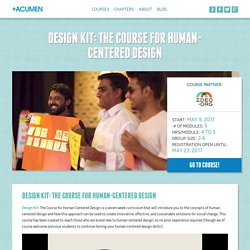
This course has been created to reach those who are brand new to human-centered design, so no prior experience required (though we of course welcome previous students to continue honing your human-centered design skills!) Our Learning Partner Acumen is excited to partner with IDEO.org in offering this course. Design Thinking in Schools: An Emerging Movement Building Creative Confidence in our Youth - Getting Smart by Guest Author - design thinking, IDEO, Innovation. By Sandy Speicher A few years ago I interviewed a group of high school students who had just taken a semester-long “Introduction to Design Thinking” course.

In the class, they did a series of projects with increasing complexity in order to learn the process of design. I asked Andrew, a freshman, to name his favorite project from the class. Without pause, he answered, the first one — designing a name badge for someone else.