
Instagram. Le world café : le brainstorming qui efface les clivages hiérarchiques. Originaire des Etats-Unis, cette méthode met en avant l'intelligence collective et développe des pistes concrètes pour les organisations.
Le brainstorming consiste bien souvent à réunir des participants autour d'une même table pour faire émerger des idées nouvelles. Le world café innove et propose un format tournant qui approfondit la réflexion et augmente le sentiment d'appartenance à un groupe. Les origines : Le premier world café a été organisé en 1995 par Juanita Brown et David Isaac, deux universitaires américains qui ont par la suite formalisé leur protocole dans l'ouvrage Shaping Our Futures Through Conversations That Matters. L'organisation du world café : Dans un premier temps, une vingtaine de personnes est répartie autour de plusieurs tables de 3 ou 4 participants . Pour favoriser les échanges et éviter la lassitude, le format idéal est de 6 tables.
Tous échangent durant 20 minutes. PLAYER sur Twitter : "Jour 2 de l'expérimentation du U : ça bosse dur chez PLAYER avec @ImFusio ! #intelligence collective #theorieU. ImFusio sur Twitter : "Jour 2 de l'expérimentation du U : ça bosse dur ! #intelligence collective #theorieU... ImFusio sur Twitter : "C'est parti pour deux jours d'expérimentation du U ! @ImFusio @playerparis #intelligencecollective...
Philosophie magazine sur Twitter : "EN KIOSQUES ☛ Pense-t-on mieux □ou à □❓ + #Karmapa, #Toqueville, #KenzaburôOé & @bernardpivot1. ImFusio sur Twitter : "Isaac Getz dans @Lopinion_fr #generationY #intelligencecollective #incubateurs... Isaac Getz : « Les entreprises traditionnelles sont, malgré elles, les plus grands incubateurs de start-up. La fabrique de l'Opinion « La jeunesse remet en cause une absence de liberté dans l’entreprise, liberté à laquelle elle s’est habituée.

L’entreprise sera adaptée aux jeunes le jour où elle arrêtera d’infantiliser les adultes » ImFusio sur Twitter : ".@AudreySaget64 @ImFusio @Lopinion_fr Talents et nouvelle gouvernance #intelligencecollective. Une ImFusienne dans l'Opinion ! Audrey Saget, co-fondatrice associée d’ImFusio, a été interviewée lundi dernier par Hugo Sedouramane pour le quotidien l’Opinion dans la rubrique Innovation, elle nous livre la vision “ImFusienne” de l’innovation managériale telle qu’elle se présente aujourd’hui : un nouveau paradigme à co-écrire et à co-réaliser avec nos organisations pour une “économie du Mieux”*.
Dans l’entreprise, « on parle de l’économie du mieux, c’est une nouvelle approche philosophique », souligne Audrey Saget, la cofondatrice d’ImFusio, un cabinet spécialisé dans la transformation culturelle et les métiers des organisations par l’intelligence collective. L’article relève notamment le fait que : Certaines approches sont plus « douces » que d’autres, mais toutes ont l’objectif de favoriser l’ouverture des salariés sur le monde.
Vivre et expérimenter le U, les 3 et 4 septembre prochain. Décidément, les fourmis savent travailler efficacement. Passer au management collaboratif : pièges et astuces. Le management collaboratif n’est en rien la panacée ultime aux déboires organisationnels des entreprises.
C’est une technique qui fonctionne dans un cadre précis et si des objectifs ont été définis en amont. Il s’agit d’optimiser la collaboration du personnel pour améliorer la performance de l’entreprise. Management collaboratif : mode d’emploi Donner la parole à l’ensemble des salariés ou les impliquer dans les décisions n’est pas un geste démocratique gratuit. Cela doit permettre d’augmenter leur motivation, leur bien vivre. Chrono Flex renvoie l’organigramme aux oubliettes, Actualité des PME. Accueil Hiérarchie simplifiée, chefs élus, salariés cooptés : un atout selon l'entreprise(...)

Cet article est réservé aux abonnés, pour en profiter abonnez-vous. Et aussi sur les Echos Les articles à la une Médias. Vaucanson Bretagne sur Twitter : ".@LeCnam De l'engagement des talents à l'intelligence collective #slowtransformation @ParlonsRH @storhaye" Chronique de votre carrière (18) : Réinventer le bonheur au travail... HBR France sur Twitter : "Les secrets de la pérennité des coopératives. #gouvernance #coopérative #scop.
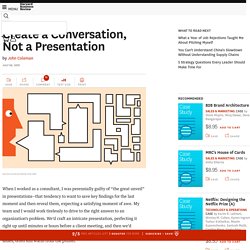
Pierre Gentile sur Twitter : "Créer des conversations et non des présentations ! #IntelligenceCollective via @HarvardBiz. Create a Conversation, Not a Presentation. Nicholas Blechman for HBR When I worked as a consultant, I was perennially guilty of “the great unveil” in presentations—that tendency to want to save key findings for the last moment and then reveal them, expecting a satisfying moment of awe.
My team and I would work tirelessly to drive to the right answer to an organization’s problem. We’d craft an intricate presentation, perfecting it right up until minutes or hours before a client meeting, and then we’d triumphantly enter the room with a thick stack of hard copy PowerPoint slides, often still warm from the printer. But no matter how perfect our presentation looked on the surface, we regularly came across major issues when we were in the room. These one-sided expositions frequently led to anemic conversations. Peter Senge : « L'intelligence collective se construit dans l'action partagée. », Idées.
Enjeux Les Echos – Il y a vingt-cinq ans, vous lanciez, avec votre livre La Cinquième Discipline, le mouvement de l’entreprise apprenante.
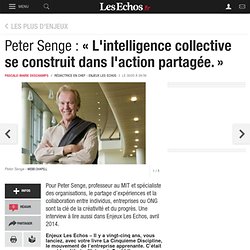
C’était aussi les débuts d’Internet. Quel bilan faites-vous de ce quart de siècle ? Peter Senge – Entre la diffusion d’Internet et la globalisation, l’environnement des entreprises et les entreprises elles-mêmes ont profondément changé. Mais les idées à la base de cet ouvrage restent d’actualité car les ressorts profonds de la créativité, eux, sont restés les mêmes. Créer une nouvelle entreprise ou lancer un projet, par exemple, requiert toujours autant de mobiliser l’imagination et l’intelligence collective. Dans La Cinquième Discipline, vous vous intéressiez à la complexité interne des entreprises. P. PLAYER sur Twitter : "D'où nait l'#Intelligence #Collective ? Réinventer d'autres futurs possibles avec Noveterra - Stéphane Riot présenté par c jaurand. ImFusio sur Twitter : "Isaac Asimov : de l'émergence des idées par la créativité... #pionnier #intelligencecollective. Quand Isaac Asimov décrivait l’environnement idéal pour faire émerger des idées nouvelles en anticipant le monde d’aujourd’hui.
Comment stimuler la créativité et l’innovation aujourd’hui ?
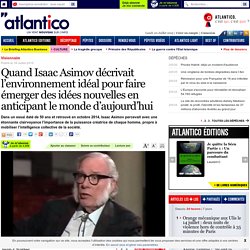
Par un saut dans le passé d’un demi-siècle, nous dirait le scientifique Arthur Obermayer. En octobre 2014, ilretrouva parmi ses dossiers un article fort intriguant écrit par son ami Isaac Asimov en 1959. A lire : le Livre Blanc 2 de l’Intelligence Collective édité par Colligence ! Colligence - A Player Paris vendredi dernier, avec Gilles... Manifeste pour inscrire l’intelligence collective au cœur d’une nouvelle révolution digitale. François Némo, ifbranding, Conseil en stratégie d’entreprise (@ifbranding)Bruno Teboul, directeur innovation et R&D chez Keyrus (@Brunoteboul)Ariel Kyrou, Essayiste, coauteur de « Ceci n’est pas un blasphème », Dernière Marge (@ArielKyrou)Yann Moulier Boutang, Economiste, codirecteur de la rédaction de Multitudes (@boutangyann) Une domination qui questionne Construire un nouveau modèle Notre « bien commun » peut-il dépendre de quelques entreprises visionnaires plutôt que d’une multitude d’acteurs réfléchissant et agissant ensemble ?
Les Scop sur Twitter : "#CNSCOP2015 #SCOP2016 Retour en textes et en images sur la Convention nationale des Scop ! LaFabriquedelaCité sur Twitter : "#inaugPLAYER un nouveau lieu dédié à l'#innovation et l'#intelligencecollective - place à l'#expérimentation. Thomas Barbelet sur Twitter : "#inaugplayer avec le Pr Sicard et Pr Haddad #ethique #education #OpenInnovation #intelligence... Intelligence collective : écrire en mode collaboratif. Ecrire à plusieurs, cela fait rêver certains et fait peur à d’autres… Sommes-nous réellement plus créatifs en groupe ?
Avez-vous déjà essayé d’écrire quelques lignes avec vos amis ou au travail en vous mettant d’accord sur chaque mot ? Quelles modalités d’intelligence collective mettre en place pour partager un objectif commun ? Quels sont les enjeux de l’écriture en mode collaboratif ? Peut-on apprendre à accompagner des collectifs dans un projet commun d’écriture ? D’où émergent la structure et le sens lorsque les intelligences et les savoirs se confrontent, mais aussi les egos et les angles morts ? Nous verrons comment constituer le champ sémantique commun, se mettre au service d’un thème et commencer à produire, créer les conditions de l’écriture à distance.
Pour présenter cette approche originale de la co-écriture, nous avons convié : Véronique Campillo, coach en écriture individuelle et collaborative. www.colligence.fr. Intelligence collective : écrire en mode collaboratif. Formation : Introduction à la démocratie participative et à l'intelligence collective. A pelles d'air. Si vous parlez avec moi, vous entendrez parfois le silence plus que les mots. Vous risquez de trouver cela un peu bizarre si vous ne me connaissez pas, surtout au téléphone. Cela ne veut pas dire que je m’ennuie ou que je ne sais pas quoi dire. Ne vous en formalisez pas ! Mes temps de silence, parfois les yeux fermés, viennent de moments de respiration. J’ai en effet décidé de suivre deux principes : respirer avant de parler, ne parler qu’avec la permission. Prendre le temps d’une longue respiration avant de parler me permet d’aller chercher des mots et des réponses que le pilote automatique ne nous offrira jamais. Il y a des moments où je ne donne pas de temps à cette respiration.
Je ne parle qu’avec la permission, lorsqu’on me le demande. World Forum Lille – Intelligence collective. Nathalie NOWAK – « Faire plaisir et se faire plaisir ». (with image, tweet) · WorldForumLille. L’intelligence collective est elle un luxe? Le Groupe Ferrein intègre désormais toutes les pédagogies collaboratives dans ses dispositifs de formation. Pour lever le voile sur ces nouveautés, nous vous proposons de découvrir et de partager le dernier né de l’Intelligence Collective. Ce livre blanc, auquel notre consultante partenaire Laure Rogez a contribué est le résultat du travail de vingt auteurs pour nous livrer les secrets de l’Intelligence Collective : Quelles formes d’Intelligence Collective mettre en place ?
L’intelligence collective est elle un luxe? Les nouvelles de la transformation culturelle et métier par ImFusio. MIT Center for Collective Intelligence. Complexité, turbulence et rapports au temps. Dans un passé pas si lointain, les cycles étaient longs. Peu de choses, biens ou activités trouvaient leur place dans un espace et un temps qui semblaient suffisants. Actuellement, nous ne pouvons plus caser toutes les activités dans le temps dont nous disposons et notre espace se trouve réduit par les biens qui s'y accumulent. Les moyens de communications réduisent aussi l'espace, que se soit pour atteindre un point distant physiquement (déplacements, voyages) ou virtuellement (communications).
Le manque de temps et d'espace nous fait arbitrer quelles activités nous allons laisser de côté et quels sont les biens dont il faut se défaire. Nous sommes bien dans l'ère du tri et de la soustraction, du "manger vite du tout prêt" et du jetable. Le "demain" du tableau annonce l'ère du partage. L'espace partagé, ce sont ces bureaux qui ne sont attribués à personne en particulier, mais qui servent aux "nomades" de passage. Changements et mutations. Intelligence collective. IC 0 > à supprimer. Theory U – The 1st Proposition.
I am a huge fan of C. Otto Scharmer’s Theory U. It is one of the most powerful frameworks for understanding the essential shifts we need to make as we step into this paradigm shift. Scharmer sums up his Theory U with seven propositions, I’m going to write a series of blog posts taking a closer look at each of them: Portail.intelligence.collective. Sign up for Twtpoll. Main Page. All Videos ? RSA Comment.
Five Innovative New Year's Resolutions. At a McKinsey alumni webcast on creative strategy last week, the presenters mentioned a book due to be soon published by INSEAD professor Hal Gregersen, Jeffrey Dyer of Brigham Young University and Clayton Christensen of Harvard. L'APPROCHE PAR LES CAPACITÉS D'AMARTYA SEN: QUELS ENSEIGNEMENTS POUR L'ÉCONOMIE SOCIALE? - FERRATON - 2008 - Annals of Public and Cooperative Economics. Introduction : À la recherche de principes novateurs pour l'action publique. The New Management – Bringing Democracy and Markets Inside the Organization. William Halal of George Washington University wrote this book in 1998, well before the advent of Web 2.0 and even longer before the term Enterprise 2.0 was coined.
I remember speaking to Dr. Halal about the concept of wirearchy back in late 2000 … he was most encouraging, and it’s not hard to imagine why. Despite attempts at organizational change during the ‘90’s, the decade was notable for down sizing, top-down control, extravagant CEO pay, and other hallmarks of the Old Management. Management 2.0 : c’est d. Décidement, c’est une vrai plongée dans le passé en ce moment. Après la « redécouverte » de Maslow chez les blogueurs français et américains , moi aussi je me tourne avec nostalgie vers un grand ancien.
En fait je ne connaissais pas ce monsieur Dee Hock (oui je sais, un manque de culture certain) avant qu’un collègue ne m’en parle, et je dois dire qu’en lisant un peu plus sur la question, j’ai déceler comme un parfum de de management 2.0. Voyons donc ce qui était possible avant de l’apparition des médias sociaux (et oui ce ne sont que des outils). En 1966, Dee Hock est convoqué par le président de la National Bank of Commerce (il y travaille depuis un an). Mind Mapping et Brainstorming en ligne - MindMeister. Mind42.com - Collaborative mind mapping in your browser. Best Online Collaboration Tools 2009 - Robin Good's Collaborativ. Business Process Planning. Webspiration: Online Visual Thinking Tool.
Bubbl.us - free web application for brainstorming online. XMind - Mind Mapping and Storming. Catalyst – Mind Mapping by Mindjet. Mind Mapping - Mindomo. Art Scape Presentation. The Content Economy by Oscar Berg: There's no shortcut to the fu. InShare0 On several occasions, on this blog and elsewhere, I've discussed why and how culture matters for Enterprise 2.0 to happen. In my most recent posts, I've specifically discussed how certain values and cultural characteristics are pre-requisites for Enterprise 2.0 to happen: My main point is that there is no chicken or the egg situation: Sure, a culture change can be supported and accelerated by technology, but there must always be a spark somewhere - a culture or subculture (a social group that shares certain values and behaviors) - that initiates this change.
If you, like me, are interested in what makes collaboration tick and what it might take besides technologies to make Enterprise 2.0 happen, there are a few readings you should look into. First, there's a fascinating read by Rob Paterson about the new virtual workplace at IBM. I say, the path to Enterprise 2.0 is paved on a supportive culture. If you roll it out, don’t expect “they will come”. In a word: culture.