
Zeitgeist Refuted and Exposed. Even secular scholars have rejected the idea of Christianity borrowing from the ancient mysteries.

The well-respected Sir Edward Evans-Pritchard writes in Theories of Primitive Religion that The evidence for this theory... is negligible. The first real parallel of a dying and rising god does not appear until A.D. 150, more than a hundred years after the origin of Christianity. So if there was any influence of one on the other, it was the influence of the historical event of the New Testament (resurrection) on mythology, not the reverse. The only known account of a god surviving death that predates Christianity is the Egyptian cult god Osiris. In this myth, Osiris is cut into fourteen pieces, scattered around Egypt, then reassembled and brought back to life by the goddess Isis. Watch the full documentary now.
The Ancient Web - the Ancient World's Great Civilizations. Roman Gods and Goddesses. Roman Gods and Goddesses In the beginning Roman gods were considered divine manifestations, faceless, formless, and powerful.
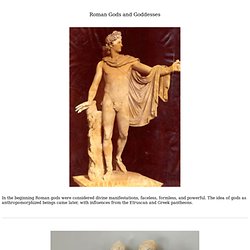
The idea of gods as anthropomorphized beings came later, with influences from the Etruscan and Greek pantheons. The Romans worshipped a main pantheon of 12 Gods called Dii Consentes: six gods and six goddesses: Jupiter, Juno, Minerva, Vesta, Ceres, Diana, Venus, Mars, Mercurius, Neptunus, Volcanus, and Apollo. 12 Around 1 Geometry of Creation Roman and Greek God Comparisons. AmpedStatus - Knowledge Is Power. Muhammad Biography. The name Baal: meaning, origin and etymology. Essenes, Essene Teachings and Essene Theology. Family tree of the Greek gods. Key: The essential Olympians' names are given in bold font.
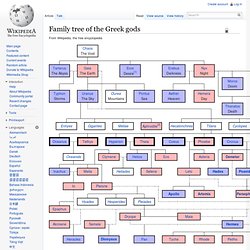
See also List of Greek mythological figures Notes External links Media related to Family trees of Greek mythology at Wikimedia Commons. Family tree of the Greek gods. NIMROD. —Biblical Data: Son of Cush and grandson of Ham; his name has become proverbial as that of a mighty hunter.

His "kingdom" comprised Babel, Erech, Accad, and Calneh, in the land of Sinar, otherwise known as the land of Nimrod (Gen. x. 8-10; I Chron. i. 10; Micah v. 5 [A. V. 6]). —In Rabbinical Literature: Nimrod is the prototype of a rebellious people, his name being interpreted as "he who made all the people rebellious against God" (Pes. 94b; comp. . ; Gen. His Feats as a Hunter. Nimrod was not wicked in his outh. Made King. According to another account, when Nimrod was eighteen years old, war broke out between the Hamites, his kinsmen, and the Japhethites. Nimrod is generally considered to have been the one who suggested building the Tower of Babel and who directed its construction. ) during the dispersion. Nimrod's Dream. The punishment visited on the builders of the tower did not cause Nimrod to change his conduct; he remained an idolater.
The Anti-Messiah Revealed. Ancient Egyptian Gods, Osiris, Isis, Hathor, Horus, Ra, Amun, Anubis, Nut, Ptah - Photos of Egypt - Images of Ancient Egypt - Pictures of Egypt - Photos of Ancient Egypt - Karnak, Pyramids, Tutankhamun, Abu Simbel, Aswan, The Nile, Edfu, Kom Ombo, Felucca. Four Highly Recommended Telescope, Accessory and Astro Imaging suppliers in the UK These are suppliers I have used and their Helpfulness and Customer Service have been second-to-none.
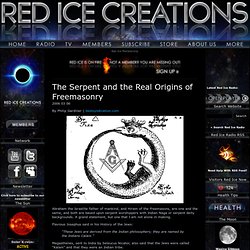
The Serpent and the Real Origins of Freemasonry. By Philip Gardiner | bestsyndication.com Abraham the Israelite father of mankind, and Hiram of the Freemasons, are one and the same, and both are based upon serpent worshippers with Indian Naga or serpent deity backgrounds.
A grand statement, but one that I am not alone in making. Flavious Josephus said in his History of the Jews: “These Jews are derived from the Indian philosophers; they are named by the Indians Calani.” Megasthenes, sent to India by Seleucus Nicator, also said that the Jews were called “Kalani” and that they were an Indian tribe. Clearchus of Soli said: “The Jews descend from the philosophers of India.
If Abraham as the father of the Jewish race is therefore a legendary figure of India, then who is he? The obvious person for an Indian Abraham is Brahma (A-Brahma) who just happens to have a consort and sister named Saraisvati [1] which is amazingly similar to the name of the Biblical Abraham’s wife - Sarai. Roman Gods and Goddesses. Godchecker.com - Your Guide To The Gods. Trinitarianism. #A99.
Osiris.pdf (application/pdf Object) Virgin Births (Mythology) Miraculous births are a common element in historical literature and religious texts.
Stories of miracle births often include miraculous conceptions and features such as intervention by a deity, supernatural elements, astronomical signs, hardship or in the case of some mythologies complex plots related to creation. Dharmic Mythology[edit] Hinduism[edit] In the story of Krishna the deity is the agent of conception and also the offspring. Because of his sympathy for the earth, the divine Vishnu himself descended into the womb of Devaki and was born as her son, Vaasudeva (i.e., Krishna). This is occasionally brought up as evidence for the hypothesis that "virgin birth" tales are a fairly common phenomenon in non-Christian religions around the world.[2][3][4] However, there is nothing in Hindu scriptures to suggest that it was a "virgin" birth.
In the Mahabharata epic, Karna was born to Queen Kunti by the deity Surya, before her marriage to King Pandu.[6][7] Buddhism[edit] Birth of Buddha[edit] Virgin Birth or Virgin Conception?