
Saturn's Moon Titan Could Support A Huge Human Colony. Mars gets a lot of press when we talk about colonizing another world.
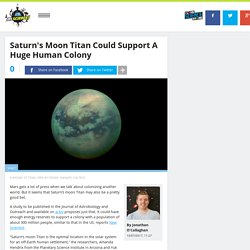
But it seems that Saturn’s moon Titan may also be a pretty good bet. A study to be published in the Journal of Astrobiology and Outreach and available on arXiv proposes just that. It could have enough energy reserves to support a colony with a population of about 300 million people, similar to that in the US, reports New Scientist. “Saturn’s moon Titan is the optimal location in the solar system for an off-Earth human settlement,” the researchers, Amanda Hendrix from the Planetary Science Institute in Arizona and Yuk Yung from Caltech in California, write in their paper.
Astronomers Have Found New Evidence That We Live In A Void. Our universe is not uniform.
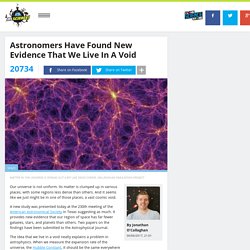
Its matter is clumped up in various places, with some regions less dense than others. And it seems like we just might be in one of those places, a vast cosmic void. A new study was presented today at the 230th meeting of the American Astronomical Society in Texas suggesting as much. It provides new evidence that our region of space has far fewer galaxies, stars, and planets than others. Two papers on the findings have been submitted to the Astrophysical Journal. The idea that we live in a void neatly explains a problem in astrophysics. “No matter what technique you use, you should get the same value for the expansion rate of the universe today,” said Ben Hoscheit from the University of Wisconsin-Madison, the study’s lead author, in a statement.
According to the findings, the spherical void we reside in is seven times larger than the average void, spanning a huge 1 billion light-years. 'Cold Spot' in space could prove the multiverse theory. In the desolate darkness of space it is difficult to imagine we are anything but alone in the cosmos.
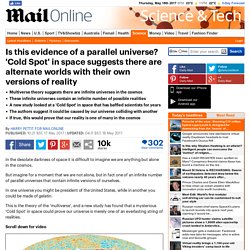
But imagine for a moment that we are not alone, but in fact one of an infinite number of parallel universes that contain infinite versions of ourselves. In one universe you might be president of the United States, while in another you could be made of gelatin. Nasa: Humans Have Inadvertently Created Artificial Barrier Around Earth. Updated | NASA space probes have discovered an artificial barrier around Earth created through human activity—showing we are not only responsible for shaping the environment on land, but that we are now having an impact on space too.
The barrier, which comes and goes, is the result of very low frequency radio communications interacting with particles in space, which results in a sort of shield protecting Earth from high energy radiation in space. This, scientists say, is potentially very good news, as we could use the barrier to protect Earth from extreme space weather resulting from events like coronal mass ejections—huge explosions on the sun, where plasmas and magnetic field are ejected from its corona, the outermost part of its atmosphere.
These ejections can result in geomagnetic storms, which have the potential to knock out communication satellites and power grids. Subscribe to Newsweek from $1 per week The result is a massive “VLF bubble” enshrouding Earth, NASA said. Fast Radio Bursts Definitely Come From Outer Space. There are many things in this universe we do not understand.
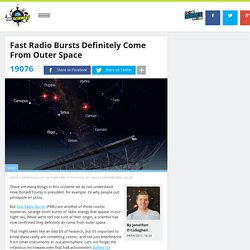
How Donald Trump is president, for example. Or why people put pineapple on pizza. But Fast Radio Bursts (FRBs) are another of those cosmic mysteries, strange short bursts of radio energy that appear in our night sky. While we’re still not sure of their origin, a scientist has now confirmed they definitely do come from outer space. That might seem like an odd bit of research, but it’s important to know these really are something cosmic, and not just interference from other instruments or our atmosphere. NASA's $1 Billion Probe Just Sent Back Incredible Photos of Jupiter Like You've Never Seen It Before.
The probe's data transmissions meanwhile are rewriting what we thought we knew about the origins of our solar system.

NASA’s $1 Billion Probe Just Sent Back Photos of Jupiter Like You’ve Never Seen It Before Roughly the size of a basketball court, NASA's Juno probe departed in 2011, hurtled through space for five years and finally made itself comfortable in Jupiter's orbit in July 2016. Now, at about 415 million miles from Earth, it has made its fifth close flyby of the Gas Giant and the images it sent home are breathtaking. NASA released a ton of software for free and here’s some you should try. NASA has just published its 2017-2018 software catalog, which lists the many apps, code libraries and tools that pretty much anyone can download and use.
Of course, most of it is pretty closely tied to… you know, launching spacecraft and stuff, which most people don’t do. But here are a few items that might prove useful to tinkers and curious lay people alike. If you’re interested in a piece of software, head to the link provided; it should provide the release or license type (some things are limited to the U.S., for instance), a contact you can hit up for more info and sometimes a dedicated site for the app or service.
Flying around looking at things, NASA style Say you’re building a drone or satellite from scratch. Once you’ve got the imagery on the ground, you might want to put it through PixelLearn, which lets you set rules about certain pixels and patterns, letting the program automatically find and categorize things like craters, buildings and so on.
One Year in Space Caused Genetic Changes in NASA's Twin Astronaut Experiment - Seeker. Spending a year in space affected former NASA astronaut Scott Kelly's body in subtle but potentially significant ways, new research suggests.
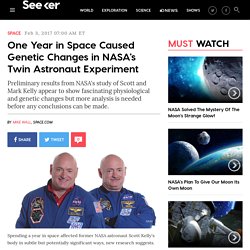
Kelly and cosmonaut Mikhail Kornienko flew the first-ever yearlong mission aboard the International Space Station (ISS), wrapping up the flight with a touchdown on the steppes of Kazakhstan last March. The goal of the project — which is ongoing, in the data-analysis phase — is to gauge the physiological and psychological impacts of long-duration spaceflight, to help prepare for crewed missions to Mars and other distant destinations. Part of this work involves Scott Kelly's identical twin brother Mark — a former NASA astronaut who flew on four space shuttle missions. Mark stayed on the ground during Scott's yearlong flight, serving as an experimental control that would allow scientists to detect genetic changes that spaceflight induced in Scott. Mind blown: The entire universe could be a hologram. Talk about a reality check: The entire universe could be a "vast and complex hologram," scientists reported Monday.
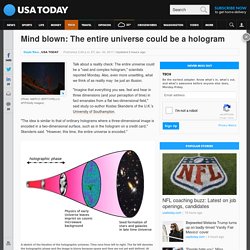
Also, even more unsettling, what we think of as reality may be just an illusion. "Imagine that everything you see, feel and hear in three dimensions (and your perception of time) in fact emanates from a flat two-dimensional field," said study co-author Kostas Skenderis of the U.K.'s . "The idea is similar to that of ordinary holograms where a three-dimensional image is encoded in a two-dimensional surface, such as in the hologram on a credit card," Skenderis said. "However, this time, the entire universe is encoded. " New theory of gravity might explain dark matter. A new theory of gravity might explain the curious motions of stars in galaxies.
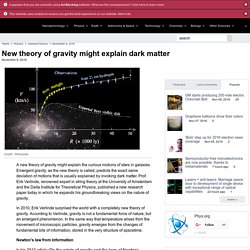
Emergent gravity, as the new theory is called, predicts the exact same deviation of motions that is usually explained by invoking dark matter. Prof. Erik Verlinde, renowned expert in string theory at the University of Amsterdam and the Delta Institute for Theoretical Physics, published a new research paper today in which he expands his groundbreaking views on the nature of gravity. In 2010, Erik Verlinde surprised the world with a completely new theory of gravity.
According to Verlinde, gravity is not a fundamental force of nature, but an emergent phenomenon. Scientists have detected a crack in Earth's magnetic shield. Earth is such a habitable place, thanks in no small part to the vast magnetic field that surrounds our planet, shielding us from harsh solar winds and cosmic radiation. But scientists have been investigating one of the most powerful geomagnetic storms in recent history, and they’ve discovered that our protective barrier isn’t as secure as we thought it was. Turns out, our magnetosphere has been cracked. Researchers have been analysing data from the GRAPES-3 muon telescope in Ooty, India, which recorded a massive burst of galactic cosmic rays on 22 June 2015. For 2 hours, Earth’s magnetosphere was being bombarded by these particles, which emit immensely high-energy radiation, and travel through space at nearly the speed of light. Scientists claim to have discover what existed BEFORE the beginning of the universe.
There are many scientific and non-scientific varieties of the answer about what came before Big Bang. Some say there was literally nothing and some say a black hole or a multiverse. But now a group of mathematicians from Canada and Egypt have analyzed some cutting edge scientific theory and a complex set of equations to find what preceded the universe in which we live. Their research paper has been published in Nature. To explain it in simple and easily understandable terms; they applied the theories of the very small i.e. the world of quantum mechanics, to the entire universe - explained by general theory of relativity, and discovered the universe essentially goes through four different phases. 25 Myths You Shouldn't Believe About Earth, Space, And Physics. Whenever someone strikes up a conversation with me about the universe, I get animated. No surprise there: I've made a living writing about astronomy, physics, geology, spaceflight, and related areas of science for nearly a decade, and have read obsessively on these topics for much longer than that.
However, people have shared a lot of peculiar "facts" with me over the years that ended up being totally false. Below are some of the silliest and most common claims I've heard. No one is perfect — I believed many of these statements at some point in my life — but it's time to put these myths, misconceptions, and inaccuracies to rest. Earth - Why there might be many more universes besides our own. Is our Universe one of many? The idea of parallel universes, once consigned to science fiction, is now becoming respectable among scientists – at least, among physicists, who have a tendency to push ideas to the limits of what is conceivable. In fact there are almost too many other potential universes. Physicists have proposed several candidate forms of "multiverse", each made possible by a different aspect of the laws of physics.
The trouble is, virtually by definition we probably cannot ever visit these other universes to confirm that they exist. So the question is, can we devise other ways to test for the existence of entire universes that we cannot see or touch? Worlds within worlds. Dutch crops grown on 'Mars' soil found safe to eat. Dutch scientists said Thursday crops of four vegetables and cereals grown on soil similar to that on Mars have been found safe to eat, amid plans for the first manned mission to the planet. Abundant harvests of radishes, peas, rye and tomatoes all grown on the soil were found to contain "no dangerous levels" of heavy metals, said the team from Wageningen University in the Netherlands.
"These remarkable results are very promising," said senior ecologist Wieger Wamelink. "We can actually eat the radishes, peas, rye and tomatoes, and I am very curious what they will taste like. " 'Alien Megastructure' Star Only Gets More Mysterious. NASA Announces The Discovery Of More Than 1200 New Exoplanets. NASA has announced a major breakthrough in its efforts to find planets outside the Solar System, leading them to reveal 1,284 new planets discovered by its Kepler space telescope. This is more than double the number it had found so far, which stood at 1,041. Universe Is Probably A Simulation: Neil DeGrasse Tyson. Neil DeGrasse Tyson has announced his belief that the universe is likely a vast simulation, containing everything we know of as reality.
How could this weird idea possibly be true? NASA Captures Stunning Photo of a Sonic Shockwave. Is the Universe a Simulation? Scientists Debate. NEW YORK — Is the universe just an enormous, fantastically complex simulation? If so, how could we find out, and what would that knowledge mean for humanity? There's A Powerful And Mysterious Signal Coming From The Core Of The Milky Way. DNews: Why Haven't Aliens Found Us Yet? Researchers discover the largest structure in the universe, and its HUGE! Researchers discover the largest structure in the universe, and its HUGE! Scholars have discovered a giant empty space in the universe where there are 10 billion galaxies missing. This incredible discovery could provide the first evidence for the existence of exotic physics which are absolutely unknown to modern science.
The expanse is being called the “supervoid” and measures a staggering 1.8 billion light years across! Astronomers Detect Host Galaxy of Fast Radio Burst for the First Time. Incredible New Map Of The Milky Way Released. NASA researchers are working on a laser propulsion system that could get us to Mars in 3 days. The simplest explanation of why we should care about gravitational waves.
Medium-Sized Asteroid Impact Would Darken The Sky And Freeze The World. Is Our Milky Way Galaxy A Zombie, Already Dead And We Don’t Know It? NASA Cuts Ties with Russia. This is how far human radio broadcasts have reached into the galaxy. NASA just saw something come out of a black hole for the first time ever.
Study may have found evidence of alternate, parallel universes. Earth Bloomed Early: A Fermi Paradox Solution? NASA finds enormous hole on the sun. Origin of the universe riddle solved by Canadian physicists – and, er, it wasn’t God. Insanely Fuel Efficient Engine Could Go To Mars And Back On One Tank Of Fuel. Gigantic Ice Slab Found on Mars Just Below the Planet's Surface. Congress and NASA: Commercial Crew program is underfunded. The Moon is Surrounded by Neon, NASA Probe Reveals.
What's The Fastest (Fictional) Spaceship In The Universe? Let's dig in to some truly eyebrow-raising theories about aliens. BBC Space Documentary - We are the Aliens. This Titan Submarine is one of Several Futuristic Projects NASA is Funding. 'Pyramid' discovered on Mars by Nasa Curiosity rover. Grand Theft Sedna: how the sun might have stolen a mini-planet - space - 19 June 2015. Pluto's Moons Are Even Weirder Than Thought.
How Did Life On Earth Start? Large Plasma Tubes Confirmed to Exist Above The Earth's Atmosphere. Astronomers discover largest known structure in the universe is ... a big hole. Alien Supercivilizations Absent from 100,000 Nearby Galaxies. VASIMR Rocket Could Send Humans To Mars In Just 39 Days. Aliens Are Enormous, Science Suggests. We've never seen the dwarf planet Ceres up close. That's about to change. Little star probably grazed our solar system, astronomers conclude. Mars One selects 1 'alien' and 99 human finalists to die on Mars - CNET. UK Scientists: Aliens May Have Sent Space Seeds To Create Life On Earth. Quantum Equations Suggest Big Bang Never Happened. Nasa twins to embark on year-long space experiment. Extreme Neptune-Like Planets Have the Potential to Become Habitable : Space. The Entire Milky Way Might Be a Huge Wormhole That’s Stable and Navigable.
Comet-Chasing Spacecraft Lands Probe After 10 Year Flight. Moon size UFO near sun may be evidence of Type II alien civilization - Honolulu exopolitics. For the first time, our region of the universe has a map and a name. This is the amazing design for NASA’s Star Trek-style space ship, the IXS Enterprise. A History of Garbage in Space. High-Energy Solar Winds Responsible For Lightning Strikes, Research Finds : News. Humans 'too stupid and religious to cope with aliens', claims expert. The Coolest Spaceships Ever Built, Compared by Size. New dwarf planet in the Oort cloud changes picture of solar system. Crystal is 'oldest scrap of Earth crust' Mars Orbiters See Clues to Possible Water Flows. Data Shows Universe Could Collapse Any Minute. Our universe is a hologram, and we’re floating inside of it, suggests new research. 'Remarkable' rocks within reach of Jade Rabbit rover.
Earth’s Mysterious Third Radiation Ring Driven By ‘Different Physics’ The truth IS out there: British scientists claim to have found proof of alien life - Science - News. S Grail Mission Solves Mystery of Moon's Surface Gravity. Can Earthlings Crowdfund a Moon Colony? 15-year-old Astronaut Abby fuels her outreach mission with social media.
INSATIABLE black hole in Milky Way's heart crams hot gas into cavity. Our Very Normal Solar System Isn't Normal Anymore : Krulwich Wonders... 'Earth-Like' Planets Discovered By NASA's Kepler Telescope Could Host Liquid Water, Agency Says. "An Alternative Universe Will Appear, Expand, and Destroy Ours" Meteor explodes over Russian Urals, injuring 950 – live updates. Mars Rover Spots Metallic 'Arm' Sticking Out Of A Rock (PICTURES) 13 more things: Dark flow - 02 September 2009. Astronauts (or other 'nauts) could find life on Mars quite healthy. NASA'S PhoneSat Wins 2012 Popular Science Best Of What's New Award. Surprising New Discovery Made Regarding the Development of a Galaxy.
Spectacular Nebula Photos Captured By Space Telescope's X-Ray Vision. Incredible Cosmic Spiral Helps Unravel Details of Stellar Evolution. Origin of Monster Black Hole's Energy Jet Revealed. NASA considers orbital outpost near moon as next big project in Morris, Illinois. Night-Shining Clouds Get Glow from Meteor Smoke. Liftport Is Kickstarting A Space Elevator - For The Moon. San Rafael boy gets letter from Neil Armstrong shortly before astronaut's death. Big Bang Was Actually a Phase Change: New Theory. Space smells like seared steak, hot metal, astronauts report. Every Black Hole Contains a New Universe.