
Being a Nurse means to hold all your own tears and start drawing smiles on people faces. (Nursing is Sacrificing) _ •● Ƹ̵̡Ӝ̵̨̄Ʒ ●•٠·˙ · [[126216480723638]]
9 in 10 Sinus Headaches Really Migraines. Untreated Migraine Cause of Most 'Sinus Headaches' Why do I need to register or sign in for WebMD to save?

We will provide you with a dropdown of all your saved articles when you are registered and signed in. Getting the Right Help If you are missing work or your child is absent from school because of a sinus headache, you need professional help. But which professional you see makes a difference. The 100 patients in the Eross study went to an average of four doctors each -- and still went on suffering. "Among folks who saw neurologists, 83% got a [correct] migraine diagnosis," Eross says. Most health plans require patients to see a general practitioner first. Eross ended up treating about half of the "sinus headache" patients in his study. Journal of Cerebral Blood Flow & Metabolism - Migraine and ischemic stroke: a debated question. Health Status Calculators. Medical Calculator Online. The Glycemic Index.
Foods. Food Comparison. The Vitamin C Foundation. Olives: How Healthy are They? Which Olives are Best? Olives: How Healthy are They?

Which Olives are Best? By www.SixWise.com Olives are one of the oldest foods known to man, dating back some 8,000 years in the Mediterranean region. The olive tree was valued as a symbol of peace and happiness, while olives were used as food and a source of oil. Today everyone knows how good olive oil is for health, but the humble olive is often passed up (often because they've unfairly gotten a bad rap for being high in fat).
All Olives Start Out Green If you take a look at your local supermarket, you'll see olives in a rainbow of colors, from green to brown to purple to black, with flavors just as diverse, ranging from sweet to sour. Unripe olives are incredibly bitter and not edible. Olives are picked at varying stages of ripeness (as they ripen they gradually turn from green to black) and cured using one of several processes, including soaking in oil, brine or water, or dry packing in salt. Cruciferous vegetables. This article is about the use of Brassicaceae as food.
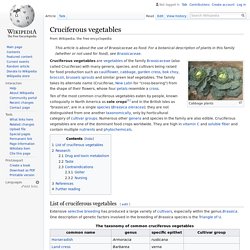
For a botanical description of plants in this family (whether or not used for food), see Brassicaceae. Cruciferous vegetables are vegetables of the family Brassicaceae (also called Cruciferae) with many genera, species, and cultivars being raised for food production such as cauliflower, cabbage, garden cress, bok choy, broccoli, brussels sprouts and similar green leaf vegetables. The family takes its alternate name (Cruciferae, New Latin for "cross-bearing") from the shape of their flowers, whose four petals resemble a cross.
List of cruciferous vegetables[edit] Extensive selective breeding has produced a large variety of cultivars, especially within the genus Brassica. Research[edit] Protein - what is protein and why is it important for good health. What is protein?

Protein is found in every cell, muscle and tissue of our body and is also present in many of the foods that we eat. The protein in our body is essentially the same as the protein in our food, except that it is structured differently. Spread the word, share this on your social networks! Basically proteins are made up of long chains of amino acids. There are 22 different types of amino acid and the body needs all of them to function properly. Amino acids are chemical compounds containing carbon, hydrogen, oxygen and nitrogen, which combine together into different structures to form the various types of protein that the body requires. There are many forms of protein, which all play an important role in the function of the body. Essential and non-essential amino acids The 22 types of amino acid are divided into two groups: essential and non-essential amino acids.
Model Diet Plan. Food cravings... Recipes. Food Nutrition Facts - Healthy Living Tips at WomansDay. Every child has heard the healthy-eating mantra "You are what you eat.
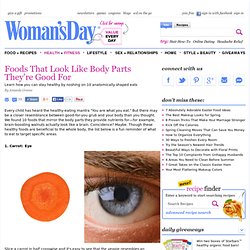
" But there may be a closer resemblance between good-for-you grub and your body than you thought. We found 10 foods that mirror the body parts they provide nutrients for—for example, brain-boosting walnuts actually look like a brain. Coincidence? Maybe. Though these healthy foods are beneficial to the whole body, the list below is a fun reminder of what to eat to target specific areas. 1. Slice a carrot in half crosswise and it's easy to see that the veggie resembles an eye—look closely and you'll even notice a pattern of radiating lines that mimic the pupil and iris. 2. The folds and wrinkles of a walnut bring to mind another human organ: the brain. 3. Long, lean stalks of celery look just like bones—and they're good for them, too.