ENGLISH. Home Tutor Scheme - Resources. 11 Interesting Ways to Teach Reading Comprehension in the Clas. The 100 Best Web 2.0 Classroom Tools Chosen By You. The Wordle of this list! (Click image to enlarge) World Clock - nice for to have up on the Whiteboard between lessons - PDF. LanguageGuide: Guias vocabulares, Guias gramaticais e Leituras.
The Grammar Aquarium. How To Create Valid MP3 Files With Audacity. One of the more popular open source audio applications, Audacity, has recently upgraded to version 2.0 and is now no longer in Beta.
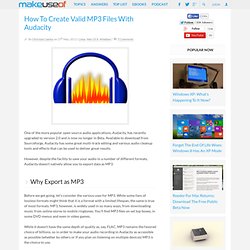
Available to download from Sourceforge, Audacity has some great multi-track editing and various audio cleanup tools and effects that can be used to deliver great results. To Be Reviewed. The 55 Best Free Education Apps For iPad. Finding apps isn’t difficult.
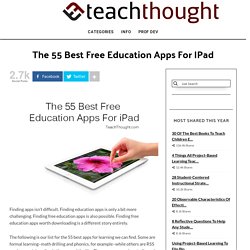
Finding education apps is only a bit more challenging. Finding free education apps is also possible. Finding free education apps worth downloading is a different story entirely. The following is our list for the 55 best apps for learning we can find. Some are formal learning–math drilling and phonics, for example–while others are RSS readers, social media platforms, and the like. A few notes: 1. 2. 3. 4. 5.
The 55 Best Free Education Apps For iPad 1. Developer Description: View 360-degree panoramas of places around the globe with Street View; View high resolution satellite imagery of locations around the world. 2. Developer Description: “…explore more than 750 Science, Math, Social Studies, English, Engineering & Tech, Arts & Music, and Health subjects right on their mobile devices. 3. Developer Description: “This app is a fun way for parents, teachers, librarians, and readers to get more information about top rated books at the fifth and sixth grade level.
Fast Drawing for Everyone. If you’re interested in learning more about the magic behind AutoDraw, check out “Quick, Draw!”
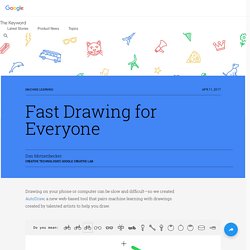
(one of our A.I. Experiments). AutoDraw’s suggestion tool uses the same technology to guess what you’re trying to draw. Résumés 1: Introduction to Résumés. What is a résumé?
A résumé is a brief document that summarizes your education, employment history, and experiences that are relevant to your qualifications for a particular job for which you are applying. The purpose of a résumé (along with your cover letter) is to get an interview. Research has shown that it takes an average of ten (10) interviews to receive one (1) job offer, so your résumé needs to be persuasive and perfect. Given this, your résumé must be user-centered and persuasive. What should it look like? The 55 Best Free Education Apps For iPad. Apps. Bloomin' Apps. This page gathers all of the Bloomin' Apps projects in one place.Each image has clickable hotspots and includes suggestions for iPad, Android, Google and online tools and applications to support each of the levels of Bloom's Revised Taxonomy.I have created a page to allow you to share your favorite online tool, iOS, or Android app with others.
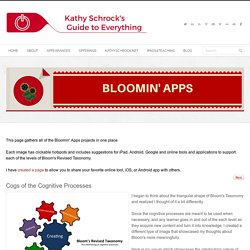
Cogs of the Cognitive Processes I began to think about the triangular shape of Bloom's Taxonomy and realized I thought of it a bit differently.Since the cognitive processes are meant to be used when necessary, and any learner goes in and out of the each level as they acquire new content and turn it into knowledge, I created a different type of image that showcased my thoughts about Bloom's more meaningfully.Here is my visual which showcases the interlocking nature of the cognitive processes or, simply, the "Cogs of the Cognitive Processes".
Whiteboard. Modifying the Flipped Classroom: The "In-Class" Version. So.
You've tried flipping your class, and it didn't go well. Or you've heard about flipping and want to try the approach, but you're pretty sure it won't work in your school. The Flipped Classroom. More and more, you might hear about the flipped classroom.
What is it? Well, the flipped classroom is a teaching model where students do traditional classroom activities, such as listen to lectures, at home via the Internet, resulting in more time for engaging practice activities in class. It’s a nice setup because students listening to lesson materials at home can set whatever pace they are comfortable with.
For example, lower level students can view materials multiple times and higher level students can breeze through everything more quickly. The Flipped Foreign Language Classroom: RESOURCES. The Flipped Language Classroom RESOURCES Below are resources for exploring the possibilities of the flipped classroom, professional learning networks where educators are discussing blended learning and reverse instruction, and tools for designing your own flipped language classroom!
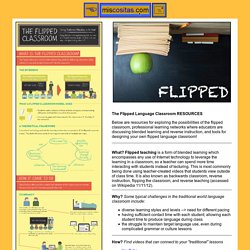
What? Flipped teaching is a form of blended learning which encompasses any use of Internet technology to leverage the learning in a classroom, so a teacher can spend more time interacting with students instead of lecturing. This is most commonly being done using teacher-created videos that students view outside of class time. It is also known as backwards classroom, reverse instruction, flipping the classroom, and reverse teaching (accessed on Wikipedia 11/11/12). Video Lesson: Mr. Bean. Follow me on twitter.