
Easy test makers. How humans learn best. Natural Learning: The Brain Based Principles. Education and educators are in the spotlight as never before.
Parents, politicians, business, and the media are calling for better “results.” And yet almost no attention is being publicly paid to how people learn naturally, and what sort of teaching best addresses natural learning. We first visited this issue in 1990 with an article in Educational Leadership, and in 1991 with out book Making Connections: Teaching and the Human Brain, both of which introduced the notion of brain based learning and 12 our Brain / Mind Learning Principles. Learning Techniques.
One of the things that we expect you to pick up by osmosis, but almost never mention explicitly, is techniques for learning itself.
After you leave university, you will be expected to be able to learn by yourself for the rest of your life. And an hour spent addressing the meta-issue of learning skills pays off in reduced time to actually learn. THE BRAIN FROM TOP TO BOTTOM. How Forgetting Helps Us Remember. But forgetting is actually a good thing.
In fact, forgetting enables us to remember. A case in point: the Russian journalist Solomon Shereshevskii, who became famous early in the 20th century for his astounding memory. He could recite entire speeches, complex math formulas, long lists of nonsense syllables and other bits of information after hearing them only once and then do it again years later, according to his neuropsychologist, Alexander Luria. Neuroscience Of Learning. The Neuroscience Of Learning: 41 Terms Every Teacher Should Know by Judy Willis M.D., M.Ed., radteach.com As education continues to evolve, adding in new trends, technologies, standards, and 21st century thinking habits, there is one constant that doesn’t change.
The human brain. Memory. 9 Brain Facts. 12.6K Flares Filament.io 12.6K Flares × One of the things that surprises me time and time again is how we think our brains work and how they actually do.
On many occasions I find myself convinced that there is a certain way to do things, only to find out that actually that’s the complete wrong way to think about it. For example, I always found it fairly understandable that we can multitask. Well, according to the latest research studies, it’s literally impossible for our brains to handle 2 tasks at the same time. Open Monitoring Meditation. Today’s article is by TeachStreet’s Kenji Crosland.
TeachStreet is a website dedicated to providing local and online classes, as well as connections to reliable psychology tutors. The Psychology of Wellbeing is a featured blog on the TeachStreet website. You can learn more about TeachStreet’s educational community here. Wisdom - Diamond Light by h.koppdelaney The philosopher and spiritual teacher J. First there’s the act of “observing” and then there’s the act of “analyzing, judging and labeling” what we have observed. In “open monitoring meditation” one begins to practice “awareness of thinking.”
John Medina. Rule #1: Exercise boosts brain power.
The human brain evolved under conditions of almost constant motion. From this, one might predict that the optimal environment for processing information would include motion. Language learning. At the Swedish Armed Forces Interpreter Academy, young recruits learn a new language at a very fast pace.
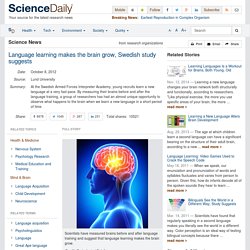
By measuring their brains before and after the language training, a group of researchers has had an almost unique opportunity to observe what happens to the brain when we learn a new language in a short period of time. At the Swedish Armed Forces Interpreter Academy in the city of Uppsala, young people with a flair for languages go from having no knowledge of a language such as Arabic, Russian or Dari to speaking it fluently in the space of 13 months. From morning to evening, weekdays and weekends, the recruits study at a pace unlike on any other language course. As a control group, the researchers used medicine and cognitive science students at Umeå University -- students who also study hard, but not languages. Both groups were given MRI scans before and after a three-month period of intensive study.
How sleep helps. Sleep helps the brain consolidate what we've learned, but scientists have struggled to determine what goes on in the brain to make that happen for different kinds of learned tasks.
In a new study, researchers pinpoint the brainwave frequencies and brain region associated with sleep-enhanced learning of a sequential finger tapping task akin to typing, or playing piano. How The Brain Learns.
What Happens When You Learn? Accelerated Learning. Learning Techniques. Learning theory. Photo by Antenna on Unsplash.
WIKI - Learning. Play has been approached by several theorists as the first form of learning. Children experiment with the world, learn the rules, and learn to interact through play. Lev Vygotsky agrees that play is pivotal for children's development, since they make meaning of their environment through play. 85 percent of brain development occurs during the first five years of a child's life.[6] The context of conversation based on moral reasoning offers some proper observations on the responsibilities of parents.[7] Types of learning[edit] Non-associative learning[edit]
VocabSushi. Life Learner.