

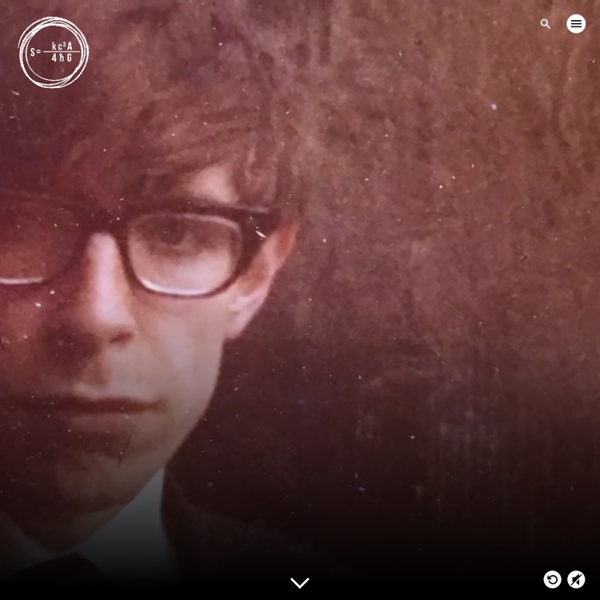
Stephen Hawking English theoretical physicist, cosmologist, and author (1942–2018) Stephen William Hawking CH CBE FRS FRSA (8 January 1942 – 14 March 2018) was an English theoretical physicist, cosmologist, and author who, at the time of his death, was director of research at the Centre for Theoretical Cosmology at the University of Cambridge.[17][18][7] Between 1979 and 2009, he was the Lucasian Professor of Mathematics at the University of Cambridge. Hawking was born in Oxford, into a family of physicians. In October 1959, at the age of 17, he began his university education at University College, Oxford, where he received a first-class BA degree in physics. In October 1962, he began his graduate work at Trinity Hall, Cambridge, where in March 1966, he obtained his PhD degree in applied mathematics and theoretical physics, specialising in general relativity and cosmology. Early life Family Hawking was born on 8 January 1942[24][25] in Oxford to Frank and Isobel Eileen Hawking (née Walker). Career Death
Bienvenue sur labosims - LABOSIMS IceCube Blog Trois lois de la robotique Un article de Wikipédia, l'encyclopédie libre. Les Trois lois de la robotique, formulées par l'écrivain de science-fiction Isaac Asimov, sont des règles auxquelles tous les robots positroniques qui apparaissent dans ses romans doivent obéir. Énoncé[modifier | modifier le code] Un robot ne peut porter atteinte à un être humain, ni, en restant passif, permettre qu'un être humain soit exposé au danger.Un robot doit obéir aux ordres qui lui sont donnés par un être humain, sauf si de tels ordres entrent en conflit avec la Première loi.Un robot doit protéger son existence tant que cette protection n'entre pas en conflit avec la Première ou la Deuxième loi. Au cours du cycle des livres sur les robots, une loi zéro, qui prendra une importance considérable, sera instituée par deux robots, R. Histoire[modifier | modifier le code] Extrait du dessin-animé Superman: The Mechanical Monsters (1941). On remarquera cependant des récits de science-fiction qui suivent la même inspiration qu'Asimov. « 1.
Banque des Savoirs - Essonne Stephen Hawking Un article de Wikipédia, l'encyclopédie libre. Pour les articles homonymes, voir Hawking. Stephen William Hawking Image de Stephen Hawking réalisée par la NASA en 1974. Signature Stephen William Hawking (prononcé [ˈstiːvən ˈhɔːkɪŋ ] Écouter), CBE, né le à Oxford, est un physicien théoricien et cosmologiste britannique. La clé des principaux travaux scientifiques de Stephen Hawking à ce jour est fondée, en collaboration avec Roger Penrose, sur l'élaboration des théorèmes des singularités dans le cadre de la relativité générale, et la prédiction théorique que les trous noirs devraient émettre des radiations, aujourd'hui connues sous le nom de radiations de Hawking (ou parfois radiations de Bekenstein-Hawking)[4]. Biographie[modifier | modifier le code] Après la naissance de Stephen, la famille part s'installer à Londres, où son père dirige la division de parasitologie de l'Institut national de la recherche médicale[7]. En 1950, toute la famille déménage à St Albans dans le Hertfordshire.
Etienne Klein | Site de vulgarisation scientifique SpaceWeather.com -- News and information about meteor showers, solar flares, auroras, and near-Earth asteroids Sélection sexuelle Initialement proposée par Darwin dès 1859, l'idée d'une sélection sexuelle a été rejetée pendant plus d'un siècle, victime des a priori des biologistes. Ce n'est que dans les années 1990 que ce domaine de recherche a pris son essor, la sélection sexuelle se révélant être en réalité une pierre angulaire de la sélection naturelle. Présentation générale[modifier | modifier le code] Le concept de sélection sexuelle désigne, dans la compétition entre les individus d'une même espèce en vue de l'accouplement, l'évolution de certains traits héréditaires de façon indépendante des facteurs de survie propres (ex : le plumage de parade nuptial du paon est un phénotype clairement désavantageux pour échapper aux prédateurs mais très avantageux dans la séduction d'une femelle). En biologie évolutive, la sélection naturelle correspond à toute sélection d'une meilleure capacité de survie ou de se reproduire dans un contexte donné (écosystème à l'équilibre, écosystème en crise, etc). En règle générale :
@.Ampère et l'histoire de l'électricité Lucy Hawking Un article de Wikipédia, l'encyclopédie libre. Lucy Hawking Éducation et carrière[modifier | modifier le code] Hawking étudit le français et le russe à l'Université d'Oxford, puis a commencé à travailler comme journaliste[4]. Hawking a écrit deux romans: Jaded (2004) et Run for Your Life (2005) (également aidé à la publication de The Accidental Marathon). En 2007, elle a publié George's Secret Key to the Universe, une histoire d'aventure où un petit garçon appelé George trouve un moyen de passer à travers un portail généré par ordinateur et voyage autour du système solaire. En avril 2008, Hawking a participé à une série de conférence à l'occasion du 50e anniversaire de la NASA, notamment à une conférence sur les enfants et l'enseignement des sciences. Hawking est un membre du personnel administratif de l'Autism Research Centre (ARC), qui est situé au sein de l'école de médecine clinique du Département de psychiatrie, Section du développement de la psychiatrie, à l'Université de Cambridge.