
Connecting Educators Through Digital Games: SimCityEDU Preview and Giveaway! Date(s) and Time: October 31, 201304:00 pm - 05:00 pm EST Provided by: Institute of Play.

A 6-Step Process For Adding Gamification To Your Classroom - A 6-Step Process For Adding Gamification To Your Classroom Gamification is the integration of game-like mechanics into non-game “stuff.”

For years, schools have been gamified. Points for performance. Points accrue to earn “badges” (e.g., letter grades). Students are separated and ranked (e.g., class ranks). While this approach offers tremendous potential that has yet to be tapped (uncovering the nuance of the learning process, for example), it can also be approached from a simpler point of view–added in to the instructional design process, which the following graphic from Mia MacMeekin takes a look at. Mobile Devices Are K-12's Pearl Harbor. Being Mobile | Blog Mobile Devices Are K-12's Pearl Harbor We have said this many times — and been taken to the wood shed for saying it — but we absolutely are convinced of its veracity: To a first approximation, the impact of computing technologies on K-12 education in the United States has been zero.

The classroom still looks the way it has looked: desks facing the front of the room where the teacher stands and tells learners stuff. On those desks is dead-tree technology. Home - 3DGameLab Wiki. How to Become a Game Designer. Two Types of #Gamification. CSU Resources Here are some resources you may find helpful from the workshop.
When you are in the classroom or teaching online, you may want to find new and interesting ways to engage students. Here is a course titled How to Increase Learner Engagement which provides ten great ideas for breaking away from the lecture and working toward engaging […] Alternate Reality Game (ARG) for K-12. World of Classcraft. New school trend: Zombie-based learning. A day on the job for Bellevue-based middle school teacher David Hunter starts just like any other teacher's day: He gets to class, settles his students down and takes attendance before he gets down to business -- talking about zombies and geography.

Hunter's unique approach takes subjects that some kids struggle to pay attention to and turn them into something that they look forward to. His idea was to create a full geography curriculum (using National Geography Standards) taught in the context of a zombie apocalypse. Using textbooks, teaching plans and role playing as tools, he draws his students into a dynamic scenario that allows them to have fun while learning. About the Game - World Peace Game Foundation. The game is actually far more complex than glimpsed in the TED Talk or in the documentary film.
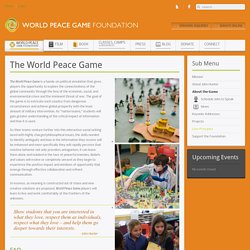
Here’s what the game requires to be facilitated, played, and maintained: Students who play must: possess a certain “intellectual stamina” and can wrestle over an extended period of time with tough problems that are without quick or easy resolutioncan interact constructively with others different from themselves (diversity as much as possible)can forestall closure and handle the certain frustrations of endless challenges and conflicts as they collaborate to achieve peace Teacher / Facilitators who wish to use the game must: In short, charisma, compassion, connectivity, creativity, patience, and awareness are all necessary in great measure.
Obama says we need more gamers. Who are we to argue? Technology came up again and again during President Barack Obama’s first “Fireside Hangout” on YouTube.

In order to ensure that America remains a hub of innovation and entrepreneurship, he emphasized the importance of education, economic, immigration, and patent reform, and said he strongly supported teaching compute programming in schools. He even endorsed video games thanks to a recent encounter with Facebook founder Mark Zuckerberg. “The concept of vocational education got a bad rap at some point because of the perception it was tracking folks into blue collar jobs, but all those categories have eroded,” Obama said.
Look at Mark Zuckerberg. I was sitting next to him at dinner a couple of years ago, and he said he taught himself programming primarily because he was interested in games. Game-Based Learning Ideas from ISTE. 8 Reasons that We Should Teach to the Game (#GBL) From James Paul Gee, David Williamson Shaffer : Looking where the light is bad: Video games and the future of assessment Abstract In the past we have referred to games as good “learning engines.”

Here we argue that games are good learning engines because they are first good assessment engines. Games require the kind of thinking that we need in the 21st Century because they use actual learning as the basis for assessment. Long games and grand strategies. How Gamification Works - 3D GameLab. Instead of courses consisting mainly of textbook learning and lectures, classes built using game mechanics such as badges, experience points, levels and leaderboards, boost student engagement by allowing students to choose from “quests” and progress at their own pace through a series of educational activities.
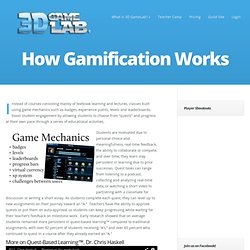
Students are motivated due to personal choice and meaningfulness, real-time feedback, the ability to collaborate or compete, and over time, they learn stay persistent in learning due to prior successes. Quest tasks can range from listening to a podcast, collecting and analyzing real-time data, or watching a short video to partnering with a classmate for discussion or writing a short essay. Leveraging Technology for Learning. Jane McGonigal: “Gaming turns you into a. 20 Educational Games Perfect For Young Students. Even though older adults might still carry a negative association with video game consoles and devices, today’s technology is vastly different than it was 20 years ago. Apps have exploded on the scene, and while there are plenty of time wasting games available on the market, today’s offerings also include a wide range of affordable apps that enrich learning and allow for quick on-the-go play. Whether your child is waiting for the doctor or relaxing on a long car ride, the following apps are some of the best games that pack an educational punch. 1.
The Letter School The Letter School app won the Editor’s choice for Children’s Technology Review for 2012. 2. From the makers of Angry Birds comes Amazing Alex . 3. If your child likes puzzle games and math, Awesum is a fantastic combination of Tetris and Sudoki. 4. Traveling explorers and geographers will love the Barefoot World Atlas app available for iOS devices. 5. 6. 7. 8. 9. 10. 11. 12. 13. 14. The app is available for the Windows Phone. The BYOT Daily. A Good Chart on Traditional Classroom Game Play Vs Game-based Learning. Refining “Game-based Learning” VEJ June 2013 by Edovation. Leveraging Technology for Learning. G.A.M.E. - Gamers Advancing Meaningful Education. Edurealms.com. JumpStart Launches Educational MMORPG School of Dragons. JumpStart has launched its newest educational multiplayer online game, School of Dragons™.

The game is based on DreamWorks Animation’s How To Train Your Dragon franchise, and is one of the first massively multiplayer online role-playing games (MMORPG) to incorporate basic science educational features in its gameplay. School of Dragons blends together three fields – film, online games, and television– to create an immersive online gaming experience for youth, allowing players to interact, play, and learn with familiar faces from the hit animated film, such as Hiccup and his dragon Toothless. As players train their own dragons and become fierce Viking adventurers in the game, they will learn key concepts in the scientific method through activities based on earth, life, and physical sciences.