
Language of flowers. The language of flowers, sometimes called floriography, is a means of cryptological communication through the use or arrangement of flowers. Meaning has been attributed to flowers for thousands of years, and some form of floriography has been practiced in traditional cultures throughout Europe, Asia, and the Middle East. Plants and flowers are used as symbols in the Hebrew Bible — particularly of love and lovers in the Song of Songs,[1] as an emblem for the Israelite people[2] and for the coming Messiah[3] — and of Jesus Christ in the New Testament.[4] In Western Culture, William Shakespeare ascribed emblematic meanings to flowers, especially in Hamlet, Prince of Denmark. Interest in floriography soared in Victorian England and in the United States during the 19th century. History[edit] Floriography was popularized in France about 1810–1850, while in Britain it was popular during the Victorian age (roughly 1820–1880), and in the United States about 1830–1850.
Discover Sanskrit. Untitled. In these pages are detailed (in an abridged form) an ancient form of magick that has been presented traditionally and updated for modern practitioners.
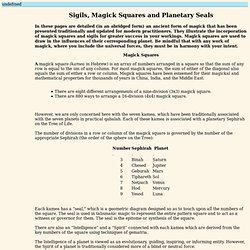
They illustrate the incorporation of magick squares and sigils for greater success in your workings. Magick squares are used to draw in the influences of their corresponding planet. Be mindful that with any work of magick, where you include the universal forces, they must be in harmony with your intent. Magick Squares.
Theban alphabet. The origins of the Theban alphabet are lost in the mists of time.
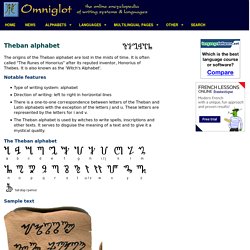
It is often called "The Runes of Honorius" after its reputed inventor, Honorius of Thebes. It is also known as the 'Witch's Alphabet'. Notable features Type of writing system: alphabet Direction of writing: left to right in horizontal lines There is a one-to-one correspondence between letters of the Theban and Latin alphabets with the exception of the letters j and u.