
Food Miles Calculator. Planet Money Makes A T-Shirt. Why A T-Shirt?
Plastic Bag Footballs for Africa Cup of Nations. Climate Change Is Forcing Entire Countries to Migrate. The people of Kiribati are going to have to move.
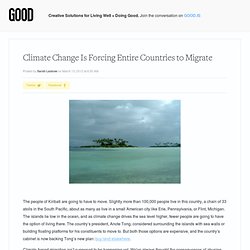
Slightly more than 100,000 people live in this country, a chain of 33 atolls in the South Pacific, about as many as live in a small American city like Erie, Pennsylvania, or Flint, Michigan. World Heritage Centre - World Heritage Map. Eagle Eye: The Best Satellite Views of the Earth. DigitalGlobe / Getty Images Burning Man festival in Nevada, Aug. 28, 2012. If you really want to know where you are, you need to pull back—way back. DigitalGlobe has rounded up the most amazing satellite images of the Earth created this year, ranging from a glimpse of the desert cauldron of creativity that is Burning Man to a massive copper mine in the South American country of Chile.
International Education Week (IEW) 2012. International Education Week (IEW) is an opportunity to promote the importance of building an international dimension into the education of young people in the UK at primary and secondary levels.
We know that familiarity with other cultures and modern foreign languages skills are an essential part of preparing young people to work in the increasingly globalised economy. The British Council is an authoritative voice on language learning, through our English teaching around the world, and we bring an intercultural dimension to foreign language learning in the UK through sharing our experiences, providing research and data and bringing in examples of international best practice. This year IEW supported a major policy shift in UK schools. From September 2014 primary schools in England will be required to teach a foreign language to pupils at Key Stage 2 (upper primary). There is also increasing policy support in other UK countries for language learning at primary level. Objectives Audiences. TonyPickford1 : Landfill. Gulls. No need to... New Ideas and a Global perspective. Seems like this blog is turning into a comments column for Steve Wheeler's ideas, but I wanted to comment on his latest post and found the comment facility in his blog just didn't appear to work on the iPad (or at least, my iPad).
The discussion of Rogers's model of innovation in current contexts is fascinating, but it set me thinking about it's applicability in global contexts. Does it describe innovation patterns in the developing world as well as in 'the North' (oh, how I hate that expression, but it's a useful shorthand for what we used to call the developed world or the West)? I am thinking particularly of the mass take-up of mobile technologies in rural Africa and India, where technologies have seemed to 'skip a generation' because landline communications were never well-established. The transformational impact of these technologies on culture, society and economies has been greater, I would argue, than their impact in the the North.
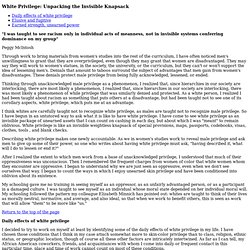
Photo: Raven3k) / stock.xchang. White Privilege: Unpacking the Invisible Knapsack - Peggy McIntosh. White Privilege: Unpacking the Invisible Knapsack "I was taught to see racism only in individual acts of meanness, not in invisible systems conferring dominance on my group" Peggy McIntosh Through work to bring materials from women's studies into the rest of the curriculum, I have often noticed men's unwillingness to grant that they are overprivileged, even though they may grant that women are disadvantaged.
Peggy McIntosh. Peggy McIntosh is an American feminist and anti-racist activist, the associate director of the Wellesley Centers for Women,[1] and a speaker and the founder and co-director of the National S.E.E.D.
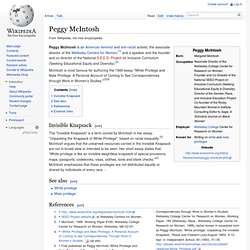
Project on Inclusive Curriculum (Seeking Educational Equity and Diversity).[2] McIntosh is most famous for authoring the 1988 essay "White Privilege and Male Privilege: A Personal Account of Coming to See Correspondences through Work in Women’s Studies. "[3][4] Invisible Knapsack[edit] Welcome to Eco-Schools England. Keep Britain Tidy. WWF UK - Conservation, climate change, sustainability. Cool Earth. No Fun being Extinct - Save a tree and save the human race. Global Dimension: the world in your classroom.
Promoting education for a just and sustainable world. People & Planet : Homepage. Primary Global Dimensions. Children Challenging Climate Change. DECSY SEAL website. Teach Global. Slavery Today. Bond - for international development. WaterAid Water educational resources. Our work with schools in the UK Get inspired by stories from schools around the UK.
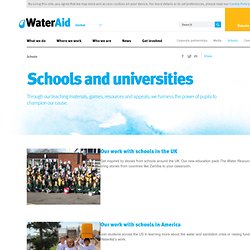
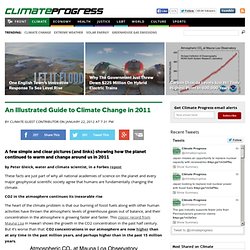
Our new education pack The Water Resource will help bring stories from countries like Zambia to your classroom. Oxfam Education. Oxfam for teachers. Brings global citizenship into the classroom. Children and games - Christian Aid. ActionAid UK: End poverty. Together. Education for Sustainability and Global Learning. ESD - Education for Sustainable Development. Education for Sustainable Development. Technology challenging poverty. Protectedplanet.net - Explore Protected Areas. Dark Optimism. Gapminder: Unveiling the beauty of statistics for a fact based world view. An Illustrated Guide to Climate Change in 2011. By Climate Guest Contributor on January 22, 2012 at 7:31 pm "An Illustrated Guide to Climate Change in 2011" A few simple and clear pictures (and links) showing how the planet continued to warm and change around us in 2011 by Peter Gleick, water and climate scientist, in a Forbes repost These facts are just part of why all national academies of science on the planet and every major geophysical scientific society agree that humans are fundamentally changing the climate.
50 doomiest graphs of 2011. 2011 saw a spike in climate disasters around the world, with a corresponding spike in global food prices.
It’s no exaggeration to attribute the “Arab Spring” to widespread food insecurity caused by rapidly changing climate. The human perturbation to the carbon cycle increased to nearly 9 gigatons per year, in spite of the global financial collapse – there’s every reason to suspect that nations are switching from the increasingly expensive 20th-century fuel (petroleum) to the still-cheap 19th-century fuel (coal), which means more carbon and mercury emissions. In addition, new studies showed that perturbations to the nitrogen and phosphorus cycles are far beyond levels that cause eutrophication in freshwater and oceans.
Teaching for a Better World. Future Scenarios - Introduction. Greenpeace UK. Friends of the Earth: Learning : Get Involved : Home. Contact Us England | Cymru/Wales | Northern Ireland Home | Press & Media | Shop | FAQs What We Do About Us.