background preloader

Creativity

Facebook Twitter

Why is Creativity Important in Education? Sir Ken Robinson Video Series from Adobe Education. Isaac Asimov on Creativity in Education & The Future of Science. 5 Outstanding TED Talks about Creativity. According to Sir Ken Robinson, creativity is the " process of having original ideas that have values". Everyone of us is born creative but the milieu where we are brought up and the kind of education we receive have a lot to do with how creative we become as we grow up.
In his popular TED talk " Do Schools Kill Creativity " , Robinson argued that students are educated out of creativity. Schools and curriculum do not seem to put a high premium on those elements that are mainly linked to the development of our creative powers including art, music, dance, and drama. Whenever there is a budget cut, the first thing they start with is art as if art is only a recreational subject.

I am actually working on a poster about creativity which I will probably publish tomorrow. 1- 4 Lessons in Creativity 2- You Elusive Creative Genius 3- How to Build your Creative Genius 4- Where Good Ideas come from 5- Fashion and Creativity. La buena escuela no asfixia la creatividad. Tendemos a ver la creatividad como algo chic y elitista, solo al alcance de unos pocos privilegiados. Así lo interpretó en 1999 el psicólogo social Howard Gardner en Inteligencia reestructurada: múltiples inteligencias para el siglo XXI. Sin embargo, con los años se va imponiendo la visión democrática de Ken Robinson, convertido en todo un gurú para un séquito de pedagogos.
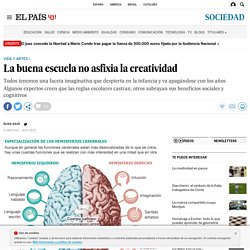
En opinión de este educador y conferenciante de masas, “todo el mundo es capaz de tener éxito en algún área si se dan las condiciones precisas y se ha adquirido un conocimiento relevante y unas habilidades”. Hasta ahí todos satisfechos. El problema llega ahora. Según este británico, la escuela mata esta creatividad que no tiene por qué ser artística, como solemos imaginar, sino científica o social.

Según Robinson, al profesor solo le interesa que se conteste lo que está en los contenidos del temario, lo que provoca la frustración de aquellos niños que son más arriesgados y a los que les gusta improvisar. 101 Tips on How to Become More Creative. 36Share Synopsis Tips to change your usual mental thinking patterns. 1. Take a walk and look for something interesting. 2. Michael Michalko is the author of the highly acclaimed Thinkertoys: A Handbook of Creative Thinking Techniques; Cracking Creativity: The Secrets of Creative Genius; ThinkPak: A Brainstorming Card Deck and Creative Thinkering: Putting Your Imagination to Work.
Tags: create, creative, creative suggestions, creative thinking, creativity, idea triggers, ideas, inspiration. 3 Paths Toward A More Creative Life. Everyone can learn to be more creative, but to become very creative, I’ve come to believe you need to lead a creative life. In watching my best students, in examining the lives of successful entrepreneurs, and in seeing the process of the great Native American artists who I know, it is clear that how they live their daily lives is crucial to their success. I realize that it sounds very “zen-y” (which is OK by me), yet I come to this realization not through a search for spirituality or clarity but from simple observation. Creativity is in such demand today that when we apply for jobs, when we join organizations, or when we just meet other people, we are asked to present our creative selves.
But we can’t do that unless we understand the nature of our own creativity, locate the sources of our originality, and have a language that explains our work. If you are one of the growing number of “creatives,” or want to become one, you need to lead a creative life. 1. For good reason. 2. 3. 5 Steps to Raising a Creative Child. Creativity and IQ, Part I: What Is Divergent Thinking? How Is It Helped by Sleep, Humor and Alcohol?

16Share Synopsis In this two part blog post, we’ll look at the creative process and how your IQ level is critical in this process. A creative advert for condoms. What makes it creative? Left brain vs right brain and creativity Have you ever heard people say that they tend to be more of a right-brain or left-brain thinker? Left brain people are said to be more rational, analytic, and controlling, while right brain people are said to be more intuitive, creative, emotionally expressive and spontaneous. While there is little evidence that a more dominant ‘half brain’ (left or right) determines a person’s personality as shown here, there is good evidence that regions of the right hemisphere have a key role in what is called divergent thinking and the creative problem solving that depends on it.

Convergent thinking and divergent thinking The psychologist J.P. What is divergent thinking? An example of a divergent thinking question is: Or “How many uses can you make of a toothpick?” Pine Crab Sauce. Richard Branson on the Art of Brainstorming. Q: Are there any techniques that could help me brainstorm? -- Kai Prout A: When I took part in attempts to set speed records for hot air ballooning across the oceans in the '80s and '90s, we got into some sticky situations. For me, the term "brainstorm" always brings back memories of flying a hot air balloon 30,000 feet above the earth into the eye of a very different kind of storm. In those terrifying, exhilarating moments, our team desperately racked our brains, trying to work out how to survive. Luckily, we were always able to come up with ideas and made it through.
While not every brainstorming session involves making life-and-death choices, the principle is the same. When you face a problem and are groping for answers, brainstorming is a great way to harness your staff's collective knowledge and come up with solutions. 1. Related: 3 Ways to Think Outside the Box 2. Enjoy a change of scenery for at least for half an hour before you start working, and remember to take breaks. 3. 4. 5. Picasso, Kepler, and the Benefits of Being an Expert Generalist.

One thing that separates the great innovators from everyone else is that they seem to know a lot about a wide variety of topics. They are expert generalists. Their wide knowledge base supports their creativity. As it turns out, there are two personality traits that are key for expert generalists: Openness to Experience and Need for Cognition. Openness to Experience is one of the Big Five personality characteristics identified by psychologists. The Big Five are the characteristics that reflect the biggest differences between people in the way they act. Openness to Experience is the degree to which a person is willing to consider new ideas and opportunities.

As you might expect, high levels of Openness to Experience can sometimes be related to creativity. However, creativity also requires knowledge. If you are not willing to do something new, then it’s hard to be creative. At the same time, creativity often requires drawing analogies between one body of knowledge and another. How About You? Uncommon Genius: Stephen Jay Gould On Why Connections Are The Key to Creativity.

By Maria Popova “The trick to creativity, if there is a single useful thing to say about it, is to identify your own peculiar talent and then to settle down to work with it for a good long time.” “Originality often consists in linking up ideas whose connection was not previously suspected,” wrote W. I. B. Beveridge in the fantastic 1957 tome The Art of Scientific Investigation. A slim and near-forgotten but altogether fantastic 1991 book by Denise Shekerjian titled Uncommon Genius: How Great Ideas Are Born (public library) synthesizes insights on creativity from conversations with 40 winners of the MacArthur “genius” grant — artists, writers, scientists, inventors, cultural critics.
In the first chapter, titled “Talent and The Long Haul,” Shekerjian seconds the notion that a regular routine is key to creativity: My talent is making connections. It took me years to realize that was a skill. Thanks, Ken Donating = Loving Brain Pickings has a free weekly newsletter. Share on Tumblr. Irrelevant Ideas Lead To Breakthroughs. At Reebok, the cushioning in a best-selling basketball shoe reflects technology borrowed from intravenous fluid bags. Semiconductor firm Qualcomm’s revolutionary color display technology is rooted in the microstructures of the Morpho butterfly’s wings. And at IDEO, developers designed a leak-proof water bottle using the technology from a shampoo bottle top.
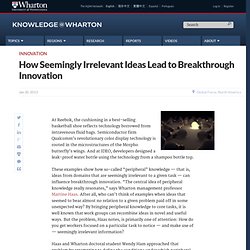
These examples show how so-called “peripheral” knowledge — that is, ideas from domains that are seemingly irrelevant to a given task — can influence breakthrough innovation. “The central idea of peripheral knowledge really resonates,” says Wharton management professor Martine Haas. After all, who can’t think of examples when ideas that seemed to bear almost no relation to a given problem paid off in some unexpected way? Haas and Wharton doctoral student Wendy Ham approached that problem by attempting to define the conditions under which peripheral knowledge is likely to influence breakthroughs. Stocks vs. Cooking or Archery? The Eight Pillars of Innovation. The greatest innovations are the ones we take for granted, like light bulbs, refrigeration and penicillin.
But in a world where the miraculous very quickly becomes common-place, how can a company, especially one as big as Google, maintain a spirit of innovation year after year? Nurturing a culture that allows for innovation is the key. As we’ve grown to over 26,000 employees in more than 60 offices, we’ve worked hard to maintain the unique spirit that characterized Google way back when I joined as employee #16. At that time I was Head of Marketing (a group of one), and over the past decade I’ve been lucky enough to work on a wide range of products. Some were big wins, others weren’t. What’s different is that, even as we dream up what’s next, we face the classic innovator’s dilemma: should we invest in brand new products, or should we improve existing ones?

Have a mission that matters Work can be more than a job when it stands for something you care about. Think big but start small. 7 Easy Ways To Be More Innovative. 8 Types Of Imagination. Imagination is critical to innovation and learning–but what exactly is it? Dr. Murray Hunter of the University of Malaysia Perlis discusses the 8 types of imagination we use on a daily basis, with explanations for each.
Dr. Hunter defines imagination as “the ability to form mental images, phonological passages, analogies, or narratives of something that is not perceived through our senses. Imagination is a manifestation of our memory and enables us to scrutinize our past and construct hypothetical future scenarios that do not yet, but could exist. Imagination also gives us the ability to see things from other points of view and empathize with others.” 8 Types of Imagination 1. 2. 3. 4. 5. 6. 7. 8. More Info Visit the IntoEastAfrica blog for more reading.

Requisite Carl Sagan And no mention of imagination would be complete without Carl Sagan. Innovation – The Leadership Soft Skills | KaurSkills. A summary of the role of leadership and soft skills in innovation. ‘A leader is best when people barely know he exists, when his work is done, his aim fulfilled, they will say: we did it ourselves.’ - Lao Tzu There are a lot of blogs and worthy peer journals, sharing the importance of innovation in business success and survival. We all agree innovation is important, but how do we nurture innovation, as something which is integral to business process, and creates value within an organisation? Exceptional leaders and authors highlight the importance of ‘soft’ skills for successful management and leadership. Just recently, Tom Peters tweeted: ‘So called “soft” people skills drive implementation. Implementation = The “all important last 99%.”‘ (via Twitter @tom_peters) In management practice you could: (a) Ignore soft skills or give credence to ‘soft’ skills, as a key factor to nurturing performance, teamwork, in creativity and ultimate innovation; Everyone has time to reflect.

Like this: Kokeilukulttuuri. Rana Florida: Your Start-Up Life: Fail to Succeed. Your Start-Up Life is a business advice column by Rana Florida, CEO of the Creative Class Group. In addition to answering readers' questions, she features conversations with successful entrepreneurs, creative thinkers and innovative leaders. Send your questions about work, life and play to rana@creativeclass.com His innovative theories combined with his wit and sense of humor earned him an estimated 20 million viewers in more than 150 countries for his legendary TED talks on You Tube.

When I met him in Barcelona, I was expecting a formal meeting -- given the "Sir" in front of his name. But as befits a thinker who believes that "if you're not prepared to be wrong, you'll never come up with anything original," Robinson is as un-stodgy a world-renowned authority as you're likely to meet -- and certainly one of the most insightful experts I've ever had the pleasure of interviewing.

Q. A. What did I get from this experience apart from the money and the road trips that it paid for? Q. A. Q. Kohti avoimempaa ja kokeilevampaa yrityskulttuuria - Oske - osaamiskeskusohjelma. Mitä jos yrityksissä pystyttäisiin unohtamaan perinteinen ylhäältä alas johtaminen? Mitä jos annettaisiin henkilöstölle mahdollisuus kehittää itse omia tapojaan toimia yhdessä? Moottorina toimisivat eri funktioiden osaamisen yhdistävät teemaryhmät ja yhteinen innostus mahdollisuudesta vaikuttaa omaan tekemiseen. Utopiaako? Ei, vaan täyttä totta. Tietotyön osuus työnteosta on huikaiseva. Tiedonhakuun, sähköpostiviestintään ja muuhun sisäiseen vuorovaikutukseen kuluu tutkimusten mukaan jopa 61 % työajasta. Jäljellejäävä osuus käytetään oman työn tekemiseen.

. - Kun halutaan helpottaa työyhteisön sisäistä vuorovaikutusta ja tiedon kulkua, on tärkeää antaa tilaa kokeilemiselle, oppimiselle ja innostumiselle. Muutos lähtee henkilöstön valtauttamisesta Työtä on koetettu tehostaa useissa organisaatioissa erilaisin hankkein, mutta laihoin tuloksin. Henkilöstön motivoiminen oman työnsä kehittämiseen alkaa muuttamalla organisaatiokulttuuria sallivammaksi. Luottamusta ja epävarmuuden sietokykyä. Linjaus2011-2015. Avoimuus säästää aikaa, rahaa ja hermoja.

Miten tulla verkostojen uimamaisteriksi? Sain yllättävän pyynnön: voisitko inspiroida Suomen lukiolaisia? Joku ihana ihminen Teknologiateollisuus ry:stä oli minut ilmiantanut (eli ei ollut vouhaamistani pelästynyt). Rivakalla aikataululla löysin itseni kameran edestä puhumassa kymmenisen minuuttia – aivan raakana, yhdellä otolla, ilman muistiinpanoja, hyvällä fiiliksellä ja viiden etukäteen mietityn asian kanssa oli pärjättävä. Mediaveteraani, monitoimija ja mobilisaattori Arto Tuominen on tuottanut tämän inspiraatiopuheenvuorosarjan, jonka mahtavat teemat ovat innovointi, luovuus ja toisinajattelu.

Teemat – check, olenhan ainakin osapäiväinen toisinajattelija. Muut puhujat sarjassa ovat melkoisen nimekkäitä, mukana ovat mm. Saku Tuominen, Manuela Bosco ja Anssi Tuulenmäki. Arto antoi minulle vain yhden ohjeen: sana on villi ja vapaa. Aluksi tunnustin lukiolaisille, että intohimoni on maksimoida mahdollisuuksia, avata ovia ja olla avoin – erityisesti asennevalinnan ja sosiaalisen teknologian avulla. 1. 2. 3. 4. 5. Like this: Mihaly Csikszentmihalyi on flow. Understand Music. Des jeux d’écriture pour développer votre créativité. Funny Commercial Miele - Dishwashing kid.