
The Young and the Digital. Mapping the Human Condition. By Maria Popova.
Jason.nelson's.digital.poetry.interfaces. It's Time for Games to Move Beyond 'Cinematic' - PS3 Feature at IGN. With every year that passes, modern games become more and more 'cinematic', while the games industry itself increasingly takes on aspects of the Hollywood model.

We're talking blockbuster production values, inescapable marketing, assumed sequels, and bankable franchises. Modality and Representation. Books in the Age of the iPad. For too long, the act of printing something in and of itself has been placed on too high a pedestal.
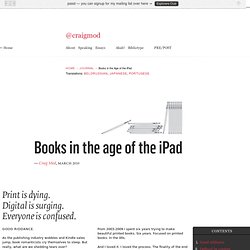
The true value of an object lies in what it says, not its mere existence. And in the case of a book, that value is intrinsically connected with content. Let's divide content into two broad groups. Content without well-defined form (Formless Content (Fig. 1)) Content with well-defined form (Definite Content (Fig. 2)) About The Licenses. Our public copyright licenses incorporate a unique and innovative “three-layer” design.
Each license begins as a traditional legal tool, in the kind of language and text formats that most lawyers know and love. We call this the Legal Code layer of each license. Inanimate Alice - Homepage. The Story Sucks. The Escapist. Fictional Landscapes by UK-based artist Kyle. Let GLaDOS guide you to your destination, you monster. Features - Ken Levine on the Storytelling Craft of BioShock Infinite. The original BioShock stands as a sterling example of environment-as-character.

The city of Rapture, with its mad scrawling on walls and atmosphere of deteriorated grandeur, told the story as much or more than the audio logs salted throughout the game, or the radio conversations with supporting characters. The strongest character in the traditional sense in BioShock, city founder Andrew Ryan, was mostly a disembodied voice. Irrational Games is trying something different in BioShock Infinite. How To Be More Interesting (In 10 Simple Steps) Media, Transmedia, and a Girl Named Alice. Ever heard of Inanimate Alice? If so, do you understand what all the fuss is? Quick preface (and a sort of warning): I’m borderline obsessed with media as a rhetorical vehicle, and find its increasingly addictive nature hugely important as digital presence bleeds into physical boundaries, especially in the field of education. If you’re less curious, you may want to do some skimming.
'The Tao Of Wu': RZA Waxes Philosophical. Longform.org. What Would the New Facebook Mean to Marshall McLuhan? Five Marketing Takeaways - Marketing HQ. By Michael Davis CCO, imc2 Michael Davis The current communications climate is not new news.
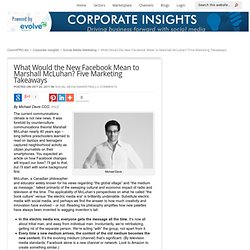
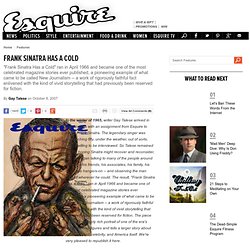
It was foretold by counterculture communications theorist Marshall McLuhan nearly 40 years ago – long before preschoolers learned to read on laptops and teenagers captured neighborhood activity as citizen journalists on their smartphones. You expected an article on how Facebook changes will impact our lives? Frank Sinatra Has a Cold - Gay Talese - Best Profile of Sinatra. In the winter of 1965, writer Gay Talese arrived in Los Angeles with an assignment from Esquire to profile Frank Sinatra.
New Details About The Last of Us. If you've been coming to IGN over the last 10 days or so, then you've already seen plenty of coverage about the upcoming PlayStation 3 exclusive The Last of Us.
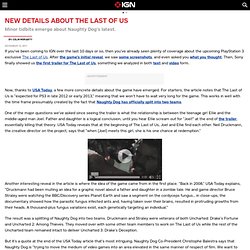
After the game's initial reveal, we saw some screenshots, and even asked you what you thought. Then, Sony finally showed us the first trailer for The Last of Us, something we analyzed in both text and video form. Now, thanks to USA Today, a few more concrete details about the game have emerged. For starters, the article notes that The Last of Us is "expected for PS3 in late 2012 or early 2013," meaning that we won't have to wait very long for the game. Gamification. Working for the Web's Big Content Machine. I'm hardly qualified to dash off authoritative articles on the theological bona fides of African critters.
But one recent evening, I made $15 for writing tips on hard-disc data recovery, another $15 for telling people how to repair burnt carpet and $7.50 for teasing out the answer to that most pressing of questions: Is a giraffe sacred? Social Media in the Age of Enlightenment and Revolution. Open Culture. Publications/czachesz_rewriting.pdf. Hypertextuality. Complicating Predictability: Textuality, Intertextuality, and Intercontextuality in Beginning Reading and Writing. Peer reviewed ERIC Number: EJ587448 Record Type: CIJE Publication Date: 1998 Pages: N/A Abstractor: N/A Reference Count: 0 Complicating Predictability: Textuality, Intertextuality, and Intercontextuality in Beginning Reading and Writing.
Textuality, Intertextuality, Hypertextuality. The Slavic and East European Journal, Vol. 39, No. 4 (Winter, 1995), pp. 535-551. Intertextuality and the Writing of Social Research. Nicholas J FoxMedical School University of Sheffield N.J.Fox@sheffield.ac.uk This paper explores postmodern social theory approaches to research writing. Intertextuality and Dialogue. Professor of Philosophy - Articles. Jean Baudrillard. First published Fri Apr 22, 2005; substantive revision Wed Mar 7, 2007 French theorist Jean Baudrillard (1929–2007) was one of the foremost intellectual figures of the present age whose work combines philosophy, social theory, and an idiosyncratic cultural metaphysics that reflects on key events of phenomena of the epoch.
A sharp critic of contemporary society, culture, and thought, Baudrillard is often seen as a major guru of French postmodern theory, although he can also be read as a thinker who combines social theory and philosophy in original and provocative ways and a writer who has developed his own style and forms of writing. For some years a cult figure of postmodern theory, Baudrillard moved beyond the postmodern discourse from the early 1980s to the present, and has developed a highly idiosyncratic mode of philosophical and cultural analysis. MediaShift. Commons. Curating digital stories from Shakespeare\'s work, life, and times. The Influencing Machine: A Brief Visual History of the Media. Marshall McLuhan Bio. Marshall McLuhan - The World is a Global Village (CBC TV)
The Medium is the Massage: Shepard Fairey + Marshall McLuhan. By Maria Popova. Every Page of Moby-Dick, Illustrated. By Maria Popova. Mark of Cain: The Language of Russian Criminal Tattoos. By Maria Popova What encrypted visual communication has to do with the Russian justice system. The Russian Criminal Tattoo Encyclopedia is among Brain Pickings‘s most popular books of all time.