New strategy would drop college textbook costs to zero. Holding a whiteboard, the University of Maryland, College Park students scrawled their complaints and posed for a picture.
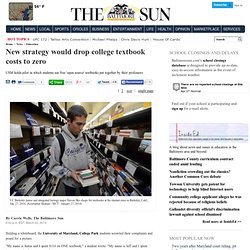
"My name is Justin and I spent $114 on ONE textbook," a student wrote. "My name is Jeff and I spent $736 on textbooks," wrote another. The images, posted online by the Student Government Association in recent months, are designed to highlight the rapid rise in the price of college textbooks over the past decade. This semester, the University System of Maryland is exploring ways to bring that cost to zero with "open-source" electronic textbooks — the latest experiment in changing the way students in Maryland and across the nation are taught. Unlike electronic versions of textbooks sold by publishers, open-source textbooks are made up of materials gathered from various sources and are not protected by copyright.
Still, open-source textbooks, which have been around for several years, face challenges and have not caught on broadly. Free Online University Receives Accreditation, in Time for Graduating Class of 7. Just in time for its first graduates, the University of the People, a tuition-free four-year-old online institution built to reach underserved students around the world, announced Thursday that it had received accreditation.

“This is every exciting, especially for the students who will graduate in April, with a degree from an accredited institution,” said Shai Reshef, the Israeli entrepreneur who invested millions of dollars to create the nonprofit university. “This has been the big question for anyone who thought about enrolling. We have 1.2 million supporters on Facebook, I think second only to Harvard, and every day, there is discussion about when we will be accredited.”
Now, with accreditation from the Distance Education and Training Council, a national accrediting group, Mr. Reshef said, the university will expand significantly. The university currently has 700 students from 142 countries enrolled in its degree programs in business administration and computer science. Wikipedia - the free encyclopedia. Simple English Wikipedia. Encyclopaedia Britannica vs Wikipedia: A Battle Already Lost? (INFOGRAPHIC) Photo: Ángel Franco/The New York Times During the week, Charlie Hilton wrote about the shift from Print to Digital for the Encyclopædia Britannica after the company officially announced that the 2012 print Edition would be the last ever. I have never bought or owned the print encyclopedia, and yet the seemingly innocuous news was saddening. It’s because the Britannica holds a warm, nostalgic seat in my memory; I always felt in awe of those gorgeously bound complete sets that were displayed at the libraries of my school and university.
They symbolised this great and historic tradition of enlightened learning, and while this symbolism can technically live on through digital media, there is something undeniably more tangible to the symbolism of a physical copy. And yet, this news has long been a foregone conclusion, given the absurdity of owning a hardcover 32-volume library costing around $1,400, and that information becomes ever more outdated from the date its published and bought. Project Gutenberg - free ebooks. Khan Academy - Free educational videos. Khan Academy Founder Proposes a New Type of College - Wired Campus. Salman Khan’s dream college looks very different from the typical four-year institution.
The founder of Khan Academy, a popular site that offers free online video lectures about a variety of subjects, lays out his thoughts on the future of education in his book, The One World School House: Education Reimagined, released last month. Though most of the work describes Mr. Khan’s experiences with Khan Academy and his suggestions for changing elementary- and secondary-school systems, he does devote a few chapters to higher education.
In a chapter titled “What College Could Be Like,” Mr. Khan conjures an image of a new campus in Silicon Valley where students would spend their days working on internships and projects with mentors, and would continue their education with self-paced learning similar to that of Khan Academy. “Traditional universities proudly list the Nobel laureates they have on campus (most of whom have little to no interaction with students),” he writes. Mr. OpenLearn: Free from The Open University. Free Online Courses, College Classes and Video Lessons - Education Portal.