
Stop Requiring College Degrees - Andrew McAfee. By Andrew McAfee | 7:00 AM February 26, 2013 If you’re an employer, there are lots of signals about a young person’s suitability for the job you’re offering.
If you’re looking for someone who can write, do they have a blog, or are they a prolific Wikipedia editor? For programmers, what are their TopCoder or GitHub scores? For salespeople, what have they sold before? Bertrand Russell’s 10 Commandments for Teachers. Do not feel absolutely certain of anything.Do not think it worth while to proceed by concealing evidence, for the evidence is sure to come to light.
ShareThis Copy and Paste. The future of teaching: Difference engine: Let the games begin. Pink Floyd - Another Brick In The Wall (HQ) Skip the use "Ghost" (Clip officiel) Connected Learning: Reimagining the Experience of Education in the Information Age. This weekend, I am attending the Third Digital Media and Learning Conference, hosted by the MacArthur Foundation, as part of their efforts to help build a field which takes what we have learned about young people's informal learning, often through the more playful aspects of participatory culture, and apply it to the redesign and reinvention of those institutions which most directly touch young people's lives -- schools, libraries, museums, and public institutions.
Today, the MacArthur Foundation is releasing an important statement about the underlying principles they are calling "connected learning," a statement which helps to sum up the extensive research which has been done by the DML network in recent years. (8) THE END OF TEACHING by @agalorda. RSA Animate - The Empathic Civilisation. Conjoncture : Une troisième révolution industrielle est en vue. L'économiste américain Jeremy Rifkin présente ce mardi à Paris son dernier essai sur les mutations en cours de l'économie et les bases d'une croissance durable tout au long du XXIe siècle.
Voici sa vision du futur. «Une troisième révolution industrielle doit prendre le relais de notre modèle actuel, à bout de souffle», assure l'économiste américain Jeremy Rifkin. Selon lui, «la crise actuelle n'est pas la crise de la finance, mais la crise du pétrole» et cet or noir sera de plus en plus rare et de plus en plus cher. Surtout, cette énergie est polluante, et les catastrophes naturelles de plus en plus violentes et fréquentes plaident en faveur d'un modèle de croissance plus soutenable. Ce modèle alternatif repose sur les énergies vertes et sur Internet, estime Jeremy Rifkin. Etudiante, je hais les partiels, marathon des nerfs pour perroquets. Si l’on se réfère à la terminologie en vogue, je suis actuellement étudiante en quatrième année dans une « grande école » dont on ne cesse de vanter la qualité de l’enseignement.
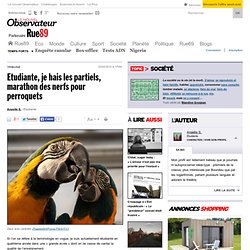
On évoque souvent le désintérêt des jeunes pour l’école. Pourtant, il y a quatre ans lorsque j’étais encore la candidate n°4307, j’ai senti mon cœur faire des claquettes sur mon estomac en remettant ma copie aux surveillants. Rapport sur les examens. What You (Really) Need to Know. Can Technology Transform Education Before It’s Too Late? Editor’s Note: This guest post was written by Prerna Gupta, who is CEO of Khush (now part of Smule), whose music apps, like Songify and LaDiDa, have been used to create over 125 million songs worldwide.
You can follow her @prernagupta. As technology continues its march toward the Singularity, transforming the way we work, socialize and play at an increasing rate, there is one very important aspect of American society that lags behind: education. Will We Need Teachers Or Algorithms? Editor’s note: This is Part III of a guest post written by legendary Silicon Valley investor Vinod Khosla, the founder of Khosla Ventures.
In Part I, he laid the groundwork by describing how artificial intelligence is a combination of human and computer capabilities In Part II, he discussed how software and mobile technologies can augment and even replace doctors. Now, in Part III, he talks about how technology will sweep through education. Enrayer la Machine à trier - La machine à trier. College Students: rEDesignMyEdu. The effects of school quality on long-term health. Volume 30, Issue 6, December 2011, Pages 1320–1333.
American RadioWorks. By Emily Hanford.
The Problem with Lecturing. Back in the late 1970s a colleague came to David Hestenes with a problem.
The two of them were physics professors at Arizona State University. Hestenes was teaching mostly graduate students, but his colleague was teaching introductory physics, and the students in his classes were not doing well. Semester after semester, the class average on his exams never got above about 40 percent. Rethinking the Way College Students Are Taught. It's a typical scene: a few minutes before 11:00 on a Tuesday morning and about 200 sleepy-looking college students are taking their seats in a large lecture hall - chatting, laughing, calling out to each other across the aisles. Class begins with a big "shhhh" from the instructor. This is an introductory chemistry class at a state university. For the next hour and 15 minutes, the instructor will lecture and the students will take notes.
By the end of class, the three large blackboards at the front of the room will be covered with equations and formulas. Students in this class say the instructor is one of the best lecturers in the department. From Questions to Concepts: Interactive Teaching in Physics. Let Kids Rule the School. Will Dropouts Save America? Michael Ellsberg is the author of “The Education of Millionaires: It’s Not What You Think and It’s Not Too Late.” I TYPED these words on a computer designed by Apple, co-founded by the college dropout Steve Jobs. The program I used to write it was created by Microsoft, started by the college dropouts Bill Gates and Paul Allen. And as soon as it is published, I will share it with my friends via Twitter, co-founded by the college dropouts Jack Dorsey and Evan Williams and Biz Stone, and Facebook — invented, among others, by the college dropouts Mark Zuckerberg and Dustin Moskovitz, and nurtured by the degreeless Sean Parker. Eight Reasons Startup Incubators Are Better Than Business School.
Let’s get this straight: If you want to work at Goldman Sachs, McKinsey or General Electric GE +0.00%, an MBA is a handy scrap of paper. But if you’d prefer to bypass the corporate ladder and actually build something of your own, spending upwards of $140,000 and two years without pay is just about the worst way to go about it. TED-ED - TED-ED Front Page. Les enjeux moraux et sociaux des droits d'entrée dans les Universités avec Yves Lichtenberge - Idées.
TEDxLondon presents the Education Revolution. David Rowan Editor of Wired magazine. Insights From the 21st Century Talent Sessions Ashoka. Les bouleversements de la pensée algorithmique ! Educational technology: The evolution of classroom technology. Flash spécial : Le rapport Fourgous pour faire entrer l'Ecole dans son siècle. Remis le 15 février, le rapport Fourgous est à la fois un plaidoyer pour l'intégration des TICE dans l'enseignement et un programme de 70 mesures pour faire basculer l'Ecole dans l'ère numérique. "Le numérique représente une vraie chance pour l’école.
Donnons-nous les moyens de réussir". Député des Yvelines, Jean-Michel Fourgous avait reçu fin août 2009 du premier ministre une mission " de réflexion et de propositions pour la promotion des TIC dans l'enseignement scolaire". La publication de son rapport est un événement majeur pour l'Ecole qu'il invite non seulement à s'équiper mais aussi à changer ses pratiques pédagogiques pour tirer le maximum de profit des TICE. Le retard français. TEDxManhattanBeach - Thomas Suarez - iPhone Application Developer. . .and 6th Grader. Mythes et réalités de la génération Y. Alexis Mons lance un clash intergénérationnel sur son blog : “Il ne manque pas de billets et d’alerte pour nous dire tous les jours que les petits jeunes arrivent, pensent et font différemment, sont nativement digitaux, sinon ont muté du cerveau.
Il est en tous les cas certain que toute marque ou organisation qui ne s’intéresserait [...] Alexis Mons lance un clash intergénérationnel sur son blog : “Il ne manque pas de billets et d’alerte pour nous dire tous les jours que les petits jeunes arrivent, pensent et font différemment, sont nativement digitaux, sinon ont muté du cerveau. La Génération Y : des pilotes de course qui doivent passer leur permis.
News: Technologically Illiterate Students. ORLANDO -- Say you are an employer evaluating college students for a job. Perusing one candidate’s Facebook profile, you notice the student belongs to a group called “I Pee My Pants When I’m Drunk.” A propos du blog. Schumpeter: Angst for the educated. The University of Wherever. Cern residency programme unites artists and physicists. Cern has launched a programme that aims to bring together artists and physicists at its laboratory near Geneva. Collide@Cern -- which falls into a wider Cern policy for engaging with the arts called Great Arts for Great Science -- is a three-month residency programme for artists to be mentored by leading scientists, supported by a stipend of €10,000.
The head of Cern's arts programme, Ariane Koek, said: "The arts touch the parts that science alone cannot reach and vice versa. Éducation nouvelle. The Macroscope: Chap. 6. This is chapter 6 of the "The Macroscope" by Joël de Rosnay Our education remains hopelessly analytical, centered on a few disciplines, like a puzzle whose pieces overlap rather than fit together. It is an education that prepares us neither for the global approach to complex problems nor for the interplay between them. Nevertheless the present generation of eighteen- to twenty-five-year-olds itself poses problems globally. It seems that through a thousand parallel channels, passing from the traditional media to those of the counterculture by a sort of osmosis with nature and society, the young people have learned to discover for themselves a form of the systemic approach.
Yet this emergent thought, this new manner of seeing and judging the world, is not the monopoly of one generation alone. The new vision of the world is not the effect of a single cause but the result of the convergence, integration, and interdependence of a large number of factors. Today, suddenly, everything is changed. Vidéos. More pedagogic change in 10 years than last 1000 years – all driven by 10 technology innovations.