
Art.sy Is Mapping the World of Art on the Web. 'Lucky' Mag Plans User-Generated Section. Every day, thousands of stylish women upload pictures of their outfits, their hair, their nails — essentially, expressions of their style — to personal blogs.
Those images are viewed, collected and spread across aggregation sites like Pinterest, Tumblr and Lookbook.nu — and soon, on the website of Lucky magazine. The Conde Nast-title is planning to launch a vertical powered by user-generated content in mid-August. Government Unveils First Map Of All The Germs In The Human Body. Bloggers and Bowerbirds - Incisive.nu. There are still a lot of elbows being thrown in the squabble about “creation” versus “curation,” and it seems to be getting worse.
As humans tend to do, we’re talking past each other and pretending to simplicity in the face of the complex and the weird. Crazy about Curation: 5 American Girls, 3 Fashion Startups. In today’s noisy, overpopulated world, we often talk about the art of curation in terms of the process of selection, narrowing down and choosing objects fit for presentation.
When we think of curators we think of gallery owners, DJs, Michelin starred chefs and boutique clothing stores. Curiously, the word curate stems from the Latin “crtus” meaning spiritual change and refers to a cleric, especially one who has charge of a parish. The word has traveled quite a long ways since its original meaning, but those who consider curation a primary focus of their job can relate to its commanding origins. To learn more about the importance of curation in today’s fashion industry, we spoke to 5 American girls who run 3 emerging fashions startups in New York City and Los Angeles. Material Wrld Material Wrld is a New York City fashion startup founded by eager entrepreneurs Jie Zheng and Rie Yano. Of a Kind. What We Talk About When We Talk About "Curation" By Maria Popova On creative restlessness, the art of context, and the contagion of intellectual curiosity.
First things first — “curation” is a terrible term. 1940 US Census becoming fully searchable online through volunteer effort. What Is the Point of... Pinterest? 5 Tips for Great Content Curation. Steven Rosenbaum is the CEO of Magnify.net, a real-time video curation engine for publishers, brands, and websites.
He's also the author of Curation Nation. You've heard the buzz word — curation — being thrown around like it's a gadget we all know how to work. In reality, good content curation isn't as simple as pushing a share button. - How We Will Read: Maria Popova. This post is part of “How We Will Read,” an interview series exploring the future of books from the perspectives of publishers, writers, and intellectuals.
Read our kickoff post with Steven Johnson here. And check out our new homepage, a captivating new way to explore Findings. This week we were extraordinarily lucky to get some of the precious time of Maria Popova, the Internet’s most awesome curator. The Verge interview: David Carr on curation, crowdsourcing, and the future of journalism. 212inShare Jump To Close David Carr has written about media for over 25 years, from his early days in Minneapolis, Minnesota, to Washington, D.C., to his current post at The New York Times, where he’s been for almost a decade.
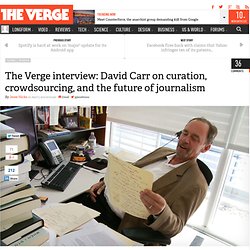
His weekly column, "The Media Equation," covers all aspects of journalism and culture, especially the always-evolving world of online news; his recent work has questioned the rise of Twitter activism, investigated the failure of Tribune media, and mused on Louis C.K.'s successful experiment in self-distributed comedy.
How to Make Images Stand Out on Pinterest [INFOGRAPHIC] Do you want your Pinterest images to stand out and get repinned?
![How to Make Images Stand Out on Pinterest [INFOGRAPHIC]](http://cdn.pearltrees.com/s/pic/th/images-pinterest-infographic-25850260)
With more than 12 million users posting pictures to the image-based social network, it's important to make sure images grab the attention of fellow Pinterest users. A properly optimized pin can make all the difference between 50 repins or no repins. Pinterest Revises "Terrifying" Terms of Service, Soon To Release Private Pinboards and API. [Infographic]: Check Out This Flow Chart to See if Your Business Belongs on Pinterest.
What Is Curation?, Video Features Curators’ Thoughts On Their Roles. The Pointless Debate Over Web Curation vs. Aggregation. 'Curator's code' proposed for web attribution. The brain behind Brainpickings.org, Maria Popova, has proposed a code of conduct for curators on the web to use to attribute their sources.
The "Curator's Code" asks anyone sharing content on the web to give credit to the place where they discovered the thing they're sharing in one of two ways. There's the "via", and the "hat tip". Both have existed for some time, but their precise meaning has never been standardised or agreed-upon. Under Popova's proposals, a "via" indicates direct discovery, and can be used when you repost a bit of content with little or no modification or addition. An example might be sharing an image on your blog, or quoting another person's words directly with little comment. 6 reasons to use Pearltrees.
Pearltrees is the first and largest social curation community on the Internet.

It’s a place to organize, discover and share all the cool content you find online. However, beyond this basic definition, a question remains: why would I want to use Pearltrees? Well, what I want to share with you are six major use cases (or reasons) we’ve identified as being most popular across our entire community of web curators. In addition, I’ll also share with you a couple of interesting ways in which I have put Pearltrees to use for myself. What Pinterest needs to fix – and fast. Lately, you can’t help but hear about Pinterest’s culminating issues. The site has been plagued by the possibility of copyright infringement and skepticism about its business model. And now the unavoidable is finally happening: phishing scams have hit the platform. Venture Beat noticed the faux promos peppering the site yesterday, and it’s not the first nor last time it’ll happen.
20 Awesome Pinterest Tools. Pinterest already offers users some great tools to help them get their accounts get noticed, including a Follow Button and Pin It button which can easily be installed on any website. But with such an active community, it’s no surprise that there are a ton of other interesting tools, apps, and sites which aim to enhance the Pinterest experience. WordPress plugins, Pinterest analytics, cool Pinterest layouts and hacks, and mobile access – Pinterest’s vibrant community has pretty much left no stone unturned. We’ve put together a list of 20 of these tools, in no particular order. Add the Pinterest plugin to your WordPress blog There are several options for adding a Pinterest button to your WordPress blog.
The Pinterest Pin it Button plugin automatically places a Pin It button at the bottom of all of your posts – old and new. Add a Pinterest Follow Me button to your signature A second option Wisestamp offers is to simply add a Pinterest button alongside your other social profile icons. Need More YouTube Views? Try Pinterest. Independent film and entertainment studio Lionsgate holds the majority (30%) of the market share of fitness DVDs.
Naturally, the company decided to create a YouTube channel comprised of athletic content. What it didn’t anticipate is how effectively Pinterest could promote its YouTube presence. Launched Jan. 3, 2012 as part of YouTube’s Original Content initiative, Lionsgate BeFit features dozens of workout videos from celebrity trainers like Jillian Michaels and Jane Fonda. The channel posts to YouTube once a day, with the goal to generate as many viewers as possible to each video within 48 hours. The Marketer's Guide to Pinterest. Pinterest, the darling digital pin board that's turned the social media world upside down, is now a top traffic driver for brands. That's a good sign marketers should get their butts up to speed on the latest pinning tips and tricks.
Fortunately for you, MDGadvertising has created an infographic explaining the nooks and crannies of the social network. Chill: It's Like Pinterest For Video. When is the social curation bubble going to burst? How Pinterest is Making Money. How Businesses Are Using Pinterest. When I wrote my Guy's Guide To Pinterest last week I mentioned that - at least to me - it seemed as if marketers hadn't done too much with the site just yet, making it feel like it was free of marketing and advertising.
I was, of course, quickly corrected. According to Ad Age, Real Simple magazine is already getting more traffic from Pinterest than from Facebook, and small and big businesses alike are exploring ways to use the site to connect with consumers. It makes sense: Pinterest has a clearly defined demographic, with 59 percent of the site's visitors in a recent 12-week period being women between the ages of 25 and 44.
15 of the Most Popular Pictures on Pinterest. 7 Tips for Planning a Wedding on Pinterest. What Pinterest is Doing That Facebook Isn't. Pinterest Becomes Top Traffic Driver for Retailers [INFOGRAPHIC] 10 Tips on Using Pinterest for your Business. 7 Ways Journalists Can Use Pinterest. Scrollsy Is A Scrollable, Pinterest-Like Version Of Etsy. The Top Brands on Pinterest. December Presents: Record Traffic For Social Interest Sites Tumblr And Pinterest. One of the most interesting findings of comScore‘s 2011 social networking report was the surge in sites designed around users’ interests, not necessarily real-life social circles.
The web measurement firm’s December numbers, which came after the report, more than confirm the trend. You are what you curate: why Pinterest is hawt. Millions using YouTube Editor to enhance videos after posting — Online Video News. Pinterest Tutorial. Mixel invites iPad users to create social collages. Why Browsing Is So Important to Content Discovery.