
Community Events - Getting Started with Gamification - (Private Browsing) Onboarding Gamification is the use of game mechanics and dynamics in serious applications to encourage better user angagement, empowerment and to give users more control, feeling of mastery and autonomy.
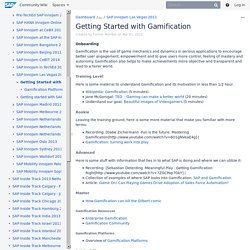
Gamification also helps to make achievements more objective and transparent and lead to a fairer world. Training Level Here is some material to understand Gamification and its motivation in less than 1/2 hour. Rookie Leaving the training ground, here is some more material that make you familiar with more terms: Advanced Here is some stuff with information that ties in to what SAP is doing and where we can utilize it: This blog discusses issues concerning learning, e-learning and transferring knowledge from retiring baby boomers to incoming gamers. The goal is to share information and knowledge to create a better understanding of learning design. - (Privat. CAC, RFP and Bigfoot I have had the privileged of teaching a great number of really talented and smart students, this semester has been no exception.
The group of students in my class is rivaled by none. They are energetic, get alone well with each other are collaborative and will make great contributions to the field. (You’ll have to […] Continue Reading → Harrisburg Presentation Resources Here are some resources from my presentation in Harrisburg. Continue Reading → 2014 DOE Symposium Conference Resources Here are my resources for the 2014 DOE Symposium Conference.
Continue Reading → Great fun at ITEAA Conference & Introduction of Exciting Game-Based Learning Modules Last week I had a chance to attend the ITEAA Conference which is the conference of the International Technology and Engineering Educators Association. Gamificación » Qué es la Gamificación - (Private Browsing) Gamificación (gamification en el ámbito anglosajón) es el empleo de mecánicas de juego en entornos y aplicaciones no lúdicas con el fin de potenciar la motivación, la concentración, el esfuerzo, la fidelización y otros valores positivos comunes a todos los juegos.
Se trata de una nueva y poderosa estrategia para influir y motivar a grupos de personas. La eclosión de la web 2.0 ha acelerado la creación de comunidades en torno a todo tipo de redes sociales, medios digitales o webs corporativas. Gamifying Education.org. The Gamification of Education Infographic #gamification #edtech - (Private Browsing) Meaningful Play. Getting »Gamification« Right. - (Private Browsing) "Learning as Fun: What Video Games Do that Classrooms Do Not" by Christian de Luna - (Private Browsing)
From Game Design Elements to Gamefulness: Defining Gamification. The proceedings of the 2011 MindTrek conference are finally online in the ACM Digital Library, and with it, the paper I co-wrote with Rilla Khaled, Dan Dixon, and Lennart E.
Nacke on “defining the damn thing” – that thing being “gamification,” of course. Here’s the abstract: Recent years have seen a rapid proliferation of mass-market consumer software that takes inspiration from video games. Usually summarized as “gamification”, this trend connects to a sizeable body of existing concepts and research in human-computer interaction and game studies, such as serious games, pervasive games, alternate reality games, or playful design.
However, it is not clear how “gamification” relates to these, whether it denotes a novel phenomenon, and how to define it. Here’s the link to the ACM digital library download: Here’s a download. From Game Design Elements to Gamefulness: Defining "Gamification" - (Private Browsing) Can Game Mechanics Save American Students? The results of an International Educational Assessment are alarming… Out of 34 countries, the U.S. ranked 14th in reading, 17th in science and 25th in math.
These poor rankings have caused many educators to rethink the methods in which we teach our elementary, secondary and collegiate youth; bring some educators to the doorstep of gamification. At the University of Michigan, Associate Professor Mika La Vaque-Manty recently redesigned his Introduction to Political Theory class in a fashion much like a player moving through a game.
Students are shown the course objective and then shown choices or paths that they can select to achieve the course goals. In this environment the undergrads have much more control over their assignments. Students choose two of three components to focus on during their studies, understanding that these areas will be weighted at 60 percent of their course grade. Lee-Hammer-AEQ-2011.pdf. Engagement through Gamification - (Private Browsing) Gamification.org - (Private Browsing) Gamification: cómo convertir el trabajo en un juego. “Gamification” es un término inglés que se refiere a la aplicación de mecánicas de juegos a actividades no recreativas con el objetivo de generar una mayor participación de los actores involucrados e inducir ciertos comportamientos deseados.
Ya son varios los casos de éxito de “gamification” en redes sociales como Foursquare o Farmville, pero, ¿qué pasaría si pudiéramos aplicar este concepto al día a día laboral? Este artículo es fruto de la colaboración entre Palermo Valley y ReadWriteWeb en español. Su autor es Mariano Rodriguez Colombelli, CEO de Joincube.com, red social colaborativa orientada a pymes y equipos de trabajo, y Co-founder de Factor IT, empresa de soluciones informáticas. Emprendedor serial y apasionado por la tecnología, busca fomentar la asociatividad entre Startups iberoamericanas para conformar estructuras que permitan competir a nivel internacional.