
L'évolution de l'arsenal des Soldats Britanniques De 1066 à 2014 - Chambre237. « Soldats Stocks» est une série réalisée par le photographe Thom Atkinson qui montre l’évolution de l’arsenal des soldats britanniques de 1066 à 2014 … Thom Atkinson 1916, soldat, bataille de la Somme.

Inspirations MAgs Feeds. FAblab.
Idées dialogues forums à mettre au propre ... Recherches sur les Energies. Ako Z°om's Groups. Diigo Community 4219 Items, 3724 Members Share your review, tips, tricks, and ideas for using Diigo here, and discuss our features, ideas for new features, anything Diigo related.

Note that bookmarks posted to this group have no relation to 'Hot Bookmarks from the Diigo Community'. Web 2.0 Tools 7684 Items, 3201 Members A collection of Web 2.0 / Cloud Tools for educators, creative & social entrepreneurs. Online Tools 4523 Items, 1817 Members Group for collecting online tools. This group includes WEB.01 tools too !!! Collaboration 1286 Items, 1540 Members Collaboration is an exciting domain given the Internet's ability to transcend boundaries, uniting individuals and networks in common goals.
Social Bookmark Websites 1019 Items, 734 Members Social Bookmark Websites List. Industrial Revolutions. Il conçoit une balle qui peut rendre 3 litres d’eau sale, potable! Australie – Eau potable : M.

Liow M. Jonathan de l’Université de Monash a conçu un petit appareil qui peut fournir jusqu’à 3 litres d’eau potable par jour en utilisant le principe d’évaporation comme moyen d’épuration! La Solarball est sûre et pratique. Les matériaux choisis sont conformes aux critères alimentaires, sont entièrement recyclables et lui offrent une longue durée de vie malgré des conditions environnementales difficiles. Comment ça marche? Toutes les pièces de l’appareil peuvent être produites en grandes quantités ce qui devrait diminuer les coûts de production, jusqu’à devenir accessibles aux pays qui manquent le plus d’eau potable!
Chercheurs Uppsala testent E-cat de Rossi. Bild av den reaktor som förstörts, enligt rapporten sedan reaktionen skenat.

De två ljusskenen kommer enligt rapporten från de områden där bränslet är placerat, och de mörka horisontella linjerna är skuggor av elektriska resistanser som används för att hålla igång reaktorn. Foto: Giuseppe Levi En större värmeproduktion än vad som är möjligt att förklara med kemiska reaktioner. Det rapporterar en grupp svenska och italienska forskare efter två mätningar om vardera fyra dygn på den kontroversiella energiapparaten E-cat. Det är fem svenska forskare från Uppsala och Stockholm samt två från Italien som tillsammans författat rapporten, tillgänglig sedan måndag morgon på sajten Arxiv.org.
Green et Vert - Source inépuisable sur le développement durable.
Chaîne de DassaultSystemes. Sciences. 9 questions pièges du développement durable. Shareable. Zep'lin flying boat ponders the future of electric vehicles. Zep'lin concept design by Damien Grossemy Image Gallery (4 images) A boat that flies.

Now there's a vehicle Phileas Fogg could really have used. Zep'lin is a blue-sky concept developed by industrial designer Damien Grossemy during a five month internship at Renault which imagines the use of solar panel sails and electric propulsion to liberate the yacht-like vehicle from terra firma. Setting out to "explore new design language of electric vehicles," Grossemy has come up with a land anywhere vertical architecture that incorporates a propeller drive, flexible wing and rudder system that would enable the craft to tilt sideways to make the most of the Sun's rays. Beautiful, elegant design?
Via The Design Blog. About the Author After a misspent youth at law school, Noel began to dabble in tech research, writing and things with wheels that go fast. Recherche. Uniting Engineers Across The World. Staff's queued videos - VHX.
Technology News. Business News & Financial News - The Wall Street Journal - Wsj.com. Singularity Institute. The Future Is Here Today…Robotics, Genetics, AI, Longevity, The Brain… WeDoData. Presse environnement : pro environnement, magazine environnement et démarche environnementale. Blog Archive » Solar-panel “trees” really are inferior (or: “In which hopelessly inept journalists reduce me to having to debunk a school science project”)
This article is reproduced from here.

For some reason it has been taken down from his blog… I have the intention of writing this very post on this blog, and I may well still do so, but for now here is someone else’s… Just to be clear, this is not a scam! It is, however, a really good example of really sloppy journalism. 13-Year-Old Makes Solar Power Breakthrough by Harnessing the Fibonacci Sequence Aidan Dwyer's Solar Power Breakthrough Using the Fibonacci Sequence – Inhabitat - Green Design Will Save the World. La Rochelle va accueillir le premier véhicule urbain sans chauffeur au monde. Google et son véhicule robot n’ont qu’à bien se tenir.
Running robots. A cheetah running in its natural environment is an elegant, fluid display of biomechanics.

What if robots could run the same way, and be deployed for search and rescue operations in areas where conventional vehicles cannot go? According to University of Delaware assistant professor Ioannis Poulakakis, a large fraction of the Earth's surface remains inaccessible to conventional wheeled or tracked vehicles, while animals and humans traverse such terrain with ease and elegance. He believes that legs have the potential to extend the mobility of robots, enabling them to become useful in real-world situations, such as search and rescue. Poulakakis is the principal investigator of a three-year, $265,532 grant from the National Science Foundation (NSF) to develop a family of systematic control strategies that work together with the robot's natural dynamics to generate fast, reliable and efficient running motions.
CES 2012. Search. Grocery Stores on Wheels - Neighborhoods. The next wave of food trucks aren't whipping up Korean tacos for adventurous foodies or slinging ice cream to kids.
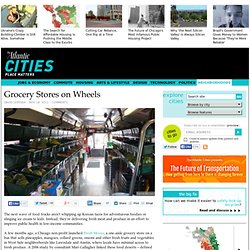
Instead, they're delivering fresh meat and produce in an effort to improve public health in low-income communities. A few months ago, a Chicago non-profit launched Fresh Moves, a one-aisle grocery store on a bus that sells pineapples, mangoes, collard greens, onions and other fresh fruits and vegetables in West Side neighborhoods like Lawndale and Austin, where locals have minimal access to fresh produce. A 2006 study by consultant Mari Gallagher linked these food deserts – defined by the USDA as a census tract more than a mile from a grocery store – to increased diabetes and other diet-related maladies, as well as premature death.
Four Chicago residents developed the concept after deciding that opening their own grocery store or waiting for big retailers would take too long.